 You are now logged out.

The “SpaceX Royalty” Portfolio: How to Collect Up to $11,400 Per Year From Critical Suppliers

It’s strange to think about artificial intelligence needing a home… but it does.
Every AI query, every cloud workload, and every satellite broadband connection depends on physical data centers that store, route, and process information around the clock.
SpaceX’s Starlink network, which beams internet access down from thousands of orbiting satellites, is no exception. Before that signal reaches your phone or laptop, it has to pass through a ground-based data center.
Importantly, SpaceX does not own most of that data center infrastructure. A small group of specialized companies do.
That’s especially meaningful for income investors, because two of the largest owners of data centers are structured as income-producing assets called real estate investment trusts, or REITs.
Under Section 857 of the U.S. tax code, REITs must distribute at least 90% of their taxable income to shareholders every year. That is not optional, and it is not left up to management’s discretion.
Translation: Both of these companies pass along a steady stream of dividend income.
Combined, these two companies − the lead recommendations in our “SpaceX Royalty” Portfolio − are on pace to distribute more than $3.6 billion to shareholders this year. Below, I’ll walk through both companies’ latest results, their ties to the AI and satellite infrastructure boom, and what today’s prices and dividends mean for your income.
“SpaceX Royalty” Play #1: Equinix (Nasdaq: EQIX)
Equinix, founded in 1998 and based in Redwood City, California, is the world’s largest data center and interconnection company by market cap. It operates over 270 data centers in more than 30 countries and serves approximately 10,000 customers, including 60% of the Fortune 500.
Unlike a traditional real estate landlord, Equinix’s real value comes from interconnection. Its facilities allow networks, cloud providers, and enterprises to plug directly into each other, forming a kind of central nervous system for the internet. Every time data moves between two companies inside one of its buildings, Equinix can collect a fee.
That business model puts Equinix directly in Starlink’s orbit. Starlink’s satellite internet service connects to the internet through Equinix facilities in areas such as Ashburn, Virginia; Miami, Florida; and Silicon Valley.
More than 10,000 Starlink satellites are already in orbit, and SpaceX is seeking regulatory approval to launch many more. As that constellation grows, so will the volume of data moving through Equinix’s properties − and the amount of cash making its way to shareholders.
Record Results and a Rising Payout
Equinix just posted one of the strongest quarters in its history.
Second quarter 2026 revenue reached $2.6 billion, up 16% year over year, helped by accelerating demand tied to AI and cloud computing. Net income climbed 30% to $479 million, and diluted earnings per share rose 29% to $4.83. Adjusted funds from operations (AFFO), the most common cash flow measure used by REITs, rose 20% to $1.17 billion, or $11.78 per share.
Perhaps most impressively, the company’s EBITDA margin, a measure of how efficiently it turns sales into profits, reached an all-time high of 53%.
CEO Adaire Fox-Martin called it “an exceptionally strong quarter [that] reflects a business that is hitting its stride,” citing double-digit recurring revenue growth for the third straight quarter and a record number of new interconnections.
Following the results, Equinix raised its full-year 2026 guidance and issued what management described as the largest long-term guidance increase in company history. The company now projects annual revenue growth of 10% to 13% through 2029. Full-year AFFO per share is expected to reach as high as $43.29.
The company is expanding to keep pace with demand, with 52 data center construction projects underway across 33 markets worldwide. It also recently deepened a collaboration with Cisco and Nvidia to help large corporate customers build standardized AI infrastructure inside its facilities, positioning Equinix even more directly in the AI buildout.
Equinix’s customer base spans finance, cloud computing, healthcare, and government, giving it a diversified revenue mix that isn’t dependent on any single industry. That diversification, combined with its scale advantage, makes it difficult for smaller competitors to replicate its global interconnection network.
The company ended the quarter with $41.1 billion in total assets and roughly $2.2 billion in cash and short-term investments, giving it ample flexibility to keep funding new construction and growing its dividend.
Equinix has raised its payout for 11 consecutive years, most recently lifting the quarterly dividend by 10% to $5.16 per share at the start of 2026. The company estimates its total dividend payouts in 2026 will exceed $2 billion.
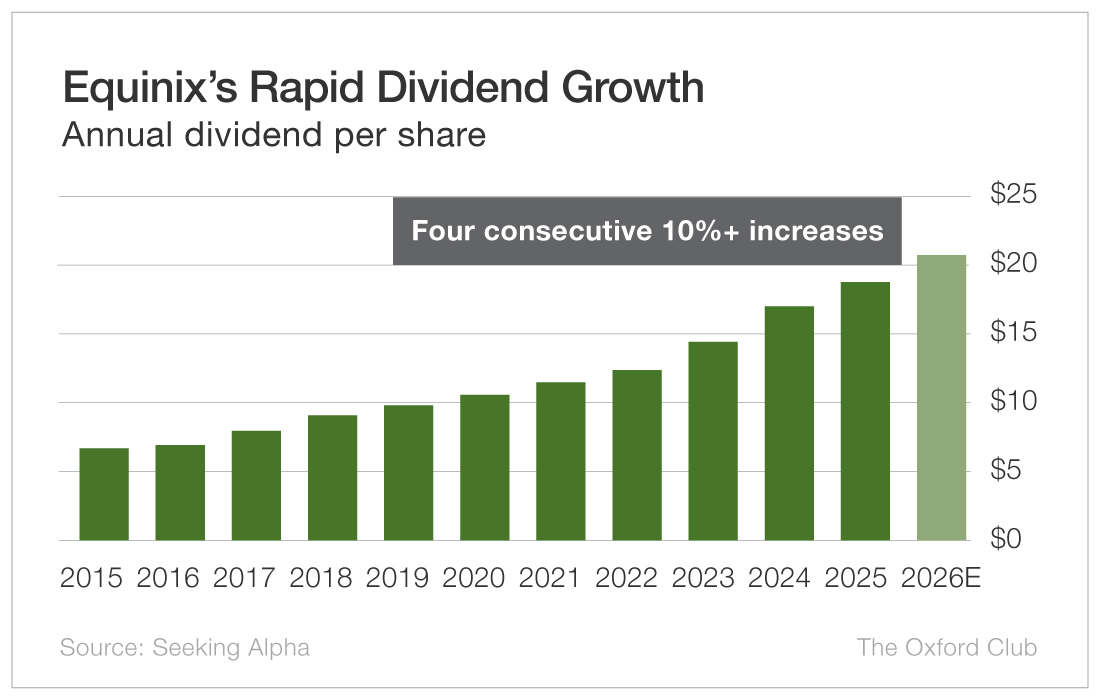
With shares recently trading at just over $1,000 per share, that works out to a yield of roughly 2%.
That’s modest by most income investors’ standards, but the company’s dividend track record is backed by one of the most essential and fastest-growing businesses in the AI economy.
Management has also signaled that dividend growth should move in tandem with cash flow growth, which is expected to be 9% to 12% annually through 2029.
Thanks to its proximity to both the AI buildout and the Starlink network, Equinix is one of the premier “SpaceX Royalty” plays in the entire market.
Recommendation: Buy Equinix (Nasdaq: EQIX) at the market. If you are collecting the dividends, place a 25% trailing stop on your position. If you are reinvesting the dividends, do not set a stop. Hold the stock in a tax-deferred account if possible.
“SpaceX Royalty” Play #2: Digital Realty Trust (NYSE: DLR)
Digital Realty Trust, headquartered in Austin, Texas, is the largest publicly traded data center REIT in the world by number of facilities. It owns, operates, or manages data centers across more than 50 metropolitan areas in 25-plus countries, giving it one of the broadest global footprints in the industry.
Digital Realty’s PlatformDIGITAL network connects more than 5,000 customers, including hyperscale cloud providers, network operators, and enterprises running AI and data-heavy workloads. That scale gives customers a single global platform to deploy capacity wherever their business is expanding.
Like Equinix, Digital Realty makes its money by renting out the physical space, power, and connectivity that cloud providers, telecommunications networks, and a growing wave of AI companies need in order to operate. As internet and satellite-based traffic multiplies, so does the demand for Digital Realty’s facilities.
Faster Growth = More Cash
Digital Realty just posted a standout quarter. Second quarter 2026 revenue jumped 29% year over year to $1.9 billion, and core funds from operations (excluding a one-time gain tied to a joint-venture transaction) rose 14% to $2.13 per share. Both figures topped Wall Street’s expectations by a wide margin.
The company raised its full-year 2026 core funds from operations guidance for the second consecutive quarter to a range of $8.15 to $8.20 per share, up 3% just since the beginning of February. It also lifted its expectations for rental rate growth on renewed leases to between 9% and 11%.
Management described the results as reflecting broad momentum across the company’s three growth pillars: colocation and connectivity, large-scale hyperscale leasing, and strategic private capital partnerships.
Digital Realty ended the quarter with roughly $6 billion in available liquidity and a net debt-to-adjusted EBITDA (earnings before interest, taxes, depreciation, and amortization) of 4.7X. That’s a reasonable level for a REIT funding a multibillion-dollar development pipeline.
That pipeline has swelled to 1.4 gigawatts of data center capacity under construction. These properties are already 63% pre-leased at an expected annual return of 11.5%. A portion of that growth came from an agreement in June to buy out Blackstone’s remaining stake in three Virginia data center joint ventures for $3.5 billion.
To help fund its growth without overextending its balance sheet, Digital Realty has raised roughly $2.5 billion so far in 2026 through its stock offering program, selling shares at an average price near $185. That gives the company more cash to reinvest in the business as its pipeline continues to expand − and more cash to pay out to shareholders.
A Past (and Future?) Dividend Raiser
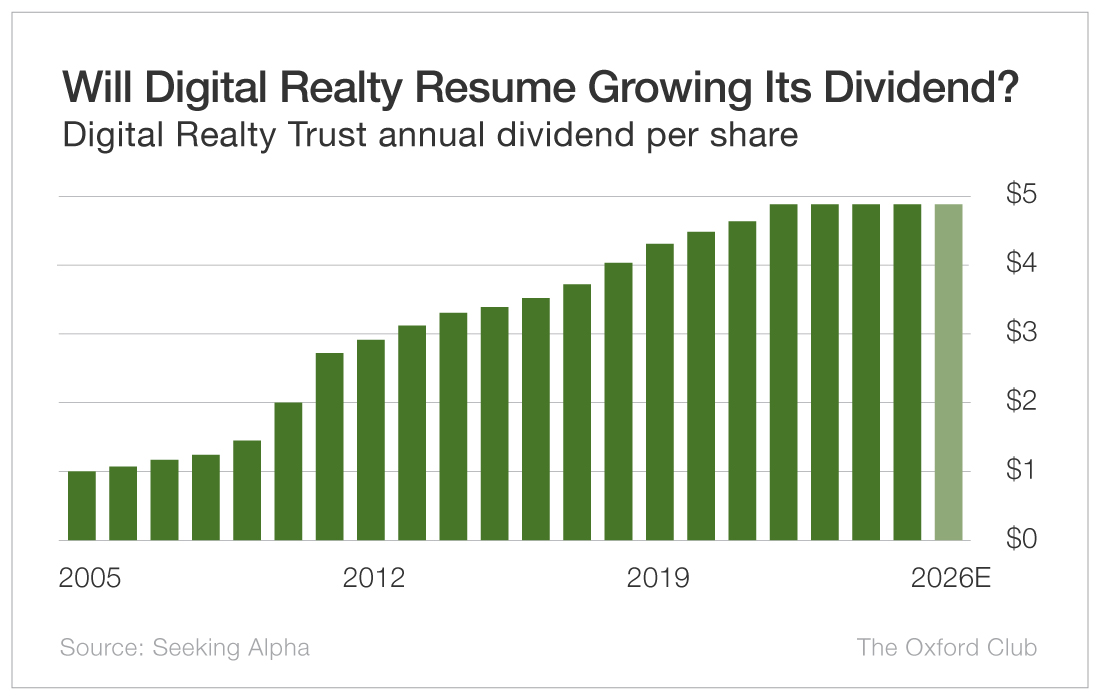
Digital Realty pays a quarterly dividend of $1.22 per share, or $4.88 annualized, for a yield of approximately 2.5%. Conservatively, that puts it on pace to pay out more than $1.6 billion to shareholders in 2026.
The payout has held at that $1.22 level for several years as the company has funneled cash into its development pipeline. However, from 2005 to 2022, it boosted the dividend every year − sometimes multiple times per year − at an average rate of 10% annually.
With core funds from operations growing at a double-digit pace and a large pre-leased pipeline coming online over the next several years, Digital Realty has real room to resume its rapid dividend growth.
One final note: This isn’t my first time recommending Digital Realty Trust. I recommended it in the January 2014 issue of The Oxford Income Letter, citing its big-name clients, its attractive valuation, and the fact that the world “was not becoming less technological” (to say the least).
Eight years later, we sold it for a gain of over 200%, far surpassing the S&P 500’s 156% gain over the same time frame.

The world still isn’t getting any less technological… and Digital Realty Trust is still a smart way to play it.
Recommendation: Buy Digital Realty Trust (NYSE: DLR) at the market. If you are collecting the dividends, place a 25% trailing stop on your position. If you are reinvesting the dividends, do not set a stop. Hold the stock in a tax-deferred account if possible.
The Bottom Line
Combined, Equinix and Digital Realty Trust are set to distribute more than $3.6 billion in dividends to shareholders this year, funded by the fees that data-hungry customers − satellite networks, cloud giants, and AI companies alike − pay to use their facilities.
An investor who put $50,000 into each stock in 2015 and reinvested the dividends would be accumulating more than $11,400 annually. They would’ve received nearly $90,000 in dividend payments alone on their $100,000 investment… and that’s not to mention price appreciation of nearly 200% for Digital Realty Trust and more than 300% for Equinix.
That is the power of compound interest.
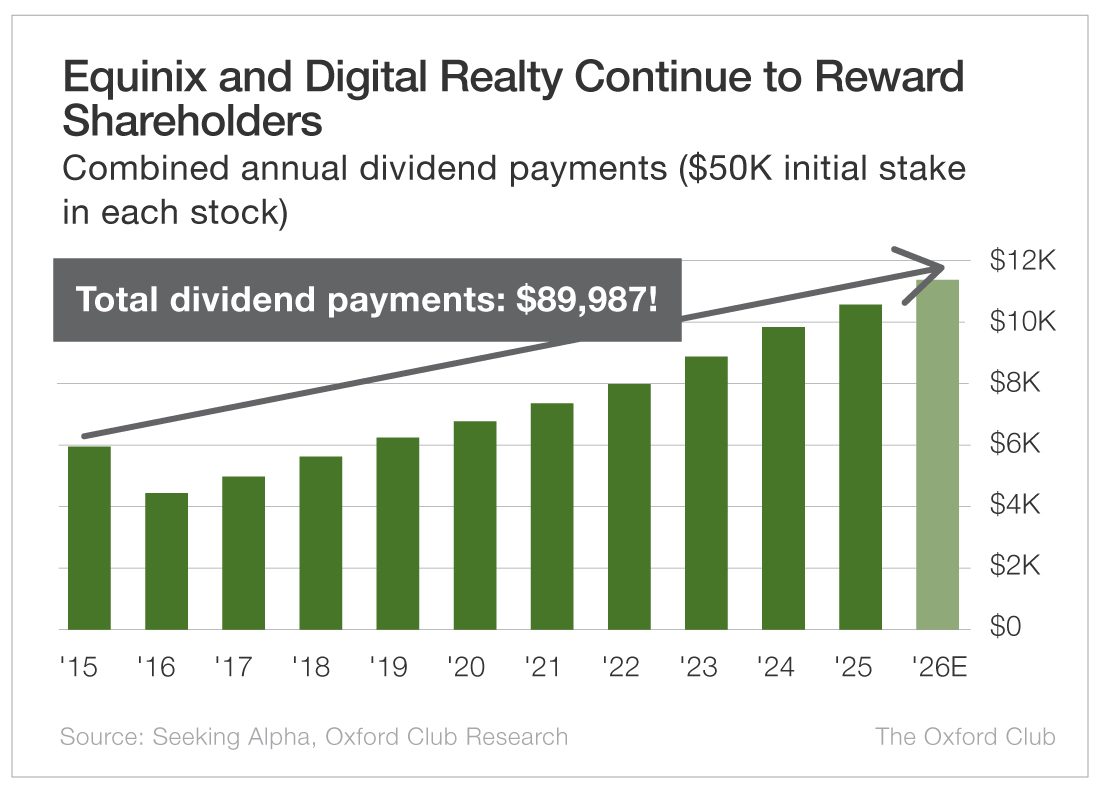
At today’s prices, both stocks yield between 2% and 2.5%, but those yields could rise over time as both companies grow their cash flow and expand their footprints to meet AI-driven demand.
Equinix typically pays dividends in mid-March, mid-June, mid-September, and mid-December. The ex-dividend dates usually fall three to four weeks earlier. Digital Realty Trust makes its payouts in late March, late June, late September, and mid-January, with the respective ex-dividend dates landing two weeks to a month prior.
Below is the expected payout schedule for both companies from the second half of 2026 through the end of 2027.
| Equinix | Digital Realty Trust | ||
|---|---|---|---|
| Ex-Dividend Date | Pay Date | Ex-Dividend Date | Pay Date |
| 8/19/2026 | 9/16/2026 | 9/15/2026 | 9/30/2026 |
| 11/18/2026 | 12/16/2026 | 12/15/2026 | 1/15/2027 |
| 2/24/2027 | 3/17/2027 | 3/12/2027 | 3/31/2027 |
| 5/19/2027 | 6/16/2027 | 6/14/2027 | 6/30/2027 |
| 8/18/2027 | 9/15/2027 | 9/15/2027 | 9/30/2027 |
| 11/17/2027 | 12/15/2027 | 12/15/2027 | 1/14/2028 |
Remember, because both companies are REITs, they must pay out 90% of their taxable income. As long as you own shares, federal law requires them to keep sending the bulk of their profits your way year after year.
Equinix’s scale and Digital Realty’s aggressive, AI-focused pipeline put both companies near the center of the SpaceX economy. Owning both gives you a rising stream of income while that buildout continues.
Of course, these two stocks aren’t the only ways to profit from SpaceX’s ascent. For details on another dividend-paying company that’s partnered with SpaceX in a different way, read my report “The ‘SpaceX Royalty’ Portfolio Part II: How to Collect Payouts From the Energy Giant Powering Every SpaceX Launch.”