 You are now logged out.

The “SpaceX Royalty” Portfolio Part II: How to Collect Payouts From the Energy Giant Powering Every SpaceX Launch

In the summer of 2021, SpaceX President Gwynne Shotwell stood on a conference stage and admitted that SpaceX might have to slow its launch schedule for the year.
The reason, however, was something most people would never guess could ground a rocket program.
It wasn’t a funding problem, an engine failure, or a regulatory holdup.
It was a liquid oxygen shortage.
“We’re actually going to be impacted this year with the lack of liquid oxygen for launch,” Shotwell told the crowd at the Space Symposium in Colorado. “For anybody that has liquid oxygen to spare, would you send me an email?”
That comment tells you something most investors chasing SpaceX exposure have completely missed: Every one of SpaceX’s Starlink satellites and Falcon 9 or Starship rockets depends on a substance most of us rarely think about.
Rockets need liquid oxygen because it acts as an oxidizer that helps rocket fuel ignite far above Earth’s atmosphere. However, SpaceX isn’t capable of producing that oxygen at the purity and volume that a modern launch program requires.
Doing so takes decades of engineering know-how, hundreds of patents, and hundreds of millions of dollars’ worth of industrial infrastructure. Only a handful of companies on the planet can do it at the scale SpaceX needs.
That’s where our next “SpaceX Royalty” recommendation comes in.
It doesn’t build engines or construct launch pads. In fact, it’s not a spaceflight company at all. Instead, it supplies the gas that makes ignition possible in the first place − and it’s been paying a growing dividend check since long before SpaceX ever existed.
Just like the two data center landlords that act as the centerpieces of our “SpaceX Royalty” Portfolio, this company owns something SpaceX simply cannot operate without. The difference is that while those two profit from SpaceX’s data center needs, this one profits from the fuel that gets SpaceX’s rockets off the pad.
Importantly for us, unlike SpaceX itself − which told the SEC in its own public filing that it does not plan to pay shareholders a dividend for the foreseeable future − this company has raised its payout every single year for more than three decades.
The company is Linde (Nasdaq: LIN), the world’s largest industrial gases and engineering company.
The Company SpaceX Can’t Launch Without
Linde traces its roots back to a German engineering firm founded in 1879. Following its 2018 merger with Connecticut-based Praxair, it became the largest industrial gases business on the planet, serving customers in more than 100 countries.
Its core business is turning ordinary air into industrial essentials. Its massive air separation plants compress and chill air until it liquefies; then, they filter out oxygen, nitrogen, argon, and other gases with extraordinary purity.
This process isn’t easy to replicate. By the company’s own count, more than 350 patents currently protect Linde’s air separation technology alone. Collectively, they form a moat that was built over more than a century of engineering.
Once they’re filtered and separated, those gases end up almost everywhere you could imagine. They flow into hospitals, semiconductor factories, steel mills, food and beverage plants, and − increasingly − rocket launch pads across the country.
Few companies touch as many corners of the industrial economy at once.
Linde’s relationship with the space industry kicked off long before SpaceX existed. The company has supplied liquid oxygen to American space missions ever since the Apollo program in the 1960s, and its footprint has only grown since then.
Today, its sphere of influence spans fueling rocket engines, supplying rare gases for satellite propulsion systems, testing spacecraft components, and even enabling 3D-printed engine parts.
Linde CEO Sanjiv Lamba said in 2025 that the company now supplies industrial gases and infrastructure to more than 80% of all U.S. commercial space launches. That includes a contract with NASA to supply the liquid hydrogen used in cryogenic rocket engines. Over the past three years, Linde’s commercial space revenue has nearly quadrupled.
As for the company’s relationship with SpaceX specifically, Linde is constructing a new $100 million air separation plant in Brownsville, Texas, located just a short drive from SpaceX’s Starbase launch site. Once operational, the plant will pipe liquid oxygen, nitrogen, and argon directly into Starbase. It will also cut the distance between production and pad from more than 500 miles down to less than 50, trimming both cost and delivery time.
This is the kind of commitment that only makes sense if the company is confident in the relationship’s staying power.
SpaceX simply doesn’t have many credible alternatives that can provide a steady, nearby, industrial-scale liquid oxygen supply. Linde is positioning itself to answer the call, launch after launch, for years to come.
A Royalty Stream Built on More Than Rockets
Linde’s SpaceX business is a small, fast-growing slice of a much larger, diversified operation. That’s exactly what makes it an attractive income play.
In the second quarter of 2026, Linde reported record sales of $9.3 billion, up 9% year over year. Adjusted diluted earnings per share (EPS) jumped 10% to $4.50 – also a company record.
That growth came from across the business. The electronics, manufacturing, and chemicals and energy segments all contributed meaningfully.
Linde also reported a record backlog of $8.1 billion in already-contracted future gas sales. That included a $1 billion multiyear agreement announced in July to supply ultra-high-purity gases to a major U.S. semiconductor manufacturer.
I expect we’ll hear more agreements announced throughout 2026. Lamba said on the company’s Q2 earnings call, “Based on the opportunities I see today, I expect our sale of gas backlog to finish the year with an 8 handle, underscoring the continued strength of our long-term growth outlook.”
I like to see a steady flow of deals − especially with high-profile clients − as it points to years of future revenue, cash flow, and dividend growth.
This past February, Linde raised its quarterly dividend by 7% to $1.60 per share, marking the company’s 33rd consecutive annual dividend increase.
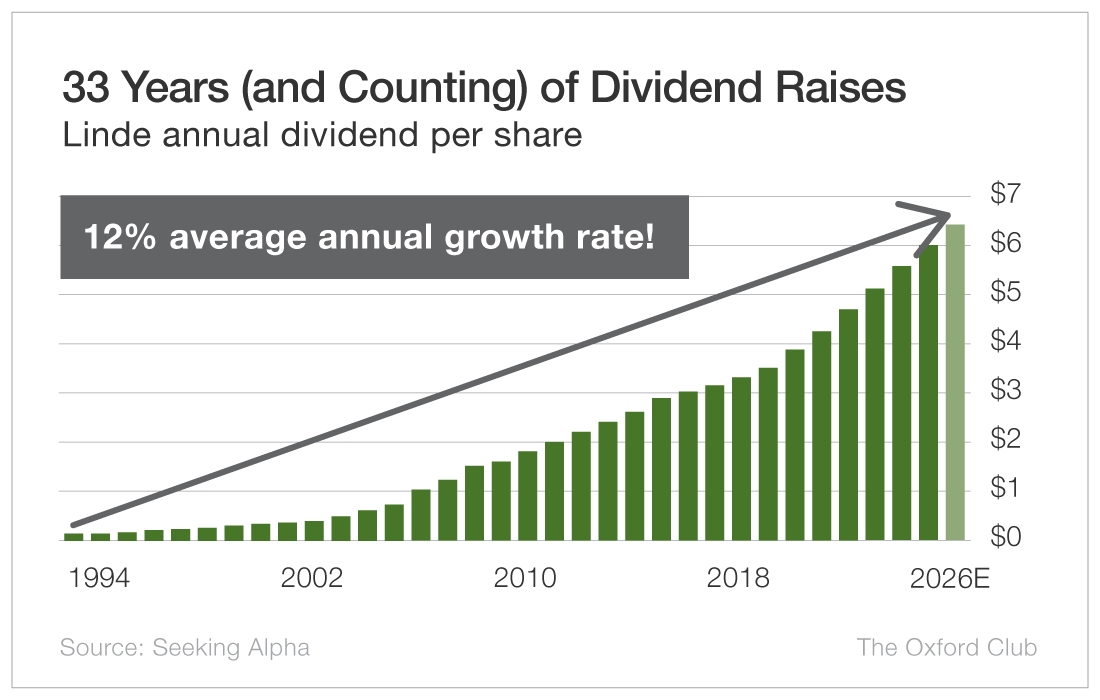
At a share price of around $500, that works out to a modest yield of 1.3%. However, the payout consumed only 55% of Linde’s free cash flow in 2025, leaving the company plenty of room to keep raising it without straining the balance sheet.
History shows what that combination of price appreciation and steady dividend growth can add up to over time.
A $25,000 stake in Linde in 2015 would be worth roughly $100,000 today from share price appreciation alone. That investment would now be generating more than $1,500 a year in dividend income − a number that has only climbed as the streak has continued.
All in all, with dividends reinvested, that $25,000 would’ve turned into over $132,000, which equates to a compound annual growth rate of more than 16%.
Again, SpaceX has been very clear that it does not intend to pay a dividend anytime soon. SpaceX shareholders are relying entirely on price appreciation, and as we’ve seen in the months since its IPO, the stock can be extremely volatile.
On the other hand, owners of Linde get paid every single year − whether SpaceX’s stock is up, down, or flat.
The Runway Ahead
We have every reason to believe Linde’s relationship with SpaceX will only get stronger from here. SpaceX has applied with the Federal Communications Commission to grow its number of Starlink satellites fourfold, and it is expected to ramp up launches of its next-generation Starship rocket in the coming years.
Both trends point toward more liquid oxygen demand. Every new satellite and every additional launch means another order for the gas that makes ignition possible.
The opportunity extends well beyond SpaceX. Lamba has called commercial space “a very attractive opportunity for growth,” pointing to double-digit growth in the segment as more private companies compete to put satellites and payloads into orbit.
Linde’s other growth engines are firing as well. Its electronics and semiconductor manufacturing business − another major source of the company’s recent growth − stands to benefit from the nationwide buildout of chipmaking capacity that’s driving demand for ultra-pure industrial gases.
That buildout shows no signs of slowing.
Now, no investment comes without risk, and Linde is no exception. The company carries meaningful debt from its history of acquisitions, and its U.S. home care business has recently impacted profit margins.
Management has said it’s reviewing that home care unit’s future as part of the broader portfolio, and investors should expect some quarter-to-quarter noise while that plays out. It’s worth watching… but not worth losing sleep over.
These are the kinds of issues a mature, cash-generating industrial leader deals with routinely − not the kind that threaten a thriving business or a 33-year dividend streak.
With a record backlog, improving fundamentals, and established relationships with SpaceX and other big-name clients, Linde looks well positioned to keep paying − and raising − its “royalty check” for years to come.
Recommendation: Buy Linde (Nasdaq: LIN) at the market. If you are collecting the dividends, place a 25% trailing stop on your position. If you are reinvesting the dividends, do not set a stop. Hold the stock in a tax-deferred account if possible.