 You are now logged out.

The VIX+ Profit Playbook

In “The Volatility Action Plan,” I showed you how the CBOE Volatility Index (VIX) tends to revert back toward both its long-term average and its short-term average after experiencing sudden spikes. By comparing the VIX’s current price to its 20-day moving average and standard deviation, we can identify moments when volatility is abnormally high and positioned to return to normal.
The trades I recommend in Technical Pattern Profits to capitalize on this trend are put options on the ProShares Ultra VIX Short-Term Futures ETF (NYSE: UVXY). However, the same underlying logic can be applied to a variety of other instruments.
There’s an old Wall Street saying that goes, “When the VIX is high, it’s time to buy. When the VIX is low, look out below!”
This mantra exists for good reason. The VIX and the broader market tend to mirror each other’s movements. Just look at how they moved from late 2024 to late 2025:
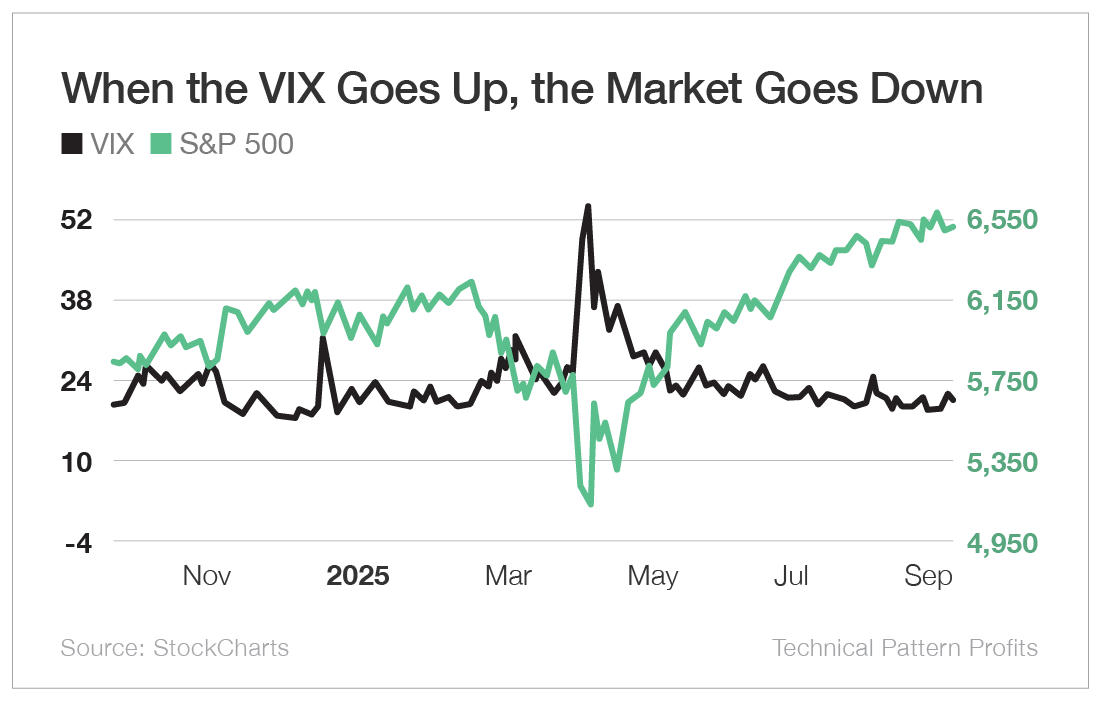
When the VIX spikes, it typically coincides with a market bottom. And as the VIX reverts back to normal levels, the market tends to explode higher.
This creates a powerful secondary opportunity: Instead of trading volatility directly through UVXY, you can profit from the market moves that follow big spikes or drops in the VIX.
In this playbook, I’ll reveal three major index ETFs you can trade when the VIX strays far from its normal range − along with a special way to supercharge your returns.
- The SPDR S&P 500 ETF Trust (NYSE: SPY)
SPY is the oldest and most liquid ETF in the world. It tracks the S&P 500 index, giving you exposure to 500 of America’s largest companies.
While SPY doesn’t track volatility directly, it serves as the most liquid proxy for broad market sentiment. Historically, volatility spikes coincide with sharp drawdowns in SPY. Then, as the dust settles and volatility returns to normal, SPY often rebounds sharply.
This inverse relationship makes SPY an excellent vehicle for capturing gains when the VIX is elevated and primed to fall.
When our VIX Z-score triggers at 1.5 or higher, signaling that volatility has spiked abnormally high, that’s often the exact moment when SPY has been oversold. Then, as fear subsides and the VIX reverts to its average, SPY typically rallies.
The advantages of trading SPY in this context are significant. First, it has the most liquid options market in the world, with extremely tight bid-ask spreads. This means you can enter and exit positions efficiently without getting shortchanged by the market makers.
Second, SPY offers tremendous flexibility. You can choose from hundreds of strike prices and expiration dates, allowing you to tailor your risk-reward profile precisely. Whether you want to buy shares outright, purchase call options for leverage, or employ more sophisticated strategies, SPY can accommodate your approach.
Third, SPY provides direct exposure to the S&P 500 – the same index from which the VIX is derived. This connection isn’t coincidental. The VIX measures expected volatility based on S&P 500 options, so the relationship between VIX spikes and SPY sell-offs is fundamental, not just correlative.
That being said, in certain market conditions – particularly during sustained bear markets – this relationship can weaken. The VIX may fall while SPY stays flat or continues lower.
Timing is also critical. You want to buy SPY (or SPY calls) when the VIX is elevated and beginning to revert, not during the initial panic when volatility is still climbing.
SPY works best as a short-term trading vehicle after volatility spikes due to broad market fear, rather than isolated sector events. Think market-wide sell-offs triggered by Federal Reserve announcements, geopolitical crises, or economic data surprises – not company-specific earnings misses.
- The Invesco QQQ Trust (Nasdaq: QQQ)
QQQ tracks the Nasdaq-100 index, which is heavily weighted toward technology and growth stocks. Companies like Apple (Nasdaq: AAPL), Microsoft (Nasdaq: MSFT), Amazon (Nasdaq: AMZN), and Nvidia (Nasdaq: NVDA) comprise a substantial portion of the portfolio.
QQQ provides a tech-focused angle on volatility reversion. Because Nasdaq stocks tend to be more sensitive to sentiment shifts than their S&P 500 counterparts, they often overreact to volatility spikes – and bounce harder when volatility fades.
This makes QQQ particularly attractive when you believe the market rebound will be strong. During periods when tech stocks are driving market swings, QQQ calls can significantly outperform SPY calls.
The advantages of QQQ are compelling for aggressive traders. It has a deep, liquid options chain that rivals SPY in terms of execution quality. More importantly, QQQ exhibits higher beta than the broader market, meaning it tends to amplify market moves in both directions.
Now, when the VIX spikes due to tech-specific concerns – such as regulatory fears, Fed policy impacting growth stocks, or earnings disappointments in major tech names – QQQ often sells off more dramatically than SPY. As a result, QQQ requires tighter risk management and more careful position sizing than SPY.
The flip side is that when volatility subsides, QQQ frequently rebounds with greater force.
For traders willing to accept higher risk in exchange for potentially higher rewards, QQQ represents an aggressive application of the VIX reversion strategy. It’s particularly effective when the Nasdaq is leading market swings and tech sentiment is the primary driver of volatility. If the VIX spike is driven by banking concerns, energy sector issues, or other non-tech catalysts, QQQ may not provide the same rebound advantage.
- The iShares Russell 2000 ETF (NYSE: IWM)
IWM tracks the Russell 2000 index, which consists of 2,000 small cap U.S. companies. These are smaller firms, most of which have market capitalizations between $300 million and $10 billion.
Small cap stocks have unique characteristics that make IWM an interesting vehicle for volatility-based trading. They tend to be more volatile than large cap stocks, more sensitive to economic conditions, and more responsive to changes in risk sentiment.
When the VIX spikes and investors flee to safety, small caps typically get hit hardest. Money flows out of riskier assets and into safer large cap names. This creates exaggerated sell-offs in IWM relative to SPY or QQQ.
The inverse is also true. When volatility subsides, small caps often experience explosive rebounds. Investors who fled to safety come rushing back, and IWM can surge dramatically in short periods.
The advantages of trading IWM center on its high beta. Small cap stocks are more economically sensitive and more volatile, which translates to bigger price swings. If you correctly time a VIX reversion, IWM can deliver outsized gains compared with large cap alternatives.
IWM also has a well-developed options market with sufficient liquidity for retail traders. While it’s not as liquid as SPY or QQQ, the bid-ask spreads are reasonable, and you have plenty of strike prices and expiration dates to choose from.
The strategy works particularly well when volatility spikes are driven by economic concerns or changes in Federal Reserve policy. Small cap companies are more sensitive to interest rates, credit conditions, and economic growth expectations than large caps. When these factors cause VIX spikes, IWM tends to sell off dramatically – and rebound just as dramatically when conditions normalize.
There are important considerations with IWM. The higher volatility that creates opportunity also creates risk. IWM can continue falling even after the VIX begins reverting if economic concerns persist. Small cap stocks are also more vulnerable to recessions and credit crunches than large caps.
Additionally, IWM can be more susceptible to momentum-driven moves. If small caps are already in a downtrend, a VIX spike might not create the same “oversold bounce” opportunity you’d see in SPY or QQQ.
IWM works best for traders who want maximum volatility and are comfortable with higher risk. It’s ideal when VIX spikes are driven by macro concerns affecting the entire economy, particularly interest rate fears or growth worries. In these scenarios, IWM’s rebound potential can exceed both SPY and QQQ.
The Secret the Pros Use to Juice Their Returns
Now let me share a strategy that professional traders use to amplify returns: leveraged ETFs.
For each of the three index ETFs we’ve discussed, there’s a corresponding 3X leveraged version that aims to deliver three times the daily performance. These are powerful tools that can turn modest market rebounds into substantial gains.
- The ProShares UltraPro S&P 500 (NYSE: UPRO) provides 3X leveraged exposure to the S&P 500. When SPY rises 1%, UPRO aims to rise 3%. This amplification can dramatically increase returns when you correctly time a VIX reversion and subsequent market rebound.
- The ProShares UltraPro QQQ (NYSE: TQQQ) offers 3X leveraged exposure to the Nasdaq-100. Given that QQQ already has higher beta than SPY, adding 3X leverage creates truly explosive return potential. When tech stocks rebound following a volatility spike, TQQQ can deliver extraordinary gains in short time frames.
- The ProShares UltraPro Russell2000 (NYSE: URTY) provides 3X leveraged exposure to the Russell 2000. This combines the high volatility of small caps with 3X leverage, creating the most aggressive option of the three. When small caps bounce following a VIX spike, URTY can generate remarkable returns.
The advantages of these leveraged ETFs are clear.
Advantage No. 1: The options on leveraged ETFs are typically cheaper than those of the regular index ETFs. This means less capital outlay for the same notional exposure.
Advantage No. 2: The leverage magnifies your gains when you’re right. A 5% move in SPY becomes a 15% move in UPRO. A 10% rebound in QQQ becomes a 30% surge in TQQQ. This amplification can transform good trades into exceptional trades.
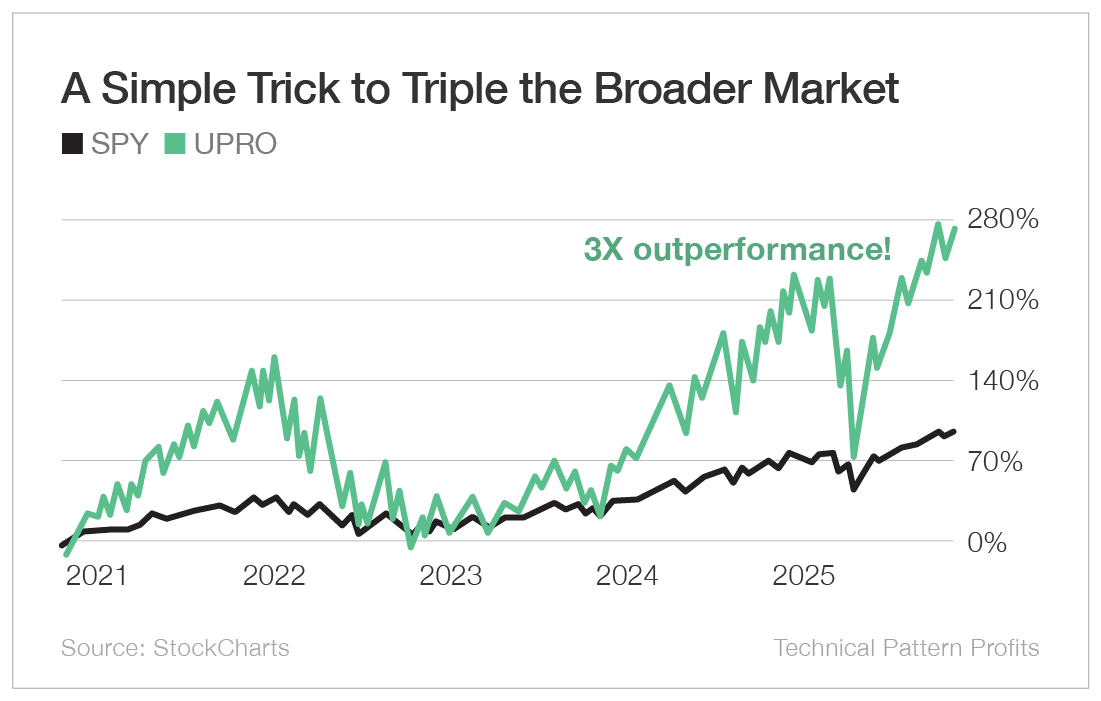
However, it’s critical to understand that leverage magnifies losses just as much as gains. If the market continues falling after you buy, your losses will be three times larger than they would have been with the unleveraged ETF. As always, never invest more than you can afford to lose.
Advantage No. 3: Leveraged ETFs may receive favorable tax treatment. Leveraged ETFs structured as partnerships may offer beneficial tax treatment under certain circumstances, including potential deferral of short-term gains or advantageous capital gains treatment. (I always recommend consulting with a tax professional to understand how individual investments may apply to your specific situation.)
The final thing to know about leveraged ETFs is that they experience decay over time due to daily rebalancing. They’re designed for short-term trading, not long-term holding. This actually aligns perfectly with our VIX reversion strategy, which targets moves lasting days to weeks, not months.
The key to success with leveraged ETFs is using them for precisely timed, short-term trades when your conviction is high. When the VIX triggers our Z-score signal and you expect a sharp market rebound, leveraged ETFs allow you to maximize the profit potential of that anticipated move.
Putting It All Together
The VIX reversion strategy I detailed in “The Volatility Action Plan” focuses on UVXY put options because they offer the most direct way to profit from falling volatility. Those are the trades I’ll be recommending in Technical Pattern Profits.
However, the inverse relationship between the VIX and the broader market creates secondary opportunities through index ETFs. When volatility spikes and the VIX triggers our entry signal, that’s often the exact moment when the market has been oversold and is primed for a rebound.
SPY offers the most liquid, accessible way to capture broad market rebounds. QQQ provides higher beta and works best when tech stocks are driving volatility. IWM delivers maximum volatility and excels when economic concerns are triggering VIX spikes.
For more aggressive traders, UPRO, TQQQ, and URTY amplify these plays through 3X leverage, turning modest rebounds into substantial gains. The lower option premiums and greater leverage make these instruments attractive for short-term, high-conviction trades.
The right choice depends on your risk tolerance, trading horizon, and market conditions. More conservative traders might prefer SPY shares or calls. Moderate risk-takers might gravitate toward QQQ. Aggressive traders who are comfortable with volatility might choose IWM or even the leveraged alternatives.
Whichever vehicle you select, the underlying logic remains the same: The VIX always returns to normal, and as it does, the market often moves in the opposite direction. By understanding this relationship and having multiple tools to capitalize on it, you can profit from volatility in ways most investors never consider.