 You are now logged out.

Three Trigger Events to Supercharge Your Portfolio

In the markets, timing is everything. Finding the right stock in the right place at the right time can be difficult. But it’s beyond worth the effort.
Good timing is the difference between a loss and a massive gain. Fortunes can be won or lost on the same stock traded at different times.
And certain events in a company’s life virtually guarantee its stock is about to make a move. When they happen, a stock that may have been minding its own business and humming along for weeks will suddenly soar 20%, 30%, 40% or more.
The move can happen in minutes, and then it’s gone as quickly as it came. The problem is that by the time these catalysts, or Trigger Events, as I like to call them, have hit the news, it’s already too late to buy the stock.
Fortunately, my Trigger Event Trader VIP Trading Research Service is set up to locate those catalysts ahead of time and position you to profit from them.
Now, I’m always tracking multiple upcoming catalysts, whether they’re Phase 2 announcements… PDUFA (Prescription Drug User Fee Act) dates… or clinical trial data… really anything that can cause a stock to go vertical. But there are three powerful Trigger Events that I focus on that are proven to serve up big, fast gains…
They are first-time dividend initiations, earnings surprises and acquisitions. And this report is your guide to what they are and how they create enormous gains.
So without further ado, let’s get started…
A Different Way to Play Dividends
If you’re at all familiar with my work, you know that I believe one of the best ways to accumulate wealth is by investing in companies with rising dividends. I even wrote a book – Get Rich with Dividends – to help people profit from stocks that generate reliable income.
Anytime a company increases its dividend, it’s providing shareholders with more cash – or, even better, an opportunity to buy more shares and compound their wealth.
But there’s one particular kind of dividend payment whose wealth-creating power can’t be matched. I’m talking about a dividend initiation… This can easily and quickly turn a modest investment into an immodest fortune.
So what is a dividend initiation? Simply put, it’s the moment a company announces its first-ever dividend.
This exciting occurrence comes only once in a company’s lifetime. It indicates that a company is producing far more cash than ever before. And it provides income to investors. That’s especially important today, as we’re emerging from a decade of historically low interest rates.
In other words, dividend initiation is an extremely strong buy signal that can send a stock’s price soaring. And now you’ll get wind of first-time dividend initiations well before they happen.
I’m sure some of you are still skeptical about how effectively this buy signal can send a stock’s price to new heights.
So let’s look at the math on Ruth’s Hospitality Group shortly before it initiated its first dividend. Back in 2013, my system would have identified it as an ideal stock to capitalize on a dividend initiation.
Had you owned the stock at that time, you could have captured a large gain… But with one of my “special trades” – a call option – you could have pocketed a 2,340% gain in just 7 1/2 months. You can learn more about options in my video series here.
But how do we spot first-time dividend initiations before they happen?
I have an easy, three-part system for spotting them.
1. Positive Trailing 12-Month Free Cash Flow
This is an accounting factor that indicates how much cash came into a company (minus capital expenditures) in the prior 12 months.
And perhaps more importantly, it’s the total amount of money available to be paid out to shareholders.
When a company starts producing positive free cash flow and can pay that money to shareholders, it’s the first major sign that a new dividend is coming.
2. Free Cash Flow Growth Exceeds 20%
Once we know that the company has achieved positive free cash flow, we look for the second sign – that cash flow is growing very quickly!
I need to see at least 20% growth per share and hopefully much more.
3. The Trigger Point
This one lets me know we’ve arrived at our destination… and alerts me to recommend the trade. Here’s how it works…
There is a tiny, secretive group of Wall Street insiders who track this special, one-time event. They recognize its power and the profit potential that arises when the big day hits. So when they see the event coming, they actually transmit an encrypted message among the group.
To be clear… this message is NOT available to everyday investors. The Guardian reports that only “the world’s most influential people in finance, including bankers, Treasury officials and hedge fund managers,” can access this private information.
And that includes me.
I pay tens of thousands of dollars a year for this elite access. And the instant I get word that a Wall Street insider is predicting this one-time event, I know this is the Trigger Point.
Now that you understand what first-time dividend initiations are and how we spot them before they happen, let’s take a look at a far more common Trigger Event: earnings surprises…
A Surprise to Be Sure… but a Welcome One
The next Trigger Event I target is earnings surprises.
See, every public company in the U.S. must file an earnings report every three months to report on its financial performance. The reports include everything from net income and revenue to cash from operations. Investors use them to gauge the financial health of a company.
Usually, earnings reports provide investors and analysts with the information they are expecting…
But on occasion, they contain a big surprise. Sometimes, earnings reports dramatically beat analysts’ estimates and wildly exceed investors’ expectations.
It might be soaring revenues, higher gross profits, improving cash flow, an unexpected leap in earnings or a new business segment that’s doing surprisingly well.
That’s where my algorithm comes in.
The system scans every company with a coming quarterly earnings report (well in advance of the release) and alerts me to the best of the best profit opportunities.
In total, the system cross-references 13 metrics that tell us which filings are likely to create the biggest profits from the Trigger Event.
Some of the most important metrics are revenue growth, earnings per share, free cash flow, debt-to-assets ratio and a track record of beating earnings expectations.
Stocks that – due to the information being released – are primed for vertical moves higher… at times move by triple digits within a few days or weeks of the release.
And if you use options on the play, your gains can be magnified by 10 times, 20 times or even 40 times your original investment.
Earnings surprises are very straightforward…
When a company significantly exceeds expectations set for it by the market, this causes a buying frenzy, which drives its share prices up dramatically. If you bought in beforehand, you can take home a serious win.
But you can also play earnings surprises the other way. After all, not every surprise is a good one. Sometimes the market expects too much from a company and it falls short. When that happens, it typically causes a mass sell-off and a dramatic drop in share price.
We can profit from that too by making a put play, which is a bet that the stock’s price is about to drop. You can learn all about puts as well as calls in the video linked above.
My algorithm can pick up on when things aren’t going a given company’s way and an earnings disappointment is likely coming up.
Earnings surprises are one of the most common Trigger Events we’ll trade in this service. My algorithm will identify the companies with the best chance of blasting to new heights.
I’ll personally dig deeper and perform a valuation analysis.
Then, once I’m sure it’s a top-level profit opportunity, I’ll notify you and provide my complete breakdown of the situation.
Now let’s move on to the final Trigger Event: acquisitions…
The First Rule of Acquisition
Acquisitions happen fast, very fast. Once they’re announced, the stock being acquired usually makes a jump. And most of the time this happens in 10 trading minutes or less.
Investors who already own shares bag the fastest profits of their lives. Everyone else is left out in the cold.
By the time an acquisition is announced, it’s already too late to buy the stock. This is a once-in-a-company-lifetime Trigger Event…
The second an acquisition is announced, the value of the company being acquired skyrockets.
That’s because when a smaller company is acquired by a larger one, it receives a sudden influx of new capital, talent and distribution channels. It suddenly has the backing of a powerhouse to propel its business to the next level.
That’s why the stock price rockets immediately.
And unless you know beforehand that an acquisition is coming, you’ll miss out on these rapid gains.
Fortunately, I’ve figured out how to identify acquisitions before they happen…
My Trigger Event Trader system lets me know when an acquisition is coming. It gives me time to alert you to let you know when to buy. That way you’ll be sure to own the stock before it breaks out.
It has three key elements, or, as I call them, milestones.
The first milestone has to do with growth. Specifically, I’m looking for quarterly revenue growth of 10% or more. This means that the company is growing very, very quickly.
The second milestone is related to cash. I look for companies with more cash on their books than debt. This means that the company can easily pay off its debts at any time and still have more cash stashed away for a rainy day.
The third and final milestone is the most important. It’s called enterprise value, and it’s the metric professional investors use to calculate the TRUE value of a company.
Most investors don’t pay too much attention to enterprise value. Instead, they focus on the market cap.
A stock’s market cap is how much the company is worth on the stock market.
Market Cap = Current Market Price (per Share) x Total Number of Shares Outstanding
Enterprise value, on the other hand, takes into account all of the company’s debt. It’s the company’s total value, not just what the market is willing to pay for it.
It’s what business executives and private equity investors use to decide whether or not they want to buy out a company.
Enterprise Value = Market Cap + Debt + Minority Interest + Preferred Equity Value – Cash and Cash Equivalents
When a larger company buys a smaller one, it’s responsible for paying off the target company’s debt and minority interest stakeholders, as well as any preferred equity shareholders it may have. These liabilities raise the price of the acquisition.
The acquisition target’s cash on hand makes it that much cheaper for the company making the purchase.
Once all three of these milestones are activated, I’ll know that the company is an attractive acquisition target. That’s when you’ll receive an alert from me with details on the trade and if there’s an options play to go along with it.
Bonus Trigger: The Power of Biotech
Now, the three other Trigger Events in this report apply to every industry. But there is one very powerful trigger I like to play that’s specific to the biotech industry.
I’m talking about Phase 2 clinical trial results. And because it’s industry-specific, I consider it a bonus Trigger Event. We trade on clinical trial results, but we don’t limit ourselves to the biotech industry.
So, why Phase 2 results and not FDA approval? The simple answer is that Phase 2 results offer us a bigger potential gain than FDA approval. Here’s why…
First, let’s take a look at the various phases of clinical trials…
Before a new, experimental drug is tried in humans, it’s put to work in test tubes and then animals. That’s called the preclinical stage. Once it’s ready for human (clinical) trials, it’s tested in three distinct phases.
A Phase 1 trial is conducted with a limited number of subjects, usually fewer than 50. In cancer trials, the drug will be given to patients sometimes as a last resort.
For drugs targeting many other diseases, they’re given to healthy volunteers so doctors can better understand how the drug reacts inside the human body.
If a drug is deemed safe after this period, the company will proceed to Phase 2. This trial usually consists of a few dozen to several hundred patients receiving varying dosage levels of the particular drug.
The data that’s considered most accurate is from a trial that’s double blind (neither the patient nor the doctor knows whether the patient has received the drug) and placebo controlled (compared with a placebo or standard of care).
Some, but not most, Phase 2 trials are double blind and placebo controlled.
In Phase 3 trials, companies test hundreds to thousands of patients. If the data proves that the drug is safe and effective, the company will usually apply for approval.
Naturally, the more patients who take part in a trial, the greater the chance the drug fails. For example, the drug may not work or there may be unexpected side effects. This is especially common in cancer trials, where the response rates are low, even with approved drugs.
Positive results in a Phase 3 trial can push a stock higher as investors begin focusing on approval and the sales and profits that could follow.
However, it doesn’t always work that way. Many drugs with seemingly strong Phase 3 results have been rejected by the FDA for one reason or another. This can crush investors who follow a drug stock all the way to the end.
So when investing in biotech, I like to find small cap and midcap stocks with upcoming Phase 2 data that can act as a big catalyst for a price move.
Very often, when a company reports strong Phase 2 results, the stock takes off, as it is the first real indication that the drug might be approvable.
Investors get excited, potential partners begin sniffing around and the media begins to cover the drug’s potential.
Even though at this point things are just starting to get promising, it’s often a great time to take the money and run. It’s when many of the early investors in the company grab their profits.
Trigger Event Trading
I began this report by saying that timing is everything…
Unless you know beforehand that one of these Trigger Events is coming, you’ll miss out on the lion’s share of the gains. And sometimes we can time things so well that we capitalize on more than one trigger…
Consider Five Prime Therapeutics. In November 2020, the stock was trading at around $5. It jumped 349% in one day on positive Phase 2 data for its cancer drug bemarituzumab.
Then in March 2021, the stock spiked 78% in one day on news it was being acquired by Amgen. That marked a gain of 605% from the day before Five Prime’s Phase 2 announcement.
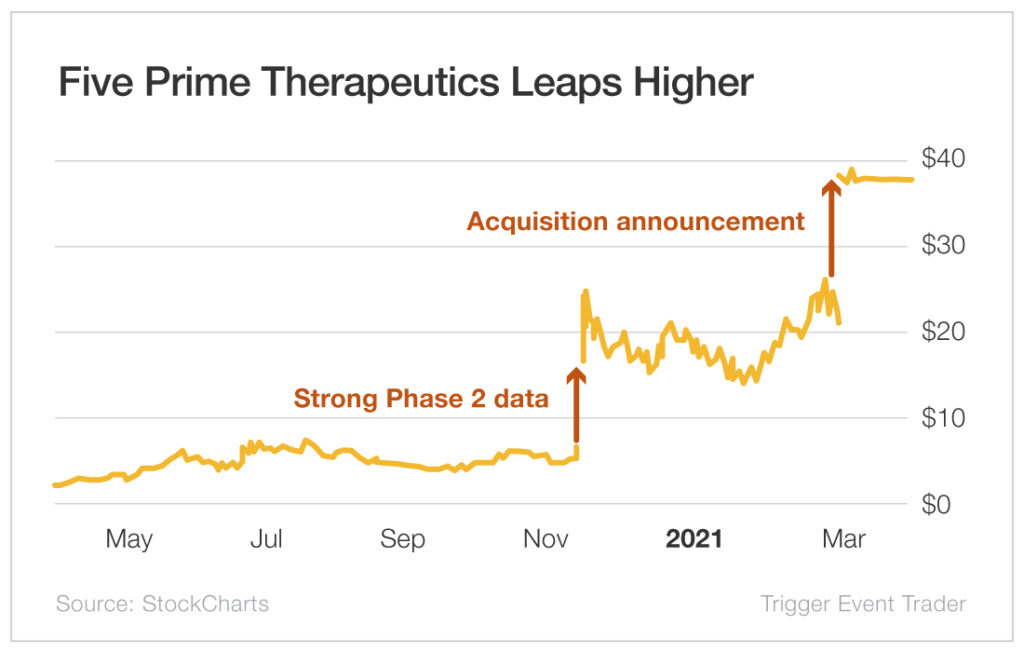
Fortunately, my Trigger Event Trader system can identify these types of Trigger Events before they happen, even when they combine as they did for Five Prime.
With this service, I’ll send two to three recommendations every month. And EACH of them will have one or more Trigger Events lined up.
Then, simply decide whether you want to make the trade… enter it into your brokerage account… and watch as catalyst after catalyst gives you the shot at multiplying your money.
Welcome to Trigger Event Trader!