 You are now logged out.

3 High-Yielding Investments to Accelerate Your Income

Focusing on dividend-paying investments is one of the great secrets to building wealth.
In this report, I’ll outline three of my favorite types of investments that pay big dividends. (Some can even help you keep more of those dividends by protecting your money from the taxman.)
While these types of investments are lesser-known and can be a little more complicated, they’re your best shot at avoiding a major retirement crisis.
Below, I explain how each of these investments works and how each can help you make more… keep more… and make it last.
Let’s start with the one with the greatest tax advantage: master limited partnerships, or MLPs.
Master Limited Partnerships
An MLP is a company organized as a publicly traded partnership.
MLPs have two types of partners: general partners, who manage the MLP and oversee its operations, and limited partners, who are investors in the MLP.
MLPs are usually considered low-risk, long-term investments that provide a steady income stream.
The risk with MLPs is that since nearly all of the company’s profits are distributed back to shareholders, any decrease in earnings can result in a dividend cut.
However, most MLPs are formed to generate steady cash flows and consistent cash distributions. They earn a stable income based on long-term service contracts.
That’s what makes MLPs a great place to find attractive yields. Quite a few MLPs are currently sporting yields of 8% or more.
The majority of MLPs are energy companies. Most of them are oil and gas pipeline companies that aren’t affected much by the price of oil or gas. Their businesses rely on the volume of product that flows through their pipelines.
Tax Treatment
MLPs do not have the same tax implications as most other stocks. For most stocks, you are a shareholder. For an MLP, you are considered a partner in the business.
MLPs have a special structure that allows them to bypass corporate taxes because they pass along the majority of profits to unitholders in the form of distributions.
That brings us to a bit of lingo: MLPs have units, not shares, and they pay distributions, not dividends. This isn’t just jargon; there are key differences from a tax perspective.
What sets MLPs apart from many other tax-advantaged investments is their distributions. Most MLPs’ distributions are considered 80% to 90% “return of capital.” For some, it’s 100%.
That’s important, because return of capital lowers your cost basis.
I’m simplifying things with this example, but if you bought an MLP at $25 per unit, held it for 10 years, and received an annual distribution of $1 per unit that was all return of capital, your cost basis would be reduced to $15.
Over those 10 years, you would not pay taxes on the $10 per unit in distributions ($1 per unit x 10 years). However, when you sold the stock, you would pay a capital gain tax on the difference between $15 and your selling price.
If your cost basis eventually went down to zero, the income you received would be taxed from that point forward – usually at the capital gains rate. But reaching a cost basis of zero typically takes years, during which you’d enjoy tax-deferred income.
MLPs can also be an effective tool for estate planning.
When an MLP investor passes away, their heirs inherit the MLP just as they would a regular stock. The cost basis, which had been steadily dropping during the investor’s life, is adjusted to the price at the investor’s death. It’s like resetting the meter.
The reason MLPs can be effective for estate planning is that the original investor can collect years of tax-deferred income, and when they pass, no taxes are collected on that income and the heirs start all over again.
Keep in mind that every MLP is different. Each has its pros and cons, and the distribution may vary from year to year.
Be sure to read the investor relations page on the website of any MLP you are considering investing in to get a thorough understanding of the way the company pays distributions.
I also strongly recommend that you talk to your tax professional before investing in MLPs, because the tax implications can be complex. You’ll receive a K-1 tax form from the company, which is different from the 1099-DIV that you get from regular dividend-paying companies.
The fact that the majority of MLP cash distributions are not taxed at all when unitholders receive them makes MLPs very appealing. These inherent tax advantages also mean that MLPs should be held in a taxable account (unlike most dividend-paying investments).
All things considered, MLPs are a worthy consideration for income-oriented and tax-reduction-focused investors.
Real Estate Investment Trusts
If you’re looking for a way to keep Uncle Sam’s greedy hands off some of your income, I urge you to take a serious look at REITs.
These are very popular investments for income investors looking for high yields, favorable tax treatment, and exposure to real estate.
For just a few dollars per share, you can essentially become an owner in real estate all over the country − and even the world.
The managers of these trusts are industry experts with years of experience and dozens of staff members at their disposal. They’re tracking down the best income-generating real estate on the market… which makes your decision easy.
You don’t have to manage properties… fix a single leaky faucet… or chase down checks from flaky tenants.
Here’s the beauty of this situation: You can purchase a REIT and sit back and collect fat dividend checks – many REITs today are paying 5%, 6%, 7%, or higher – that often include tax advantages!
Like MLPs, REITs do not pay corporate taxes. Instead, they must pay out 90% of their profits to shareholders in the form of dividends.
In other words, they’re passing along a large portion of their rent checks to you.
The REIT Choice
There are REITs for nearly everything: apartment buildings, office buildings, shopping centers, hospitals, medical offices, nursing homes, data storage centers, and more.
That’s why REITs can be volatile. Just like other sectors in the economy and the stock market, the real estate market has its booms and busts.
If real estate values fall, so will the net asset values of the properties that REITs own. Additionally, a weak economy can lead to a greater number of vacancies, thus reducing REITs’ profits and, as a result, their dividends.
Lower interest rates may make it easier for REITs to borrow money, allowing them to experience faster growth. They also help tenants pay rent.
Looking at the big picture, I expect REITs to be a great place to invest in the coming years.
Tax Treatment
REITs offer special tax treatment that makes them valuable for income investors.
But first, there’s some bad news about REIT dividends…
If you own stock of a regular corporation like Microsoft (Nasdaq: MSFT) and get paid a dividend, that dividend is taxed at the qualified dividend tax rate, which is 0% for lower income earners, 15% for most investors, or up to 20% for high earners. Most REIT dividends, however, are taxed at your ordinary income tax rate, which is going to be higher than the qualified dividend tax rate.
For that reason, I recommend holding REITs in tax-deferred accounts if possible.
But the good news is that even if you hold a REIT in your taxable account, REIT dividends provide other tax advantages that reduce your taxable income.
Some REIT dividends − or at least a portion of them − may be qualified dividends. That would mean they qualify for the lower rates mentioned above, ranging from 0% to 20%.
There’s also a chance that a portion of the dividend may be considered return of capital, which would be tax-deferred and lower your cost basis.
Some REITs have a unique tax advantage in that they qualify for a Section 199A deduction. In those cases, investors can deduct up to 20% of their REIT dividends from their taxable income.
With all the potential advantages of REITs – qualified dividends, return of capital, Section 199A deductions, and the juicy yields – you’ll often end up with more money in your pocket than you would with a typical dividend-paying stock. (And don’t forget the significant capital gains potential!)
In short, the income from just about any REIT is going to be more than the puny returns from a bank savings account or mutual fund money market account.
If you wanted to try to find the most favorable REITs from a tax perspective, websites focused on REITs typically provide information on past dividend payments and the portion that qualified for special tax treatment. Once you’ve invested, your brokerage firm will send you a 1099-DIV at the beginning of the year, indicating how the previous year’s dividends should be treated.
Business Development Companies
For years, America’s richest citizens have had essentially exclusive access to the kinds of private companies capable of building enormous fortunes.
Billionaire venture capitalist Peter Thiel famously turned a tiny early investment of just a few thousand dollars into billions over time by backing private startups before they went public.
Thiel was able to create that fortune using a method that was – until recently – off-limits to regular investors: private equity. In other words, he invested in shares of companies that were not listed on a public exchange.
Historically, only institutional investors, pension funds, large banks, hedge funds, and the seriously rich and powerful were allowed to invest in these private companies (due to the Securities and Exchange Commission’s “accredited investor” requirement).
That’s how Thiel became the first outside investor in Meta Platforms (Nasdaq: META), which was known as Facebook at the time.
Most individual investors are still excluded from participating in these private equity offerings directly. But thanks to our final type of investment − BDCs − there’s a way for you to get in the game… and collect huge dividends.
What’s the Strategy?
BDCs are publicly traded investment companies that primarily lend to small, privately owned enterprises.
BDCs are not like most stocks trading on the NYSE or Nasdaq. In addition to their investments in private companies, they may also actively invest in stocks, fixed income, turnarounds, restructurings, and real estate.
Some BDCs specialize in certain sectors, such as biotech, technology, or retail. Others are generalists, entertaining opportunities wherever they lie.
This multipronged approach provides investors with plump dividend yields and terrific capital gains potential.
We all know how wealthy you could’ve become if you had invested in Microsoft and Apple (Nasdaq: AAPL) at their IPOs. Imagine how rich you would’ve been if you had invested even before they went public.
Companies don’t have to be publicly traded to sell shares. Early-stage companies that are still private and raising money can do so as well. These shares have generally only been accessible to accredited investors in private deals, but that is likely about to change, as an executive order by President Trump may allow investors to own investments in private companies in their retirement accounts.
However, the risks with these kinds of investments are high.
That’s where BDCs come in. Rather than risking your retirement on a startup, you’re better off having a professional choose the investments.
Those equity positions can become very lucrative as a company matures − particularly if it goes public.
Sometimes BDCs lend money to startups (or even mature companies) instead of taking equity positions. For early-stage companies with little revenue, getting a loan from a bank is nearly impossible… so they go to BDCs.
A BDC may lend money to a startup at, say, 13% annual interest, even though the standard bank business loan might be at 8%. Since the startup can’t get a bank loan, it has to pay the higher interest rate due to the higher risk. The BDC then passes most of that interest income − at least 90% − along to shareholders.
The Role of BDCs in Your Portfolio
BDCs diversify your portfolio in several ways. As a form of private equity, BDCs provide the diversification of an alternative investment – one that doesn’t necessarily move in harmony with the overall stock market.
Through their other businesses in real estate, lending, bonds, and alternative investments, they provide exposure to many segments of the economy. That’s not something you can get from most stocks.
In addition, because many BDC portfolios are stuffed with high-interest loans, profitable fixed-income investments, and steady management fees, you can look at the shares as a high-yielding investment − one that often offers double-digit yields and the ability to expand its dividend distributions.
However, not all BDCs are the same.
Keep in mind, BDCs that specialize in equity investments may have more inconsistent dividends, as their payouts could depend on when they are able to sell their positions. If a BDC sells $10 million worth of stock in one quarter and only $2 million worth in another, depending on the company’s dividend policy, the dividend may fluctuate.
That being said, a BDC that makes a lot of equity investments may have more upside potential and/or very strong yields during good years.
BDCs that specialize in lending to companies (rather than investing in them directly) may have more reliable dividends, as they can usually project what their income streams will be from loan payments. In that case, you may have less upside but more consistency when it comes to income.
Many BDCs pay healthy yields, but as with any investment, the higher the yield (or potential reward), the higher the risk.
If you’re considering investing in a BDC with a high yield, do your homework on the company, see how consistent the dividend has been, and try to determine whether it will be sustainable.
If a BDC has a long and consistent track record, you should have a bit more confidence that it can continue paying the dividend.
Tax Treatment
As with REITs’ dividends, BDCs’ dividends are treated differently by the IRS.
Because of the way they are structured and regulated, BDCs aren’t considered taxable entities.
In exchange for this favorable tax treatment, BDCs must distribute at least 90% of their profits to shareholders.
Generally, you’ll be taxed on the kind of income the BDC received:
- If it earns interest on a loan, you probably will be taxed on that portion at the ordinary income rate.
- If it sells a company for a capital gain, you will be taxed on that portion at the capital gain rate.
When you are investing in BDCs, look at their payment histories and methods of payment and choose your investments based on what should be most tax-advantageous for your circumstances.
BDCs report income to investors as dividends on a 1099 form (rather than a K-1, which is used by MLPs).
Once you’re a shareholder, you should receive a statement from the BDC every year with the payment breakdown, so you’ll have all the information you need when filing your taxes.
Because BDCs can generate high income (I’m seeing many double-digit yields currently) and large capital gains, they are attractive choices for almost anyone who can tolerate higher risk.
I generally suggest buying BDCs in tax-advantaged accounts like IRAs, where the aggressive income-producing tactics can benefit from compounding.
It’s Time to Tax-Manage Your Portfolio
You can’t reach financial independence as quickly if you’re surrendering too much of your annual returns to the taxman.
Let’s say one investor owns a $100,000 tax-managed portfolio. Another invests the same amount but is surrendering the equivalent of 4% of the portfolio’s value each year in taxes.
Even if both portfolios have the same gross (pretax) annual returns, the results over time become dramatically different.
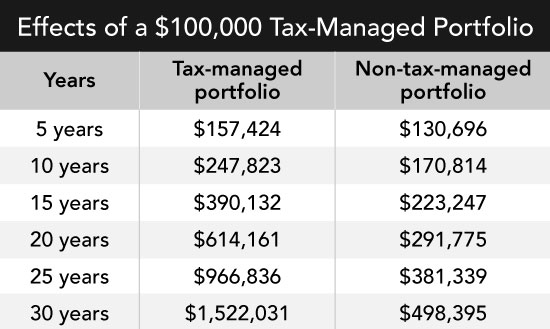
The investor who keeps their taxes to a minimum ends up with a portfolio worth three times as much… despite generating the exact same gross returns!
Clearly, if you’re not doing everything possible to minimize your taxes, you’re at a serious disadvantage.
Use These 3 Investments to Pocket Big Income
MLPs, REITs, and BDCs can be excellent ways to add yield to your income portfolio.
These investments often generate a ton of cash and − due to their corporate structures − are required by law to pass it along to shareholders and unitholders. That’s why they are able to pay investors more than most other income-generating investments.
Keep in mind that such investments can be volatile, as they are usually concentrated in one (often cyclical) sector and have more complex tax ramifications for shareholders.
But if you don’t mind doing a little homework and talking to your tax professional (or handling it yourself with tax software), these investments can be an excellent way to boost the amount of income you receive every year.
Thanks to their tax-favorable distribution methods, many of them can help you keep more of that income.
With inflation still well above the Fed’s 2% target and interest rates projected to keep dropping in 2026, these types of investments are crucial to ensure your income and grow your wealth.
Again – and I can’t stress this enough – talk to your tax professional about any questions you may have. Each of these investments provides unique benefits and risks. It’s up to you to decide which ones work best for you.