 You are now logged out.

The Secret Partner Powering Elon’s AI World Engine

“Energy and persistence conquer all things.” – Benjamin Franklin
A few years ago, I was sitting in a hall with more than 5,000 people, and I had the good fortune to be one of only two invited to speak directly with Elon Musk.
And there was something Musk said that afternoon that sent me back to my research desk for weeks.
One of the most exciting things Musk is building right now is a machine designed to win the single largest technology race of our lifetime – the race to build artificial general intelligence (AGI).
That is, a system that can understand, learn, and reason across essentially any intellectual task a human can.
And there is one small, publicly traded American company sitting at the epicenter of Musk’s ambitious project. Most investors have never heard its name. By the time they do, I suspect the easy money will already have been made.
Why am I so confident?
Because one small American company is solving a major problem Musk faces as he makes this new project a reality…
The Bottleneck Nobody Priced In
Inside a 785,000-square-foot former appliance factory in Memphis, Tennessee, Musk’s xAI has assembled the most powerful AI supercomputer on Earth. He calls it Colossus.
The scale is almost hard to believe.
Colossus cost roughly $40 billion to build. It burns through about $1 billion a month just to keep running.
The problem – and the caveat Wall Street has been slow to understand – is that the grid cannot do this.
Consider that a conventional cloud data center from a decade ago drew 40 to 50 megawatts (MW).
That’s enough electricity to power over 35,000 homes.
Musk’s Colossus project currently requires 300 MW, about as much electricity as a midsize American city.
And Musk has talked openly about scaling to 2 gigawatts of dedicated power – enough to light up 1.5 million homes.
The thing is, if you want to plug a gigawatt-scale data center into the American power grid, you have to get in line. That line is called the interconnection queue, and, in most of the country, the wait is measured in years.
Sam Altman’s OpenAI put it about as bluntly as it can be put: Electrons are the new oil.
So some builders stopped waiting for the grid and decided to bring their own power. Musk is one of them.
And the company I mentioned above has quietly become the single most important supplier to Elon Musk and other technology companies.
The Partnership That Changes Everything
The company is Solaris Energy Infrastructure (NYSE: SEI).
Solaris builds, owns, and operates power plants that sit directly on a customer’s property.
The industry term is “behind the meter,” which simply means the electricity never touches the public grid. It’s generated and consumed on-site, feet away from the servers that need it.
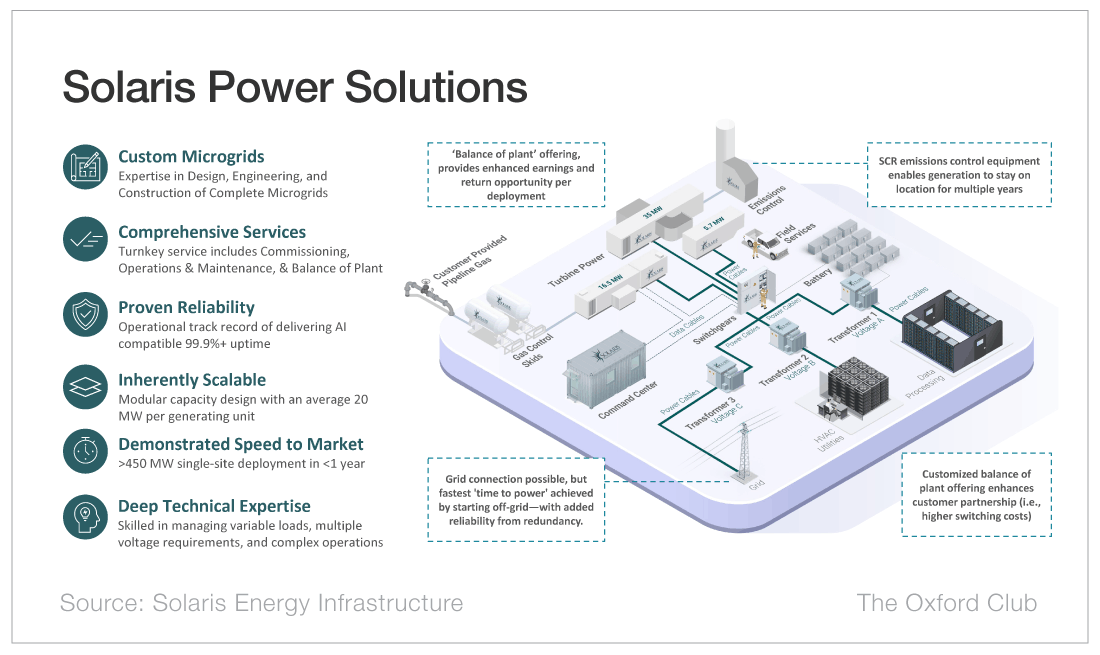
Solaris shows up with modular natural gas turbines and stacks them like building blocks until the customer has what it needs. It also supplies the transformers, switchgear, and control equipment that convert raw generation into clean, stable, and usable power.
While every other power company in America plays by the old rules – waiting on permits, fighting utilities, begging for a slot in an interconnection queue – Solaris rolls in with industrial-scale natural gas turbines, sets them up directly on-site, and delivers power in months instead of years.
The customer gets a working private power plant. No interconnection queue. No waiting on a utility. And it happens fast.
Solaris has deployed more than 450 MW at a single site in under a year, at 99.9%-plus uptime, which is the standard that AI workloads demand.
And Musk has already fired up dozens of gas turbines from Solaris to power Colossus…
In fact, Musk entered into a joint venture with Solaris to keep Colossus running, called Stateline Power.
Stateline is the entity that owns and operates the on-site power infrastructure feeding Musk’s Colossus supercomputer complex.
Solaris holds 50.1% of it. Musk’s side holds 49.9%. It is structured to deliver approximately 900 MW of primary power to an AI data center under a seven-year power services agreement.
This Musk partnership proved Solaris could do something almost no one else can. And now more companies are lining up.
In the spring of 2026, Solaris signed a second long-term contract, for more than 500 MW, with an affiliate of an investment-grade global technology company. Then, on April 24, it signed a third – more than 600 MW on a 10-year term with a five-year extension option.
In other words, Solaris is now operating, building, or planning power projects for three distinct hyperscalers.
Musk and Stateline proved that Solaris can deliver. The latest contracts prove Solaris can scale.
And the company’s earnings indicate that the model is working…
The Numbers
The company’s revenue growth tells a compelling story.
Adjusted earnings before interest, taxes, depreciation, and amortization (EBITDA) came in at $103.1 million in 2024. In 2025, that grew to $244.2 million.
That is a 137% jump in a single year. And the acceleration has continued into 2026.
In the second quarter of 2026, Solaris reported…
- Revenue of $219.4 million, up 47% year over year
- Power Solutions segment revenue of $158.3 million, up 109% year over year
- Adjusted EBITDA of $108.3 million, up 78% year over year
- 950 MW of capacity earning revenue, up from 910 MW in the first quarter and 780 MW in the final quarter of last year.
And management raised third quarter adjusted EBITDA guidance by 11%, to a range of $90 million to $105 million.
The balance sheet supports the buildout, with more than $800 million in cash attributable to Solaris. In April, the company expanded its borrowing capacity to $500 million to fund the buildout.
And in the middle of this aggressive expansion, Solaris declared its 32nd consecutive quarterly dividend. This is a capital-intensive growth company that still pays its owners every single quarter, without fail.
Besides the strong growth, one thing I really like about Solaris is how it generates revenue.
Solaris receives fixed plus variable monthly payments on long-term contracts. Its customers procure and pay for the natural gas.
That means Solaris does not take commodity price risk. If gas prices triple, that is the customer’s problem.
Solaris collects its checks without worrying about volatility in natural gas prices.
Skin in the Game
Solaris is also founder-led, with more than 20% insider ownership. Every employee is a shareholder. When management wins, you win, and when they lose, they lose alongside you.
Chairman and co-CEO Bill Zartler has done this before. He also founded Aris Water Solutions – another company providing an unglamorous, essential piece of infrastructure – and built it into a company that was acquired by Western Midstream (NYSE: WES).
This is a man with a demonstrated pattern: Identify a physical bottleneck that everybody is complaining about and nobody is solving, build the equipment business that solves it, and monetize it.
He spotted the AI power bottleneck early. The company he built to serve oilfield logistics still throws off roughly $90 million a year in cash, and that cash is being redeployed straight into the power business. The old business is funding the new one.
Plus, Solaris is repeating a pattern that I’ve seen work time and time again throughout the years…
The Pick-and-Shovel Pattern
Every time a massive technology wave hits, the headline companies grab the attention – but it’s the infrastructure players that quietly hand early investors the biggest gains.
Look at what’s already happened in this AI buildout…
- Vertiv (NYSE: VRT), which makes the unglamorous power and cooling gear data centers can’t run without, traded around $13 in early 2023. As of early August, it’s around $290.
- Modine Manufacturing (NYSE: MOD), a thermal-management supplier, ran from $20 three years ago to more than $200 today.
- Comfort Systems (NYSE: FIX), the contractor hyperscalers call to build data centers fast, went from around $90 in early 2022 to over $1,700 today.
Three life-changing returns from infrastructure companies that happened to supply something the new economy suddenly needed.
Solaris is in the exact same position today.
And there are a few upcoming catalysts that I believe could send Solaris shares higher…
Tailwinds on the Horizon
I rarely see a setup with this many potential triggers stacked this close together. Each one of them has the potential to send the stock soaring.
Here is what I am watching…
- S&P SmallCap 600 inclusion. The company was added to the S&P SmallCap 600 on July 15. The added visibility for investors should continue to boost the share price in the near future.
- The next Solaris earnings report. Management already raised third quarter guidance by 11%, and Solaris beat the Wall Street estimates on EBITDA by 19% last quarter. A company that raises guidance and then beats it tends to get repriced.
- SpaceX’s next earnings call. Positive news from the company, particularly regarding its push toward full power for Colossus, could be a boon for Solaris’ stock.
- The Colossus “full power” milestone. Musk is racing to scale Colossus toward 1 million graphics processing units. Any public confirmation that the site is running at full power is direct, on-the-record validation of the behind-the-meter model. And as I mentioned, Solaris co-owns the plant that makes it possible. I expect Wall Street analysts to connect the dots soon.
- New contract announcements. Solaris reports an active pipeline of roughly $800 million to $1 billion in incremental orders. Management estimates that pipeline represents $160 million to $200 million in potential annualized EBITDA. It has signed two new contracts in the last several months, and more could be coming.
- A permanent capital structure. Management has said it is evaluating refinancing options, which could help the company clean up its debt stack.
- Growing institutional recognition. With a market cap of roughly $4.8 billion, Solaris is now big enough for large funds to buy but still small enough that most of them haven’t yet.
Of course, nothing is guaranteed. And no investment is without risk.
It’s worth noting that the company is spending heavily to build out its turbine fleet, and it has taken on real debt to do it. But the debt is funding long-term, contracted revenue, and the concentration is shrinking.
Ultimately, this is a real company, with real contracts, real revenue, and a partnership tied directly to the most important technology buildout of our time.
The Bottom Line
My first investment as a young man wasn’t a stock at all. It was a Morgan silver dollar. I’ve always been drawn to real, tangible assets – the things the economy actually runs on.
Solaris is exactly that. It’s not a speculative bet on a chatbot or an app. It’s the power that the entire AI revolution depends on.
Elon Musk – the richest man on the planet, who’s building rockets, satellites, and humanoid robots – is depending on this one small company to keep the lights on inside the most important AI project in history. And most of Wall Street hasn’t seen the potential.
That is precisely the kind of setup I look for: a real business, with real earnings, sitting at the center of a historic wave… before the crowd arrives.
As I remind my readers, “Bull markets climb a wall of worry” (quoted in The Maxims of Wall Street, Page 64).
The worriers will be sitting on the sidelines. I think that’s your opportunity.
The window to buy at today’s prices won’t stay open forever. Once Wall Street fully wakes up to what this company really is, the stock could move fast.
Recommendation: Buy Solaris Energy Infrastructure (NYSE: SEI) at market. While this should be considered a long-term position, some Members may prefer to use a 25% trailing stop to protect their principal and profits.