 You are now logged out.

The #1 AI Chip Play in 2026
I like to think of AI as “advanced intelligence” rather than “artificial intelligence.” And right now, the race to make AI systems – and make them even more advanced – is creating endless opportunities for investors…
It’s driving enormous demand for chips, data centers, and the infrastructure that supports them.
Companies like Nvidia have become synonymous with this trend, as their hardware sits at the center of modern AI development.
But as with every major shift, the most visible companies are not always where the biggest opportunities lie.
Because behind every chip… there is a process. And behind that process… there is a constraint most investors have never considered.
It’s not computing power. It’s not energy. And it’s not even manufacturing capacity.
It’s patterning.
And without it, not a single semiconductor can be produced.
The Hidden Step That Makes Every Chip Possible
To understand why this matters, it helps to take a step back and look at how chips are actually made.
At a basic level, semiconductor manufacturing means building tiny circuits onto silicon wafers. These circuits contain billions of transistors. These transistors allow chips to process information.
But those circuits don’t assemble themselves.
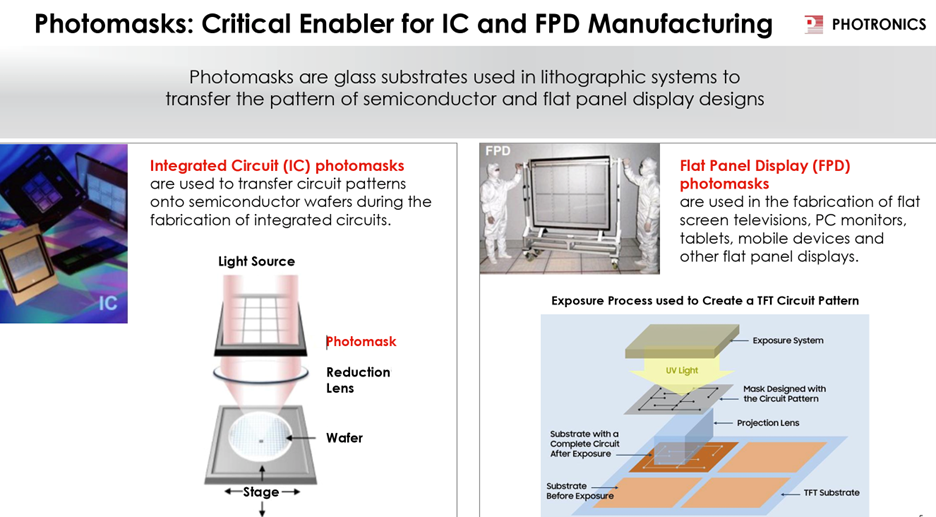
They must be precisely “printed” onto the wafer using a process called lithography.
And lithography depends on a critical tool: the photomask.
A photomask holds the blueprint of the circuit design. That design is transferred onto the silicon wafer layer by layer, using light.
Each layer must align perfectly with the last. Even a minor deviation can render the entire chip unusable.
This is not a forgiving process.
It is one of the most precise manufacturing steps in the world. And every new chip design requires an entirely new set of photomasks.
That means as chip complexity increases, demand for photomasks does not just grow – it accelerates.
A single advanced chip can require dozens of individual photomasks.
Each one must be made with extreme precision, using specialized materials and processes that only a few companies can handle.
As demand for AI chips increases, the need for photomasks increases even faster.
At the same time, the cost per mask set is rising.
In some cases, a full mask set for a leading-edge chip can cost tens of millions of dollars.
In short, it can be very profitable for the very small number of companies that have the expertise to create these photomasks.
Where the Supply Chain Becomes Investable
Most investors are familiar with chip designers like Nvidia or AMD… or foundries like Taiwan Semiconductor or Samsung.
But few investors pay attention to the companies supplying the tools and materials that make chip production possible.
I like to identify companies that attach themselves to larger industry leaders – benefiting from their growth without competing directly with them.
In many cases, they operate in specialized niches. Competition is limited, and switching costs are high.
Photomask production fits this description perfectly.
There are only a handful of companies globally that can produce advanced photomasks at scale.
The technical barriers are high. The capital requirements are significant. And the customer relationships tend to be long-term and deeply integrated.
Once a semiconductor manufacturer qualifies a photomask supplier, it is not easily replaced.
That creates a durable position within the supply chain.
And it is precisely where Photronics Inc. (Nasdaq: PLAB) operates.
A Quiet Specialist With Critical Positioning
Photronics is not a household name.
It does not design chips. It does not manufacture wafers. And it does not appear in headlines alongside the largest AI companies.
But its role in the semiconductor ecosystem is fundamental.
The company specializes in the production of photomasks used in both mainstream and advanced semiconductor manufacturing.
It operates manufacturing facilities across the United States, Europe, and Asia, allowing it to serve a global customer base that includes leading foundries and integrated device manufacturers.
Among those relationships, one stands out in the current environment.
For years, Tesla has purchased AI chips through Samsung.
And who provides the photomasks for those chips? Photronics.
Now Elon Musk is launching his own AI chip facility… the Terafab.
His goal is to build 100 billion to 200 billion AI chips in the Terafab each year.
But he will need a photomask company to do it.
And we believe Photronics will be that company because it already has an existing relationship through Samsung.
And this is one thing I love about Photronics.
It has the potential to become a key partner in the Terafab. But it also already has a great existing business working with Samsung.
Samsung is one of Photronics’ largest customers.
That matters, because Samsung sits directly in the path of one of the most important developments in AI hardware today – the push to build increasingly powerful, custom-designed chips.
As large technology companies move toward designing their own semiconductors, production is shifting toward foundries capable of handling those designs at scale.
Samsung is one of the few companies in the world with that capability.
And as production ramps, so does demand for the underlying inputs required to make those chips.
Including photomasks…
Why the Next Wave of AI Chips Matters
The next phase of AI development is not just about improving existing models.
It is about scaling them.
That requires more chips, more advanced architectures, and more frequent design iterations.
Each new generation of chips brings changes in architecture, performance, and efficiency. Each change requires a new set of photomasks.
This is where the economics become compelling.
Photronics does not need to predict which company will build the best AI model. It does not need to compete with chip designers. It simply needs to supply the essential inputs required for each new generation of chips.
As long as the industry continues to innovate, demand for its products continues.
A Look Beneath the Surface
Unlike many companies tied to emerging technologies, Photronics is not operating at a loss.
It is a profitable business with a track record of steady execution.
In its most recent quarter, Photronics reported revenue of approximately $227 million, with earnings that came in ahead of expectations. That performance capped a solid fiscal year. The company generated about $860 million in revenue and more than $150 million in net income.
Photronics also continues to hold more than $280 million in cash, with limited debt obligations. That provides flexibility to expand production capacity, which is what we expect to happen as the Terafab comes online.
The company’s strong financial position makes it a great partner for Musk’s plans for dramatic AI chip expansion.
And this could be very good for shareholders.
Over the past several years, the company has repurchased a meaningful portion of its outstanding shares – reducing share count and enhancing per-share value.
Taken together, this combination of profitability, balance sheet strength, and continued reinvestment stands out.
It reflects a company that is not only participating in the semiconductor cycle… but also steadily strengthening its position within it.
A Valuation Gap That Stands Out
Despite its position in the supply chain, Photronics trades at a great price – especially given the potential upside from a Tesla partnership.
Shares are currently priced at roughly 10 times forward earnings.
Other photomask specialist companies are trading at 25 times earnings or more.
Again, this is why buying it now at a great price is such a big upside play.
Imagine what all the people who follow Musk closely will do once the Terafab is pumping out chips… with this company becoming a key part of that.
They will load up on shares and drive the valuation much higher.
Photronics operates at a chokepoint in the manufacturing process.
Without photomasks, chips cannot be produced.
And yet the market continues to assign it a valuation that is far below its importance.
Even a modest re-rating, combined with continued earnings growth, could create meaningful upside over time.
Why Timing Is Becoming More Relevant
The AI buildout going on right now is unprecedented.
OpenAI has said it plans to increase the number of AI chips it uses many times over.
Meta is building massive data centers as big as Manhattan.
Musk wants to increase the number of satellites in space to 1 million, building a massive AI data center in the sky.
All of this will require billions of AI chips.
And only a few companies in the world can provide the complex blueprints needed to build these chips. Photronics is one of those key companies.
And we believe it will see substantial growth as a result.
Combine that with the chance to become a crucial supplier in Elon Musk’s new Terafab and you have the perfect combination of a strong business at a great price… with very big upside.
And it is why Photronics stands out as one of the most compelling ways to gain exposure to the continued expansion of the AI economy.
Action to Take: Buy Photronics Inc. (Nasdaq: PLAB) at market. See our portfolio page for the latest stop price.