 You are now logged out.

The Great Rebalancing: Seven Overpriced Giants to Sell Before the Bubble Pops

It happens with every stock market trend linked to a major transformational moment in history.
The railroad boom. The internet. Cloud computing.
Each time, the underlying technology was real. The change it brought to the world was genuine. But somewhere in the middle of the excitement, a group of stocks got priced for something that doesn’t exist – a future with no setbacks, no competition, and no margin for error.
That is where we are today with AI.
The technology is real. The capital pouring into data centers, semiconductors, and infrastructure is real. The productivity gains may prove to be enormous.
But the market has stopped making careful distinctions. It’s treating great businesses, cyclical businesses, and pure story stocks as though they all belong in the same category – and pricing them accordingly.
Some of the biggest names in this boom are no longer just expensive. They are priced for flawless execution, nonstop demand, and margins that leave no room for error. When that happens, the investment stops being about business quality. It’s about investor psychology.
I’m not saying we should be running from AI stocks.
But these are the seven names where I believe that risk has become unacceptably high.
The Problem With AI Hardware Suppliers
Before we look at each company, I want to explain something that applies to all of them – and that the market is currently choosing to ignore.
Most of these seven companies have one thing in common: They make hardware. Chips. Drives. Networking equipment. Physical goods that roll off a production line.
That sounds simple enough. But it creates a business problem that never goes away.
Supply, Demand, and the Cycle That Never Stops
Hardware companies live and die by the balance between supply and demand. When demand spikes – as it has with the AI buildout – these companies post spectacular numbers. Revenue soars. Margins expand. Earnings per share hit records. The stock chart looks like a rocket.
But here’s what the market tends to forget in those moments: Demand spikes don’t last forever.
Hyperscalers – the Amazons, Googles, and Microsofts of the world – go on spending binges when they’re building out a new infrastructure cycle. Then they pause. They optimize what they have. They work down inventory. And suddenly, the hardware suppliers who were shipping everything they could make find themselves with too much supply and not enough orders.
This is called an inventory correction, and it’s as predictable in the chip and storage business as winter following fall. It has happened after every major technology buildout in history – after the internet boom, after the cloud computing surge, after the smartphone cycle. Prices collapse. Margins crater. Stocks that looked invincible give back two or three years of gains in a matter of months.
The companies that navigate this best are the ones with true pricing power – firms that make something no one else can replicate, so customers can’t just shop around when they want a better price. Software businesses often have that kind of moat. Service businesses often do. Hardware businesses, with rare exceptions, do not.
When you sell memory chips or hard drives or networking switches, your product is ultimately a commodity. You can differentiate on performance and reliability – and the best companies do. But at the end of the day, buyers have options. And when supply outstrips demand, even a market leader has to cut prices to move product.
That’s the trap these stocks are walking into.
Why the Charts Are Deceiving You Right Now
Every one of the companies in this report is showing excellent financial results. Revenue is up. In some cases, dramatically up. The earnings are real. The growth is real.
So why sell?
Because the stock prices are not reflecting the current moment. They’re reflecting a fantasy version of the future – one where the AI buildout never pauses, where pricing stays strong indefinitely, and where the normal laws of supply and demand take a permanent vacation.
Stocks priced for perfection get punished for anything short of it. A single soft quarter – revenue that “only” grew 20% instead of 60%, or margins that came in a few points below expectations – can send a stock down 30% or 40% in a day. We’ve seen it happen over and over in cycles exactly like this one.
The charts look compelling. That’s precisely the problem.
With that context in mind, here’s what each of these companies does, where its numbers stand, and why the current setup is more dangerous than it appears.
The Seven Companies
Sandisk Corp. — A Fresh Listing in an Old Commodity Business
Sandisk Corp. (Nasdaq: SNDK) makes NAND flash memory – the chips that store data in solid-state drives, enterprise servers, and the AI data center infrastructure now being built at a furious pace. Every time you save a file on a modern laptop, access a cloud application, or run an AI query, flash memory chips like the ones Sandisk makes are involved.
The company was spun off from Western Digital in 2025 and returned to the public market at almost the perfect moment: newly independent, tied to AI, and operating in a flash market that had clearly improved after a brutal two-year downturn.
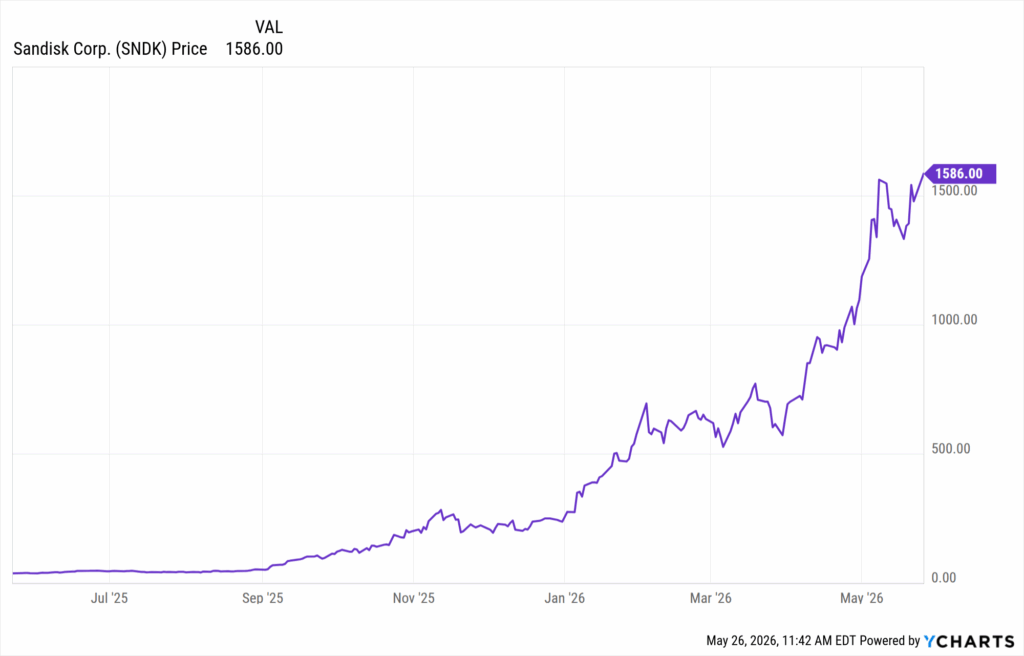
The most recent quarter looked extraordinary. In fiscal Q2 2026, revenue climbed 61% year over year to $3.03 billion. Earnings per share hit $5.15. Operating income jumped to $1.07 billion from $195 million a year earlier. Data center revenue surged 76% year over year to $440 million.
But look at the quarter before that, and the story shifts.
Q1 2026 revenue came in at $2.31 billion – up 23% year over year. But that was the only good news. Gross margins fell to 29.8% from 38.6%. Operating income dropped 40%. Earnings per share fell 49% to $0.75.
This shows how fast profits can collapse in this business even when revenue is still growing.
Management’s own language tells the story. CEO David Goeckeler described Sandisk’s “structural reset” as aligning supply with attractive demand. That’s a polite way of saying that chips are still a commodity. Margins depend on industry behavior, not product strength. As long as demand spikes, Sandisk can post strong results. But those conditions rarely last.
Sandisk is improving. It is still a flash-memory company first and an AI beneficiary second. Investors who pay peak prices for cyclical earnings usually learn this the hard way.
Western Digital Corp. — A Recovery Story With a Ceiling
Western Digital Corp. (Nasdaq: WDC) is one of the world’s largest manufacturers of both hard disk drives and NAND flash memory. Its products store data across consumer devices, enterprise servers, and – increasingly – the AI data centers that hyperscalers are racing to build. For decades, Western Digital was best known as the company whose hard drives came pre-installed in desktop PCs. Today, it’s positioned as an AI infrastructure supplier, and the market has repriced it accordingly.
Shares have risen more than 900% in the last 12 months. But Western Digital’s story is still one built on recovery, rather than dominance. A year ago, the company was working through an inventory hangover and fighting with depressed pricing. AI demand gave it a lifeline. The market is now treating that lifeline as a permanent transformation.
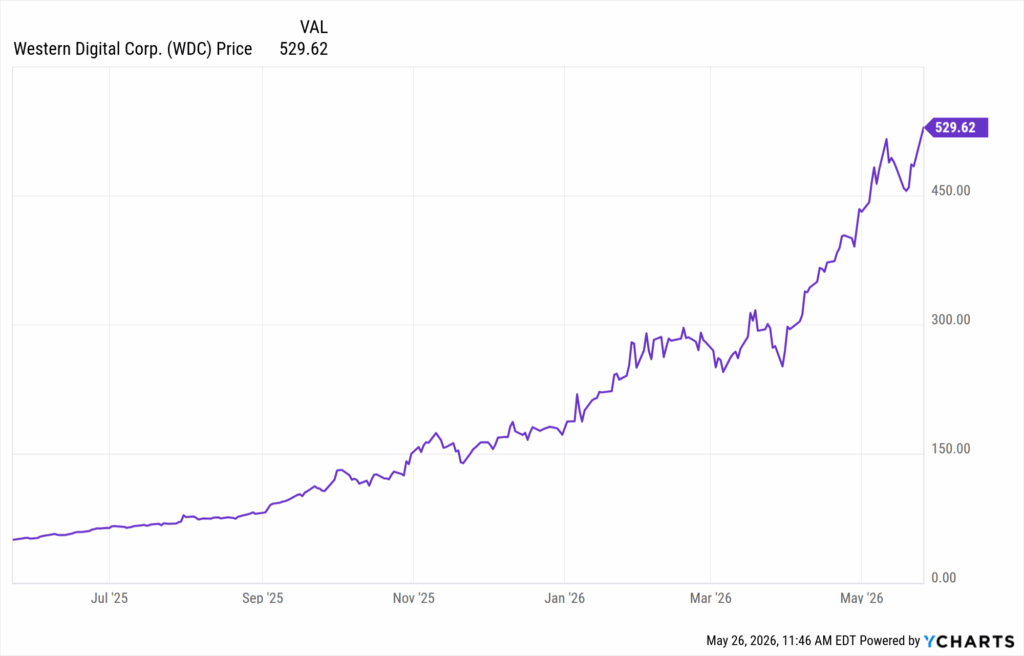
It isn’t. Similar to Sandisk, Western Digital’s business improves when pricing firms, inventory clears, and enterprise demand returns. In other words, a lot must go right at once.
Trading at 41 times trailing earnings and 60 times free cash flow, the shares are priced for perfection. Western Digital doesn’t control memory pricing. It doesn’t own the kind of moat investors associate with elite chip designers or software platforms. It benefits when conditions improve. That is not the same as having durable pricing power.
Storage companies rarely deserve peak multiples late in a recovery narrative. This one is no exception.
Seagate Technology Holdings — Useful Supplier, Dangerous Valuation
Seagate Technology Holdings (Nasdaq: STX) is the world’s largest dedicated manufacturer of hard disk drives – the spinning magnetic platters that have stored computer data since the 1950s. That might sound like an old business, but it’s still an essential one. Think of AI data storage in two layers: the fast, expensive memory right next to the processor, and the vast, lower-cost archive sitting behind it for training data, backup files, and historical records. Seagate’s drives handle that second layer. Cloud customers have no practical alternative at the scales they’re operating.
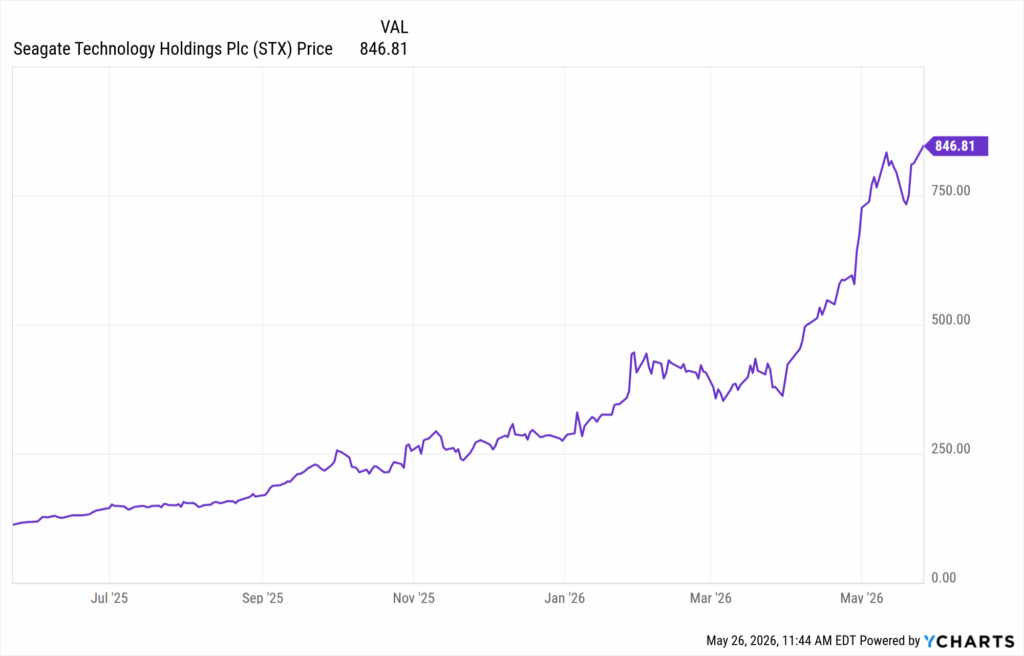
The business is real. Seagate has historically converted earnings into cash with discipline, and that track record makes the bull case easy to frame. But this stock is now wildly overpriced.
In the last year, shares have surged 600%. The stock now trades at nearly 30 times forward earnings. On a trailing basis, it trades at 280 times book value and 120 times cash.
So the company hardly has room for error.
Yes, Seagate boasts strong free cash flow – and that can support the narrative for a while. But if hyperscalers slow their orders, the market will quickly remember that digital storage is not a scarce asset.
Micron Technology — The Best Business Here, and Still Too Loved
Micron Technology (Nasdaq: MU) makes the memory chips that sit between a processor and its data – specifically, the DRAM and high-bandwidth memory that AI servers depend on to function. Every time an AI model processes a request, it’s pulling vast amounts of data into memory at blinding speed. The faster and more capable that memory, the faster the AI can work. Micron is one of only three companies in the world – alongside Samsung and SK Hynix – that can supply this technology at scale.
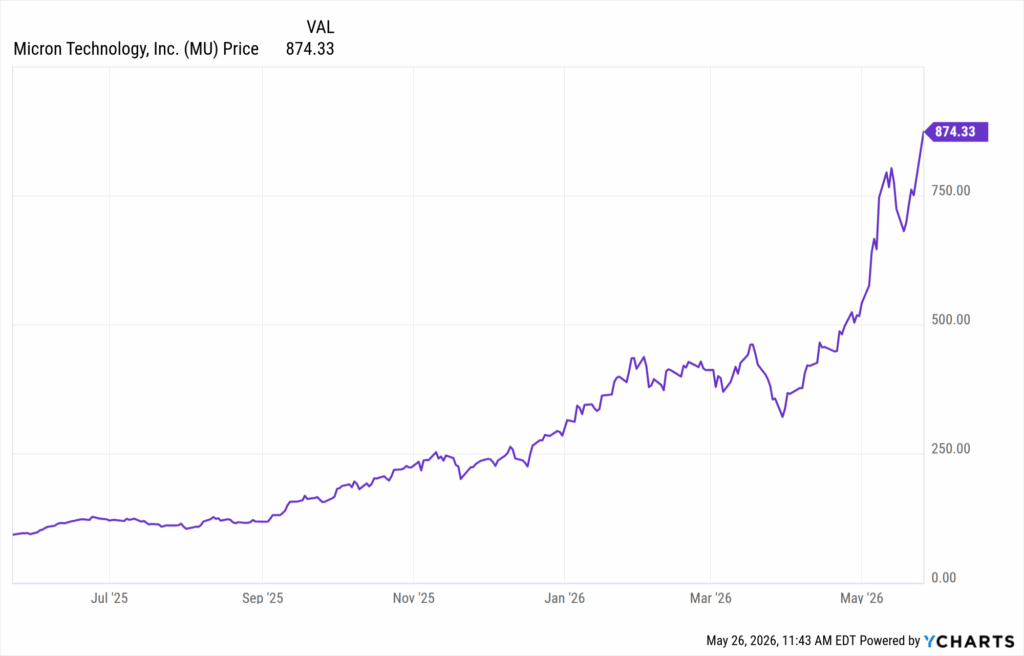
The latest quarter was extraordinary. In fiscal Q2 2026, revenue nearly tripled to $23.86 billion. Diluted EPS jumped to $12.07. Operating income reached $16.14 billion, and operating margin rose to 67.6%. Adjusted free cash flow climbed to $6.9 billion. And management expects even more growth from here, projecting fiscal Q3 revenue to reach roughly $33.5 billion and non-GAAP EPS to hit about $19.15.
Micron ended the quarter with $16.7 billion in cash against $10.1 billion in debt – a cash-to-debt ratio of roughly 1.65x, the strongest position the company has reported in years. But a strong balance sheet doesn’t eliminate the cycle. It only helps Micron survive it.
Memory upcycles always look most convincing when margins are at their widest. That is also when investors are most willing to pay for permanence in a business that has rarely delivered it. Shares trade at more than 50 times trailing free cash flow. At that price, every stumble gets magnified.
Micron can be both impressive and vulnerable at the same time. If supply loosens, buying slows, or pricing softens even a little, investors may find they paid too much for earnings that were always near their ceiling.
Bottom line: Strong company. Risky setup.
Broadcom Inc. — No Longer Cheap Enough for Its Own Brilliance
Broadcom Inc. (Nasdaq: AVGO) is a semiconductor and infrastructure software company with two distinct businesses. On the chip side, it designs the custom AI accelerators and high-speed networking silicon that the world’s largest cloud companies use to build their AI infrastructure. Google, Meta, and others have moved away from buying off-the-shelf chips and toward chips designed specifically for their workloads – Broadcom is the firm they hire to design them. On the software side, its VMware acquisition brought in a massive enterprise software business that helps large companies manage their computing infrastructure. That combination – custom AI chips plus mission-critical software – is why the stock has become one of Wall Street’s favorite AI plays.
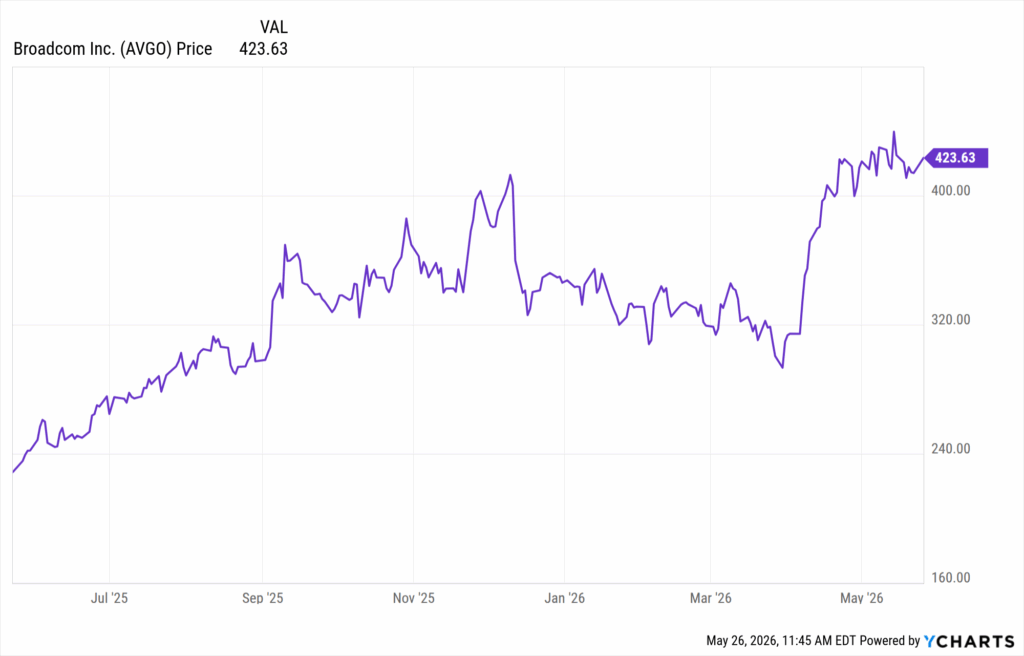
The recent results explain exactly why investors have chased it so hard. In Q1 2026, revenue rose 29% year over year to $19.3 billion. Adjusted earnings climbed to $2.05. Adjusted EBITDA reached 68% of revenue. Free cash flow totaled $8.0 billion. AI semiconductor revenue more than doubled to $8.4 billion, and management guided the next quarter’s AI revenue to $10.7 billion.
Those are excellent numbers. But the stock trades at a trailing price-to-earnings ratio near 82 – nearly three times the broad market.
The multiple is built on three assumptions: Broadcom’s AI backlog converts smoothly, profit margins stay elevated, and hyperscaler spending remains intense. All three are true right now. The question is whether they’ll stay true at the pace the current price demands. The multiple leaves no room for normal pauses – a custom-chip delay, a slower networking order, a VMware integration hiccup.
When investors pay an elite multiple for a company already delivering elite numbers, the next surprise doesn’t need to be bad to hurt the stock. It only needs to be less spectacular than the market expects.
Tesla Inc. — Asking Investors to Ignore the Core Business
Tesla Inc. (Nasdaq: TSLA) makes electric vehicles, operates a global network of charging stations, and sells energy storage systems to homes and utilities. It also develops autonomous driving software and has announced plans to deploy a robotaxi service. That last part is the reason the stock is priced where it is. The car business is slowing. The robotaxi and autonomy businesses haven’t arrived yet. So the market is being asked to value Tesla not on what it earns today, but on what it might earn if the autonomous driving bet pays off.
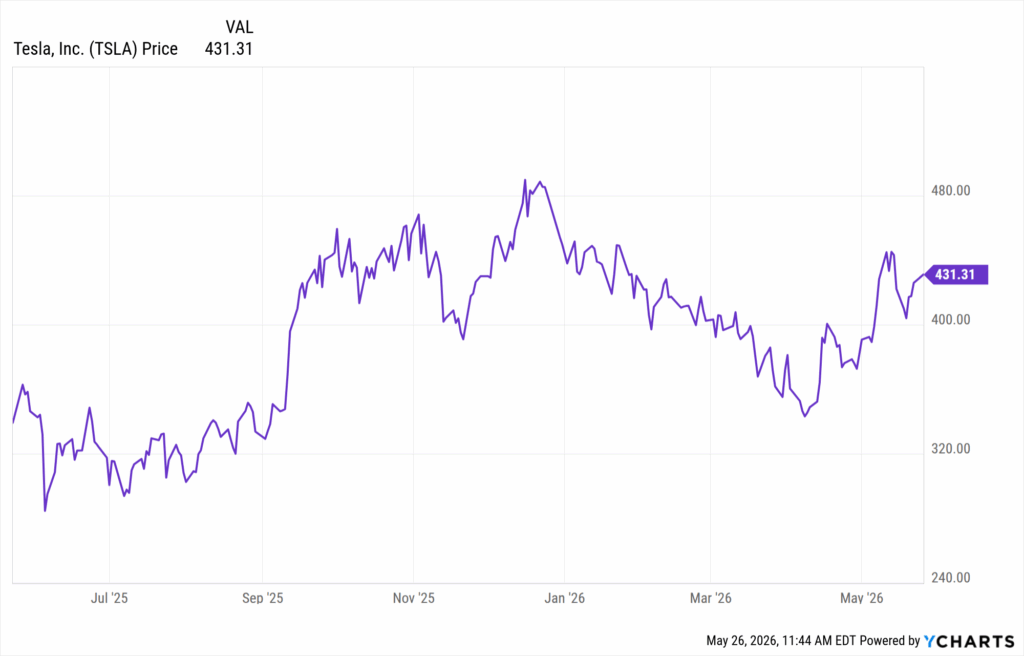
In Q4 2025, revenue fell to $24.9 billion, down 3% year over year. Earnings per share dropped 17% to $0.50. Operating margin slipped to 5.7%. Free cash flow came in at just $1.4 billion.
That is not what a premium multiple usually buys an investor. The stock trades at 152 times forward earnings. Even Wall Street can’t agree on what it’s worth – Wells Fargo has had price targets as low as $125 while Wedbush’s have been as high as $600. That 5x range is telling. It reflects the fact that no one can value a company when most of its projected worth hasn’t been earned yet.
The business isn’t collapsing. Automotive gross margin improved, and total gross margin topped 20.1% in the quarter. But the market is pricing Tesla as a future AI platform whose biggest profit streams haven’t arrived yet.
Tesla’s valuation assumes tomorrow will rescue today. That is a dangerous place for any stock to live.
Arista Networks — A Victim of Its Own Excellence
Arista Networks (NYSE: ANET) makes the high-speed switching and routing equipment that connects servers to each other inside data centers. Think of their products as the plumbing of an AI cluster. When you train a large AI model, you’re not using one server – you’re using thousands of them simultaneously, passing enormous amounts of data back and forth at every step. Arista’s gear makes that communication fast enough to be practical. Without it, large-scale AI simply doesn’t work.
The company has executed brilliantly over the past decade. And investors have rewarded it with a valuation that assumes hyperscaler demand stays unusually strong for an unusually long time.
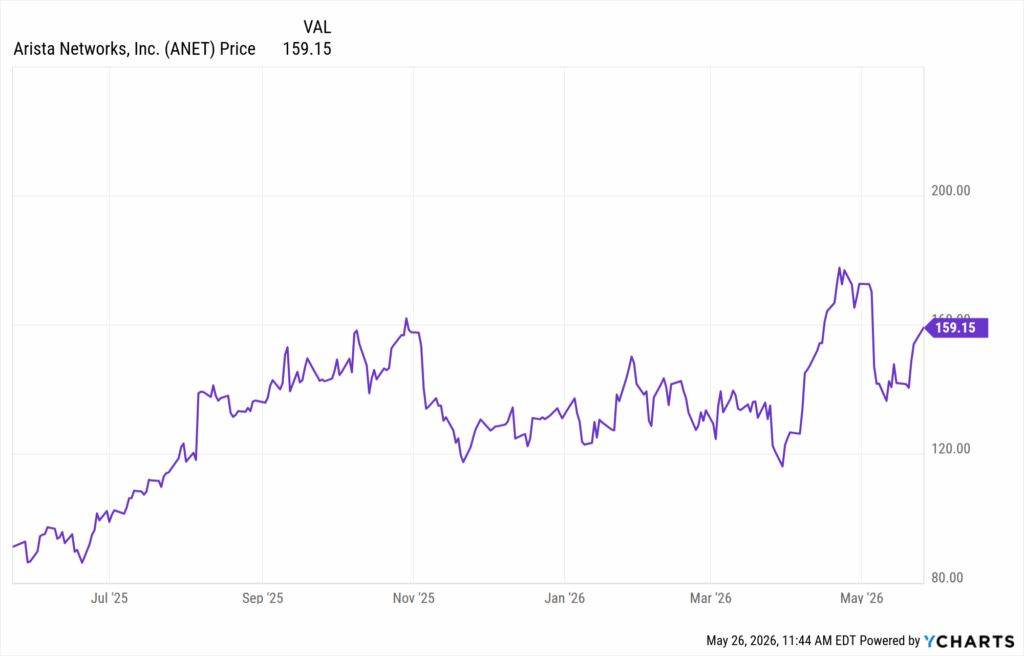
Here’s the trap. Arista’s excellence is no longer a secret. The stock is already treated as one of the premier ways to play AI networking. Once the market has fully recognized a company’s quality, the upside shifts – it’s no longer about being right on the business. It’s about being right that expectations are still too low. That’s a much harder edge to hold, especially with a stock price of 24 times sales.
Networking demand also bunches around deployment waves. Arista wins when cloud customers race to expand. It stalls when those same customers pause, optimize existing fleets, or shift their spending elsewhere inside the data center. And that expansion pause always comes.
At this valuation, there is very little margin for error. This is the classic point where a great company becomes a fragile stock.
Why None of These Are as Strong as They Appear
Here’s the honest summary: several of these are genuinely excellent businesses. Broadcom is a remarkable company. Micron is executing at the highest level in its history. Arista has earned its reputation several times over.
The problem isn’t the businesses. The problem is the stock prices.
Every one of these companies is being priced as though the current environment – surging AI spending, strong pricing, peak margins – will persist forever. That has never happened before. Not with railroads. Not with the internet. Not with cloud computing. Every buildout cycle in history has eventually paused, and when it does, the hardware suppliers feel it first and feel it hardest.
The memory and storage names – Sandisk, Western Digital, Seagate, and Micron – face an additional structural problem. They don’t control their own pricing. When demand softens and the market gets oversupplied, margins collapse, and they collapse fast. We saw what that looked like in 2022 and 2023. We’ll see it again.
Broadcom and Arista have stronger competitive positions, and that matters. But both are priced at multiples that assume every order converts on time, every new product ramps without a hiccup, and hyperscaler budgets never blink. Any one of those things going slightly wrong is enough to take 20% or 30% off a stock priced at these levels.
Tesla is in its own situation. The AI narrative there is speculative by design – it’s a bet on something that hasn’t been proven yet, priced as though the proof is already in.
I want you to think clearly while everyone else is getting louder. The winning move in AI now is to avoid the stocks where the gain is already in the price – the stocks that already made believers rich – before the market remembers that gravity still applies.
The Great Rebalancing starts when investors stop confusing a powerful trend with a safe stock. And when that distinction comes back into focus, these seven giants could fall a lot faster than most people think.