 You are now logged out.

The Best of The Oxford Income Letter: January-June 2026
Growth Meets Income: Beat the Crowd With This Rapid Dividend Raiser
By Marc Lichtenfeld • Chief Income Strategist • June 2026
“I swear I’m going to put my foot through this f*&$!#g computer!”
That was how I greeted my bride of nine months one March evening in 1996 as she walked through the door.
Yes, she really is the luckiest girl in the world.
Having been with me for a number of years at this point, she was used to my nonsense.
“Well, don’t,” she replied calmly as she walked into the other room. “The computer is new, and it was expensive.”
The reason for my fury? Trying to do our taxes using an off-the-shelf software package.
At the time, I wasn’t making much money, we didn’t have many investments, and we lived in an apartment. In my mind, a reasonably intelligent person (which I thought I was until that afternoon) should have been able to do his or her taxes fairly easily. My frustration had reached a boiling point.
Up until then, I’d always paid someone to do my taxes. From that point forward, I again decided it was money well spent. (It’s also cheaper than channeling my inner Ray Guy by punting my computer across the room every year and having to get a new one.)
I’m not alone. There are millions of reasonably intelligent individuals who want or require help to prepare their tax returns.
That’s where H&R Block (NYSE: HRB) comes in.
The 71-year-old company serves 22 million taxpayers each year. In addition to helping you figure out what you owe (or are owed), it guarantees accuracy. If there is a mistake that results in penalties or interest, H&R Block will cover the charge.
The company has a variety of services, including tools for do-it-yourself taxpayers, those who want to work with an expert, and tax professionals.
For example, anyone who just wants a second pair of eyes on a return they completed themselves can use H&R Block’s free Second Look service. You only pay if you file an amended return.
Using a tax preparer like H&R Block could also have benefits beyond finding additional tax deductions. The company has enrolled more than 2 million 530A Trump accounts, representing 90% of clients whose children were eligible for the $1,000 government contribution. Those kinds of benefits translate to customer loyalty and long-term relationships.
H&R Block is a turnaround story. After two years of market share losses, the company maintained its percentage of the market this tax season.
Importantly, its financial performance has been strong.
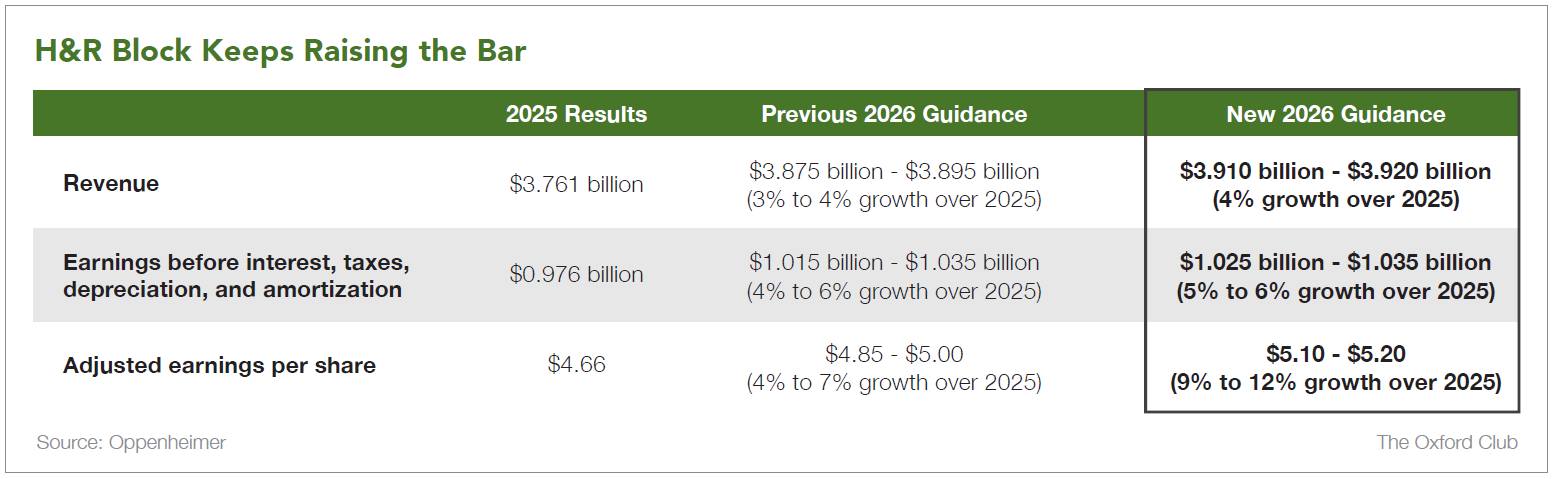
Over the past decade, earnings per share have grown at a 10.3% compound annual growth rate. In the fiscal third quarter, which ended March 31, revenue grew 5.3% year over year to $2.4 billion and adjusted earnings per share grew 11.9%.
As you can see below, the company also raised guidance across several metrics, including earnings per share.
Despite strong earnings growth, there are a lot of skeptics. More than 14% of the float is sold short.
One argument against the stock is that AI will replace the need for tax preparers.
Well, they made the same argument when QuickBooks − and other software packages that drove me to the brink of insanity − came out. Yet H&R Block is making more money than ever.
Also, AI makes mistakes. A lot of them. The industry uses a euphemism, calling them “hallucinations.” But they are mistakes, and some of them are major. At this point, I don’t trust ChatGPT to navigate the complexities of the U.S. tax code and tell me exactly how much I owe − not when I’ve seen how often it simply makes things up (excuse me, “hallucinates”).
Lastly, are you really going to upload your financial documents and sensitive data into ChatGPT and send them into the ether? I sure as hell won’t. You’d have to be crazy to do that.
That’s not to say there aren’t uses for AI when it comes to preparing taxes. In fact, H&R Block employs AI to help its own experts as well as other tax professionals. It also uses AI to handle tasks such as calculations, data collection, and data entry, which frees up tax pros to have more in-depth client conversations.
H&R Block’s tax platform even earned the “Best Use of AI” award from CNET and was named the “Best Overall” online tax product.
Dividends and Buybacks
Management is committed to returning cash to shareholders. In the first nine months of fiscal 2026, the company returned $561 million to investors in dividends and share buybacks. It has $700 million remaining in authorized repurchases and just approved another $100 million.
Continued buybacks could put a squeeze on short sellers. When short sellers cover their positions, they buy stock, which adds demand and often pushes the price higher.
H&R Block currently pays a $0.42 per share quarterly dividend, which comes out to a 4.2% dividend yield. It has raised its dividend for 10 straight years.
The company has boosted the dividend in the third quarter (its fiscal first quarter) for the past few years, so we should see an increase very soon.
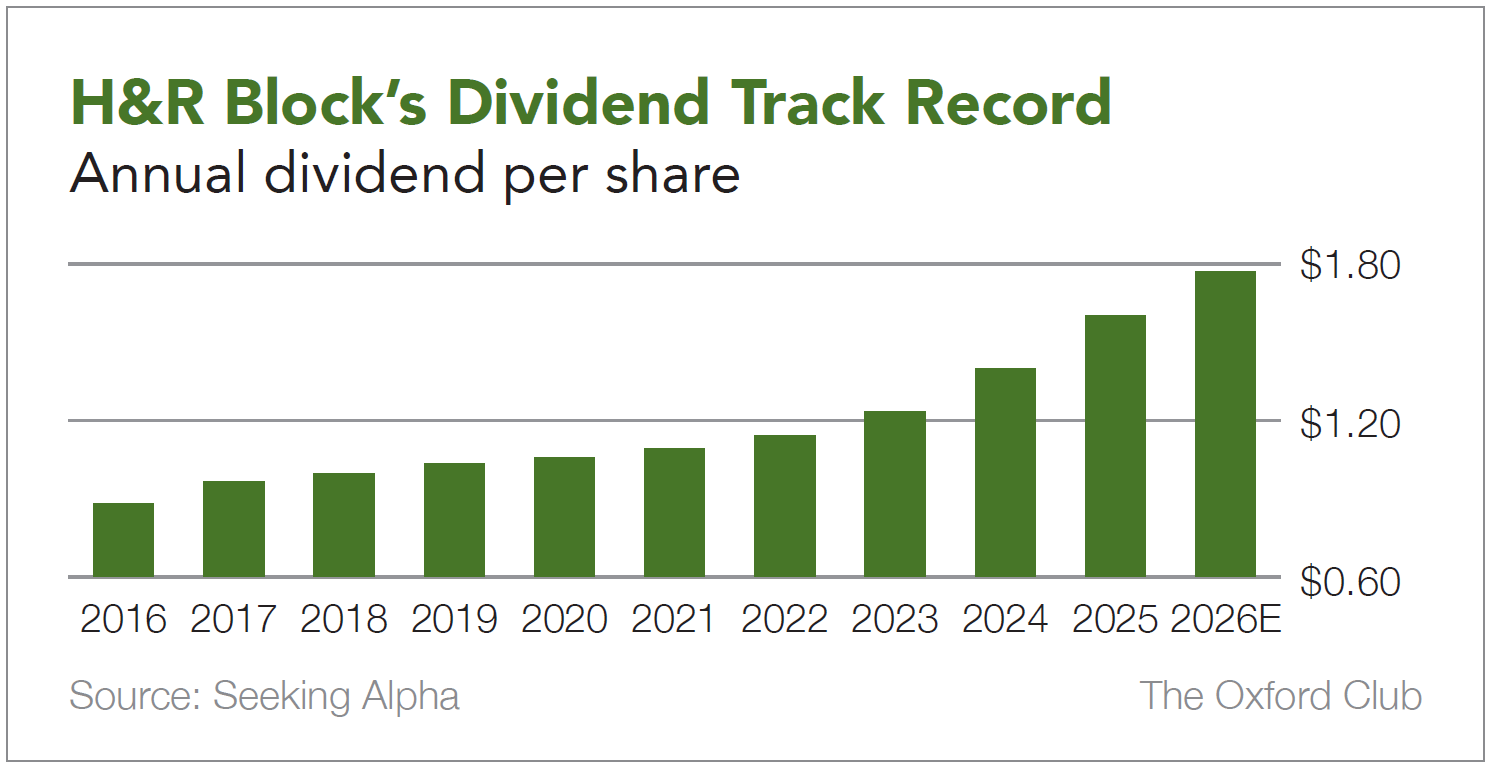
If this year’s increase matches last year’s hike of 12%, it will push the yield on today’s price to over 4.75%.
The company generates a lot of cash flow. In fiscal 2025, H&R Block made $599 million in free cash flow while paying out $197 million in dividends, giving it a payout ratio of just 33%. That’s well below my preferred threshold of 75%.
This fiscal year, H&R Block is forecast to generate $718 million in free cash flow while paying $199 million. If those numbers are accurate, the payout ratio will fall to 28%.
Our Safety Net model for analyzing dividend safety penalizes companies with falling one- and three-year free cash flows. The 2025 total represents a 9% decline from 2024 and was also lower than the figure from three years ago. This year’s projected $718 million is higher than last year’s total but still lower than it was three years ago.
As a result, H&R Block’s dividend safety rating is not especially high.
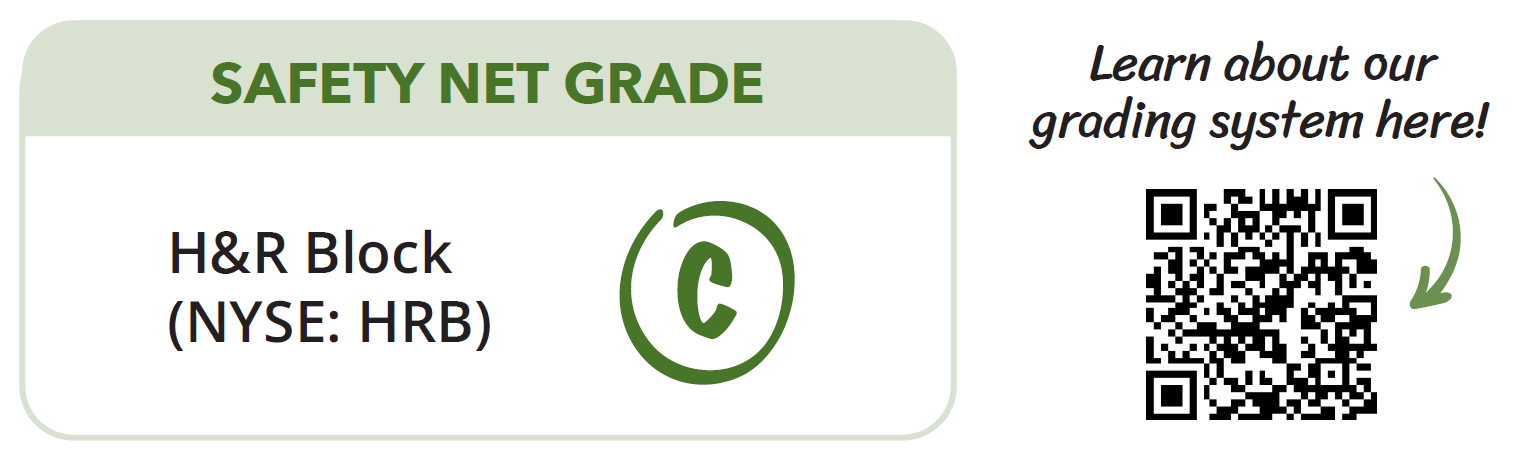
However, given that the payout ratio is so low and free cash flow is expected to rise, I don’t believe the dividend is at all at risk. If free cash flow increases even just a little in 2026, the stock’s dividend safety rating will get an upgrade.
A strong and growing yield, an excellent product, and improving financials make this a turnaround story worth owning.
It may even save a few computer screens.
Action to Take: Buy H&R Block (NYSE: HRB) for $44 or lower, and add it to the Compound Income Portfolio. Hold the stock in a tax-deferred account if possible. If you can’t, a taxable account is fine. You’ll simply pay taxes on the dividend each year − and H&R Block can tell you exactly how much you owe.
[Editor’s Note: Marc recommended H&R Block in the June 2026 issue. It remains an active “Buy” recommendation as of the time of this writing in late June 2026. To view all of the Oxford Income Letter portfolios, click here.]
A 5.5% MEAR With Less Than 3 Years to Maturity
By Marc Lichtenfeld • Chief Income Strategist • March 2026
In today’s bond market, income is plentiful, but efficiency is not.
You can find yields north of 5% in plenty of places. The problem is many of them require you to commit your capital for five, seven, or even 10 years. That’s a long time to stay exposed to interest rate cycles, shifting credit conditions, and market volatility.
Occasionally, though, you can capture that same level of income in a much shorter window.
That’s the case with the Goldman Sachs BDC (CUSIP 38147uag2) January 28, 2029, 5.1% coupon bonds.
These bonds mature in just under three years, have six remaining semiannual interest payments, and trade slightly below their $100 par value − $98.15 as I write this.
That combination matters.
At today’s price, you’re locking in roughly a 5.5% minimum expected annual return (MEAR) if you hold the bond to maturity, and the short time period significantly limits your duration exposure relative to other bonds with similar yields. (MEAR is a metric we developed here at The Oxford Club that is a more accurate measure of expected bond returns than the most commonly used metric, yield to maturity.)
In other words, you’re earning mid-5% income without tying up capital for most of a decade.
Goldman Sachs BDC is a business development company that lends directly to middle-market businesses − firms that are too large for traditional small-business loans but not large enough to easily tap public bond markets. These borrowers rely on private credit providers for financing to support growth, acquisitions, and operations.
The company primarily makes senior secured loans and structured credit investments. These loans typically sit high in the borrower’s capital structure (ahead of equity and junior debt), which improves the likelihood of getting paid back if things go wrong.
Goldman Sachs BDC is externally managed by Goldman Sachs Asset Management. The parent company oversees hundreds of billions of dollars across all kinds of investments and operates one of the most established private credit networks in the world.
While the bond is an obligation of Goldman Sachs BDC itself − not of the larger investment bank − this management structure provides disciplined underwriting, ongoing portfolio monitoring, and consistent access to institutional funding channels.
Those advantages are important in credit markets. Access to capital and savvy risk management often increase resilience through economic cycles.
But the real appeal here is structural.
This bond sits in a part of the maturity curve that offers an unusually attractive balance between yield and time commitment. Many bonds yielding above 5% today extend well beyond five years. That adds meaningful exposure to interest rate shifts and other potential headwinds.
With less than three years remaining, this bond avoids much of that risk.
Just as important, the short timeline preserves your flexibility. When the bond matures and you get your principal back in January 2029, you can then reassess prevailing rates and economic conditions before redeploying capital.
The bond’s return profile is increasingly being driven by the time remaining until maturity rather than by long-term macro forecasts. Over time, the price should continue to move closer to its $100 par value.
Of course, no bond is risk-free.
Middle-market companies (like Goldman Sachs BDC’s borrowers) can be more sensitive to economic slowdowns than large cap corporations, so a deterioration in credit conditions could affect prices.
Private credit markets are in the news right now due to concerns about investor redemptions and loans to software companies. While the stocks of some BDCs have fallen hard, their bonds haven’t budged, which speaks to the safety of bonds.
What makes this bond particularly useful is how it fits within a broader income strategy. It functions as an income anchor, delivering a strong yield while keeping maturity risk contained. That combination is not easy to replicate.
Opportunities like this don’t usually last. As shorter-term bonds near maturity, their prices move closer to par, causing their yields to shrink.
For income investors seeking a balance of yield, flexibility, and defined timeline in a chaotic market, these bonds deserve consideration.
Action to Take: Buy the Goldman Sachs BDC (CUSIP 38147uag2) January 28, 2029, 5.1% coupon bonds for $100 or lower. Bond prices are often listed as one-tenth of the actual cost, so a listed price of $100 indicates an actual cost of $1,000 per bond.
[Editor’s Note: Marc recommended the Goldman Sachs BDC bond in the March 2026 issue. It remains an active “Buy” recommendation as of the time of this writing in late June 2026. To view all of the Oxford Income Letter portfolios, click here.]
Should You Claim Social Security Now… or Wait?
By Anthony Summers • Director of Trading • April 2026
One of the most common questions I’m hearing right now is “Should I claim Social Security early or wait?”
Due to solvency fears and recent rule changes, that question has taken on new urgency, pushing more Americans to claim their benefits early.
Social Security claiming activity jumped 13% in the first half of 2025, an increase of more than 276,000 claims, putting filings on track for nearly 4 million across all of 2025. Full-year data from 2025 has yet to be released, but from 2012 to 2024, claims increased by an average of just 3% per year.
In plain English, retirees are making permanent income decisions earlier, often without fully weighing the long-term trade-offs.
At the same time, nearly half of those claiming early say they’re doing so because they’re worried Social Security is “running out of money.” That’s a behavioral shift driven more by headlines than reality.
The real advantage is being able to separate the panic from the math and decide − based on your longevity, your spouse’s protection, and other factors − whether you can afford to wait.
For most conservative retirees, the default should be to delay − not because it always maximizes returns, but because it creates a larger, inflation-adjusted income stream that’s much harder to outlive.
The question is whether your portfolio can support that delay safely.
Still, the concern about Social Security solvency isn’t unfounded. The latest projections show the system’s reserves could be depleted by 2033. But even then, current tax revenue is expected to cover roughly three-quarters of scheduled benefits.
Even in a worst-case scenario, benefits don’t disappear. They simply get reduced.
Despite that, many people are locking in permanently lower benefits today to avoid a risk that may never fully materialize.
And that decision is costly.
As shown in the table below, claiming at 62 reduces your benefits by as much as 30% compared with waiting until full retirement age. That’s not a temporary adjustment. It’s a permanent reduction in your monthly income for the rest of your life.
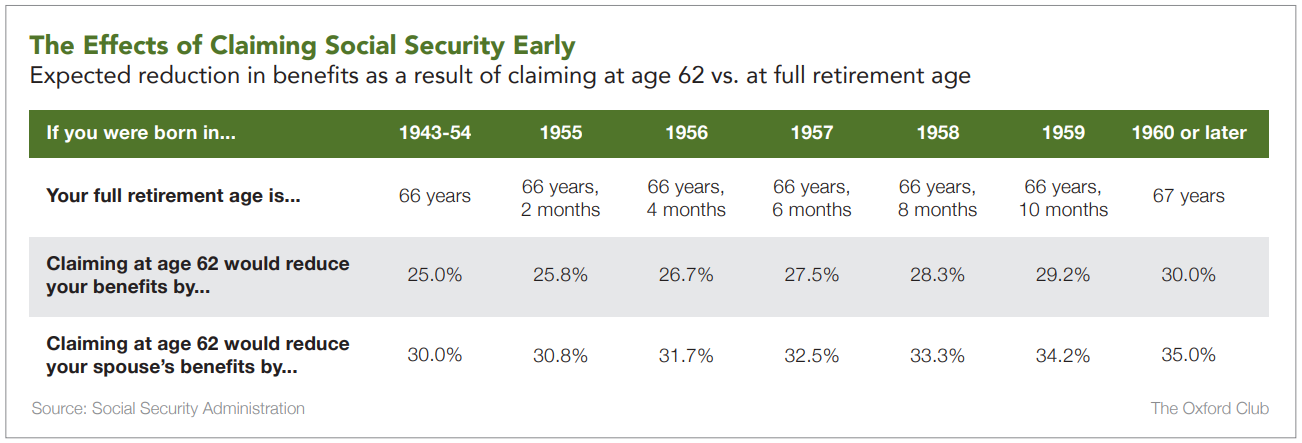
On the other side of the equation, delaying Social Security increases your benefits by 8% per year between your full retirement age and age 70. That means if your full retirement age is 67, waiting until age 70 boosts your monthly benefits by roughly 24%.
More importantly, this isn’t just about higher income − it’s about longevity protection. Married couples at age 65 today have at least a 50/50 chance that one spouse will live beyond age 90. The higher benefits from delaying don’t just support you; they also increase the survivor income your spouse may rely on later.
To see how that trade-off plays out in practice, let’s look at how different claiming strategies affect both income and long-term portfolio performance.
Morningstar’s 2025 research found that retirees who delayed Social Security and withdrawals until age 70 had first-year spending of about $83,000, compared with $75,000 for those who claimed at 67. That tells us delaying can produce meaningfully higher income in retirement.
However, those who waited ended up with about $120,000 less in their portfolios on average.
In plain terms, if you delay, you’re converting some of your portfolio into more guaranteed income.
The decision isn’t simply “claim early or delay.” The real question is whether you can safely turn part of your portfolio into a larger, inflation-adjusted income stream later.
This is where your situation matters.
If you have a well-funded portfolio, delaying often makes sense − but only if you can fund the gap without taking on unnecessary risk. That means managing withdrawals carefully and being mindful of market conditions early in retirement.
If your savings are more limited or your health suggests a shorter time horizon, claiming earlier can be a reasonable choice. In that case, the priority is securing reliable income now rather than maximizing lifetime totals.
The practical takeaway is this: Don’t claim early because of headlines. Run the numbers for your situation. If you can fund a delay without putting your portfolio at risk, it’s often worth considering. If you can’t, then claiming earlier is a reasonable and disciplined choice.
AI’s New Risk: When Tech Becomes Infrastructure
By Anthony Summers • Director of Trading • February 2026
Artificial intelligence is often discussed as a stock story − big price moves, a handful of winners, and a familiar debate over whether we’re looking at a breakthrough or a bubble.
But the more important risk signal sits just beneath those headlines.
AI is pushing the largest technology companies away from a model built primarily around software and toward something closer to physical buildout − data centers, specialized chips, and power-hungry facilities.
That shift matters because infrastructure-heavy cycles behave differently and tend to be less forgiving when the timing is off.
Let me explain, starting with the scale of the spending.
The five largest hyperscalers − Microsoft, Amazon, Alphabet, Meta, and Oracle − are expected to spend more than $600 billion in capital expenditures this year. Approximately 75%, or $450 billion, will be tied to physical AI infrastructure like equipment, chips, and data centers.
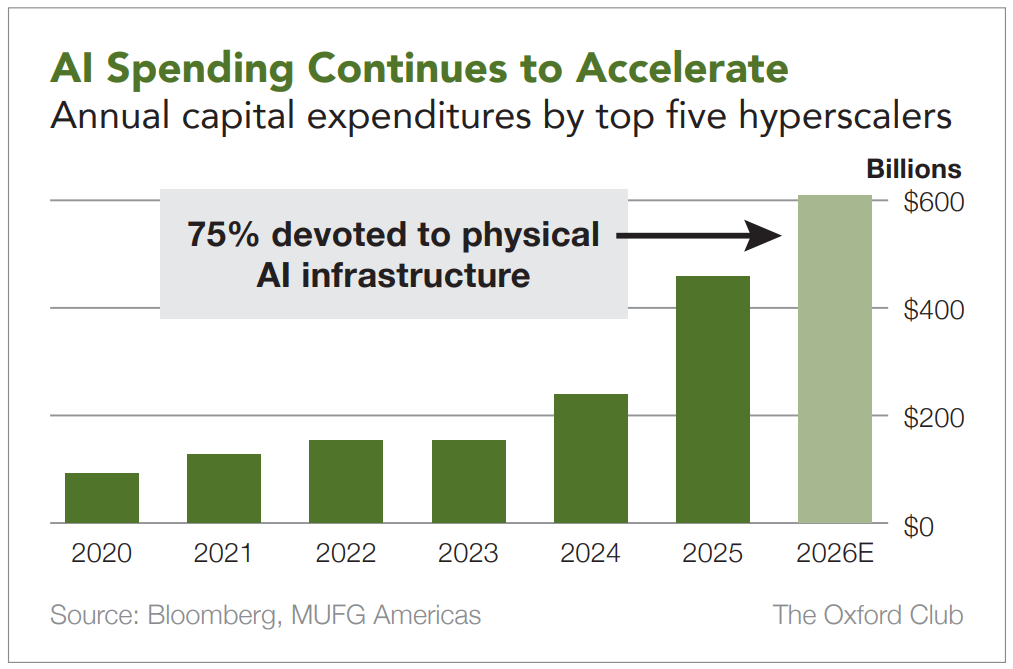
Globally, capital expenditures related to data centers have grown by double digits year over year for eight consecutive quarters − and surged at least 40% in each of the first three quarters of 2025.
That isn’t a gradual increase. It’s a clear change in direction.
When a business starts to look more like physical infrastructure than software, the risks change. Data centers and GPU (graphics processing unit) clusters can be built quickly. Revenue usually can’t.
As competition ramps up, it could push AI services toward something closer to a commodity, where the products are largely interchangeable. In that case, even though AI tools may prove useful, see widespread adoption, and create real economic value, prices could still disappoint − because profits would be spread thinly across many players.
That doesn’t mean the technology failed. It means the payoff may take longer than expected.
That’s why the way this buildout is financed is important. Equity investors can live with uncertainty, because a few big winners can offset many disappointments. Debt investors don’t have that luxury. They depend on steady cash flow, stable asset values, and the ability to refinance.
As AI spending has accelerated, borrowing has become a bigger part of the picture. Over the past year, tech firms have increasingly relied on bond markets and private credit to fund data center expansion. Some estimates suggest private credit alone could supply more than half of the roughly $1.5 trillion needed for data center construction through 2028.
The concern isn’t that borrowing is bad. It’s that borrowing leaves less room for error. If usage comes in lower than expected, lenders feel it first. If pricing weakens, the pressure shows up in credit before equity. And if new chip designs make older equipment less valuable, the assets backing that debt can lose value quickly. That’s when confidence can turn into forced selling.
Market concentration adds to the sensitivity. When a single theme drives a large share of market returns, small changes in expectations can have outsized effects.
The market doesn’t need to decide that AI has failed in order to spark a sell-off. It only needs to believe that profits will arrive more slowly − or be shared more widely − than investors once assumed. Prices can fall even while the technology keeps improving.
In short, the AI buildout is starting to look like a cycle driven by heavy spending and borrowed money. History suggests those cycles often run ahead of demand and then correct.
Now, that doesn’t erase the long-term value of what gets built. These innovations often lead to increased efficiency, better tools, and higher productivity. It’s just that the financial claims on the technology tend to change hands.
For conservative, income-focused investors, the takeaway is about awareness, not necessarily action.
AI’s shift into the physical world can affect your portfolio indirectly through large-scale infrastructure spending, credit conditions, and market concentration.
The environment to watch is one where spending stays high and financing becomes easier, yet outcomes remain uncertain.
Those conditions can support real innovation, but they can also make markets more fragile.
The point isn’t to predict a collapse or dismiss a powerful technology. It’s to recognize that as the focus of AI shifts from virtual to physical, progress and financial stress can exist at the same time.
Marc’s Mailbag
Q: I’m interested in setting up a bond portfolio to generate monthly income. Should I wait for the next Oxford Income Letter issue; use the last issue as a guide; or duplicate the existing “Buy” recommendations, avoid the “Hold” list, and add new “Buys” as they come up? − Robert R., May 2026
A: Welcome to the world of bonds, Robert. I can’t give personal advice, but any bond that is rated “Buy” and trading below my limit price can be bought. I don’t recommend buying bonds that are rated “Hold.”
Assuming that you want to have a diversified portfolio with a number of different bonds, it may be worth considering adding some bonds that are already in the portfolio and then buying new ones as they are added. (You can also check out Oxford Income Pro, which currently has 18 “Buy”-rated bonds in the portfolio. Learn more at http://oxford.club/Pro2026.)
If you prefer to move slowly, then it may make sense to buy one bond − either an existing recommendation from the portfolio or the next new one − so you can get comfortable with the process and then add more as you see fit.
Q: Hi Marc, I have learned much since joining The Oxford Income Letter, thank you! As I near retirement, I plan to position my portfolio into more instant dividend stocks. Currently, the Instant Income Portfolio has most positions on “Hold.” My question is how do you determine which stocks are placed into the Instant Income Portfolio rather than the Compound Income Portfolio? − Eddie, April 2026
A: Thanks, Eddie.
The answer is simple math.
The goal of the Instant Income Portfolio is to generate 11% yields within 10 years. The goal of the Compound Income Portfolio is to generate 12% average annual total returns over 10 years with dividends reinvested.
I plug each company’s numbers into a model, and if the stock is on track to achieve those goals, it goes into the corresponding portfolio.
All stocks that qualify for the Instant Income Portfolio also qualify for the Compound Income Portfolio. However, the reverse is not true. That is why you see more stocks in the Compound Income Portfolio than in the Instant Income Portfolio.
Q: Marc, I’ve made a lot of money taking your advice and I’ve learned a lot from you, so thank you! When a position hits the stop, isn’t the real question the value of the company and the long-term prognosis? It seems like it should be a qualitative decision at the time as opposed to a knee-jerk reaction based on a sell order that’s been sitting there for months. If the stop is hit, I’ll want to know the safety of the business and future of the dividend. Bottom line for me is it’s a qualitative decision, not automatic. Your thoughts? Thank you. − Dennis O., February 2026
A: You make valid points, Dennis. There could be a situation where a stock or fund’s price tanks due to market conditions but the fundamentals are fine.
That being said, trailing stops are put in place to avoid catastrophic losses. If the market does fall hard and you don’t have a stop in place, suddenly a small loss becomes a very large one and you need a big jump to make your money back.
If the price were to fall from, say, $6 to $3, that’d be a 50% haircut, but you’d need a 100% gain to get back to $6. That kind of gain is not easy to come by.
More importantly, while stocks occasionally get smashed in a “throw the baby out with the bathwater” scenario, there are other times when a falling price may be a sign of lurking trouble underneath the surface.
It’s frustrating to get stopped out, especially when the company or fund seems to be doing okay. But it’s all about risk management and ensuring that we don’t suffer a big loss. The market often − but not always − knows more than we do.