 You are now logged out.

The AI Income Blueprint: How to Collect 16 Royalty Payouts Per Year

The AI revolution runs on energy. Every prompt, every autonomous decision, and every search query consumes electricity – and that demand is only going to grow.
Goldman Sachs projects that the majority of AI’s energy demand will be met by American oil and natural gas, and one region sits at the center of it all: the Permian Basin.
Spanning up to 86,000 square miles across West Texas and southeast New Mexico, the Permian Basin is the most productive oil- and gas-producing region in the United States and has been one of the driving forces behind the U.S.’s emergence as the world’s top oil producer. In fact, the Energy Information Administration projects that the Permian will account for half of all U.S. crude oil production in 2026.
With energy demand projected to skyrocket both in the United States and abroad due to AI, the Permian Basin’s supply has become more important than ever.
In a White House dossier released in July 2025 titled “Winning the Race: America’s AI Action Plan,” President Trump wrote:
“As our global competitors race to exploit these technologies, it is a national security imperative for the United States to achieve and maintain unquestioned and unchallenged global technological dominance. To secure our future, we must harness the full power of American innovation.”
Most investors trying to profit from AI have focused on the semiconductor companies, the cloud platforms, and the hyperscalers. But there’s a quieter, more powerful approach: owning royalties on the land, water, oil, and natural gas that AI data centers are competing for.
Today, I am spotlighting two investments that, combined, can deliver up to 16 royalty payouts per year – more than one per month – while giving you direct exposure to the energy surge fueling America’s AI buildout.
1. Texas Pacific Land (NYSE: TPL)
Texas Pacific Land traces its origins to 1888, when it was formed to manage land that had been left behind after the bankruptcy of the Texas and Pacific Railway.
For most of its history, it was a quiet, passive entity… but that changed around 2010, when horizontal drilling and hydraulic fracturing unlocked the enormous oil and gas potential sitting beneath its West Texas acreage. The trust converted to a corporation in 2021 and joined the S&P 500 in 2024.
Today, TPL controls nearly 900,000 surface acres and around 200,000 net royalty acres, almost all of which reside in the Permian Basin.
It does not drill a single well. Instead, it owns the land and the perpetual mineral rights beneath it. When operators like Chevron and ConocoPhillips produce oil and gas, TPL collects a share of the revenue – without paying a dollar in drilling or operating costs.
That structure produces extraordinary results. In 2025, TPL reported record revenue of $798 million (up 13% year over year), net income of $481 million (up 6%), and free cash flow of $498 million (up 8%). Adjusted EBITDA margins were approximately 84%.
Those numbers arrived despite oil’s multiyear decline from above $100 per barrel for much of 2022 to below $60 by the end of 2025. Over that same three-year stretch, TPL grew oil and gas royalty production at a rate of 17% annually, water sales volumes at 18%, and water royalty volumes at 30%.
The business keeps growing regardless of the commodity cycle, because TPL’s scale and market share allow it to expand even when prices are working against it.
The company’s water business is sometimes overshadowed by the oil and gas segment, but it’s an important part of the picture for investors. Modern drilling consumes enormous amounts of water and generates even more wastewater that must be treated and disposed of. TPL owns the land and the underground infrastructure that make those services possible.
Water sales revenue hit a quarterly record of $60.7 million in the fourth quarter of 2025, and daily water sales hit 1 million barrels for the first time in company history.
Unlike oil royalties, water revenue doesn’t fluctuate directly with the spot price of any particular commodity − it’s driven by how much drilling activity is occurring on TPL’s land, which tends to be more stable from month to month. As long as operators are drilling in the Permian, the water checks keep coming.
Then there’s the AI angle.
Data centers require three things in enormous quantities: land, energy, and water. TPL has a near-monopoly on all three across its nearly 900,000 acres in one of the cheapest energy regions in the world.
In late 2025, the company invested $50 million in Bolt Data & Energy – a data infrastructure company chaired by former Google CEO Eric Schmidt – and secured the right of first refusal to supply water to all Bolt-affiliated data center projects. Bolt reportedly aspires to build a 10-gigawatt campus on TPL’s land, and analysts estimate each gigawatt could generate more than $125 million in annual water revenue for TPL.
A Premier AI Income Play
From 2000 to 2025, TPL delivered a cumulative total return (with dividends reinvested) of more than 55,000%, or roughly 29% annually. A $1,000 investment in 2000 would have grown to more than $556,000.
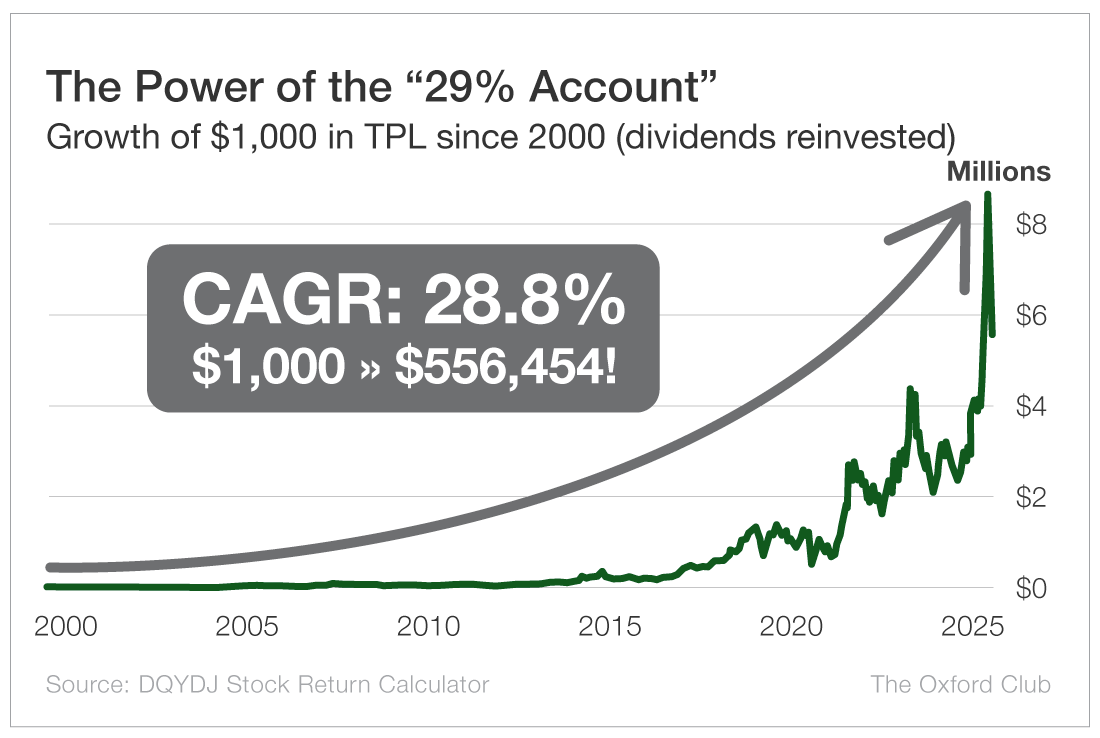
In early 2026, the board raised the quarterly dividend by 12.5% to $0.60 per share, marking the 23rd consecutive year that the payout was increased. The balance sheet carries $145 million in cash and no net debt, and the company has access to a $500 million credit facility that it has yet to tap into.
In short, there may be no company in the entire market that’s better positioned to help investors pocket income from the AI boom.
Recommendation: Buy Texas Pacific Land (NYSE: TPL) at the market. If you are collecting the dividends, place a 25% trailing stop on your position. If you are reinvesting the dividends, do not set a stop. Hold the stock in a tax-deferred account if possible.
2. Permian Basin Royalty Trust (NYSE: PBT)
If TPL is the leading long-term royalty compounder in the Permian Basin, PBT is the income engine – a simple, transparent structure that has been sending monthly checks to investors for more than 40 years.
Founded in 1980, Permian Basin Royalty Trust has a single purpose: collect royalty income from its Texas oil and gas properties and distribute every available dollar to unitholders. There are no employees, no capital expenditures, and no debt.
The trust’s two core assets have been producing income through every commodity cycle for decades. The Waddell Ranch properties in Crane County, Texas, sit atop one of the most prolific oil-producing regions in the entire Permian Basin. The trust collects 75% of the net royalty income from every barrel that comes out of the ground at Waddell Ranch.
The second asset – the Texas Royalty properties – is a diversified portfolio of roughly 125 royalty interests spread across 33 counties in Texas. These mature properties, which include a number of established oil fields, have been generating royalty income since the trust was founded in 1980.
Together, these properties have funded more than 300 consecutive monthly distributions. That monthly cadence – 12 payouts per year – is the trust’s most practical attraction.
Combined with TPL’s four quarterly dividends, the pairing delivers up to 16 royalty payments per year.
A Temporary Setback – and Why It’s Now Behind Us
Last year was a transitional year for Permian Basin Royalty Trust. Declining oil prices pushed the Waddell Ranch properties into a temporary “excess cost” position, reducing distributions. The trust’s nine-month distributable income fell roughly 46% year over year.
However, two significant developments have since changed the picture:
- In August 2025, Permian Basin Royalty Trust settled its litigation against Waddell Ranch operator Blackbeard Operating for $9 million. The dispute dated back to 2020, when Blackbeard took over as operator and almost immediately began allegedly withholding financial data and miscalculating royalty payments, leading to the lawsuit being filed in 2024. The settlement includes new overhead rates and reporting requirements that should improve the property’s economics going forward.
- In December 2025, 98.5% of votes cast at a special meeting supported governance reforms that give unitholders more flexibility to modernize the trust’s structure.
All in all, the problems are largely in the rearview mirror, and I expect to see a nice rebound in both distributable income and distributions in 2026.
Investors who buy today are paying a discounted price for a trust whose underlying assets are intact, whose legal disputes are resolved, and whose governance is now more accountable than at any point in its history.
Layer in the AI energy demand story – the same Permian Basin gas powering the trust’s royalties is now the fuel of choice for the data centers being built across West Texas – and the setup becomes even more attractive.
Recommendation: Buy Permian Basin Royalty Trust (NYSE: PBT) at the market. If you are collecting the distributions, place a 25% trailing stop on your position. If you are reinvesting the distributions, do not set a stop. Hold the stock in a tax-deferred account if possible.
Oil Has More Room to Run
Several factors could push oil prices meaningfully higher from here, which would be very bullish for both Texas Pacific Land and Permian Basin Royalty Trust.
Geopolitical risk remains elevated across multiple fronts: The Russia-Ukraine war has stretched past four years, and tensions in the Middle East − from the war in Iran to a potential resumption of the Israel-Hamas conflict − still loom over global energy markets.
The AI buildout may be the most powerful long-term tailwind of all. Energy consumption from U.S. data centers is projected to rise 130% by 2030, with natural gas expected to be the dominant fuel source − a direct and growing tailwind for Permian Basin production.
As oil prices recover, the cash flow and payouts from these two companies should increase – potentially dramatically.
The Bottom Line
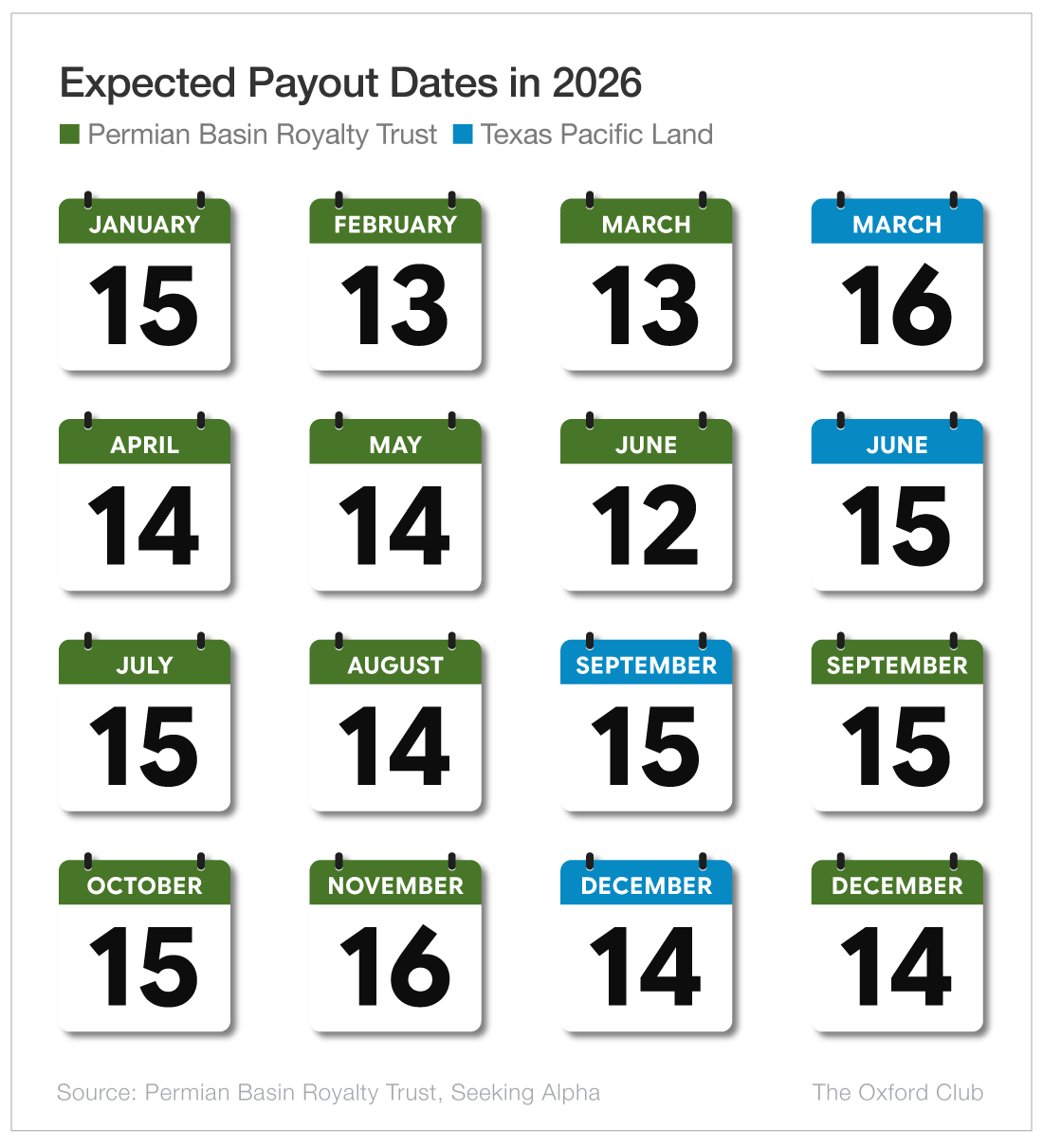
Texas Pacific Land pays quarterly dividends four times per year. Permian Basin Royalty Trust pays monthly distributions 12 times per year. Own both, and you collect up to 16 royalty payouts annually.
Permian Basin Royalty Trust’s monthly distributions are typically paid between the 12th and the 16th of the month. In order to receive each one, you must have owned the trust on the “ex-dividend date,” which is about two weeks before the distribution is paid.
Texas Pacific Land’s four quarterly dividends are usually paid in mid-March, mid-June, mid-September, and mid-December. Its ex-dividend dates also fall about two weeks before the dividends are paid.
However, the case for these two investments goes beyond the payout schedule. TPL is a world-class royalty business with exceptional margins, a 25-year compounding record, and direct exposure to the AI infrastructure buildout in West Texas. Permian Basin Royalty Trust is the monthly income vehicle – simple, commodity-sensitive, and positioned to surge in tandem with energy prices.
Together, they give you both near-term yield and capital gains potential and long-term compounding power.
Artificial intelligence is reshaping the demand side of the energy equation, and President Trump’s deregulation and “drill, baby, drill” agenda are reshaping the supply side. The Permian Basin sits at the intersection of both forces, and Texas Pacific Land and Permian Basin Royalty Trust sit at the heart of the Permian.
I can’t think of a better way to collect income from the AI boom without buying a single tech stock than by owning these two powerful energy plays.