 You are now logged out.

The #1 AI Stock: How to Retire on This Obscure Under-$10 Stock

Note: Our original pick for this report, Exscientia (Nasdaq: EXAI) was acquired by Recursion Pharmaceuticals (Nasdaq: RXRX). The combined company is an AI-driven powerhouse in the pharmaceutical industry. Recursion’s NVIDIA-powered supercomputer BioHive-2 will likely accelerate the development of the drugs already in Exscientia’s pipeline. In addition, Recursion should see its growth accelerate as it inherited Exscientia’s partnerships with Sanofi (Nasdaq: SNY) and Merck (NYSE: MRK). Due to that acquisition, our recommendation is now that you add Recursion Pharmaceuticals to your portfolio. It combines everything good about Exscientia mentioned in this report with a very impressive supercomputer and even more resources. I
The opportunity I am about to reveal in this report is involved in the most important new cutting-edge technology in the world: artificial intelligence (AI).
AI represents nothing short of a new industrial revolution. McKinsey projects that AI could add the equivalent of $2.6 trillion to $4.4 trillion annually in annual economic benefits across dozens of use cases.
Programs like ChatGPT are interesting, but AI’s potential goes far beyond a very clever chatbot. This technology won’t replace human workers, but it will make them exponentially more productive.
Smart personal assistants like Siri will only get more intelligent and useful as they become genuine intelligences, allowing better multitasking and schedule management.
AI programs can completely automate various processes from manufacturing to new software integration.
They can create personal advertisements, collect and catalog vast quantities of customer data, and design web pages all in minutes, whereas it would take days, weeks or months for a human to do the same thing.
Perhaps most critical for business is the powerful security applications AI has. A program doesn’t need to sleep or take breaks. It can monitor a network and respond to security issues 24/7.
And we’re just at the beginning. AI is a relatively new technology, and there is a twist here that takes it to another level…
The #1 AI stock is taking this groundbreaking new technology and applying it to one of the biggest markets in the world…
The $12 trillion healthcare industry.
Healthcare is bigger than the tech, oil and gas, and communications industries.
And it’s responsible for some of the biggest stock gains of all time.
Like Amgen (Nasdaq: AMGN)… up 26,000% since 1990.
And Intuitive Surgical (Nasdaq: ISRG)… up over 18,000% in 20 years.
And Tandem Diabetes Care (Nasdaq: TNDM)… which jumped over 1,700% in just one year.
The AI company in this report has that kind of upside potential.
And while investment professionals usually tell you that diversification and index funds are the path to a wealthy retirement…
The truth is…
If you want the true dream retirement… and you’re worried that you haven’t saved enough… it’s not all about diversification.
It’s about finding that one stock that’s created a new cutting-edge technology or product that is now set to change the world.
It’s common knowledge that the average American is woefully unprepared for retirement. If you look at the median retirement savings by age, you’ll see that those in the 55-64 age group – who are preparing to retire soon – have an average of $185,000 saved.
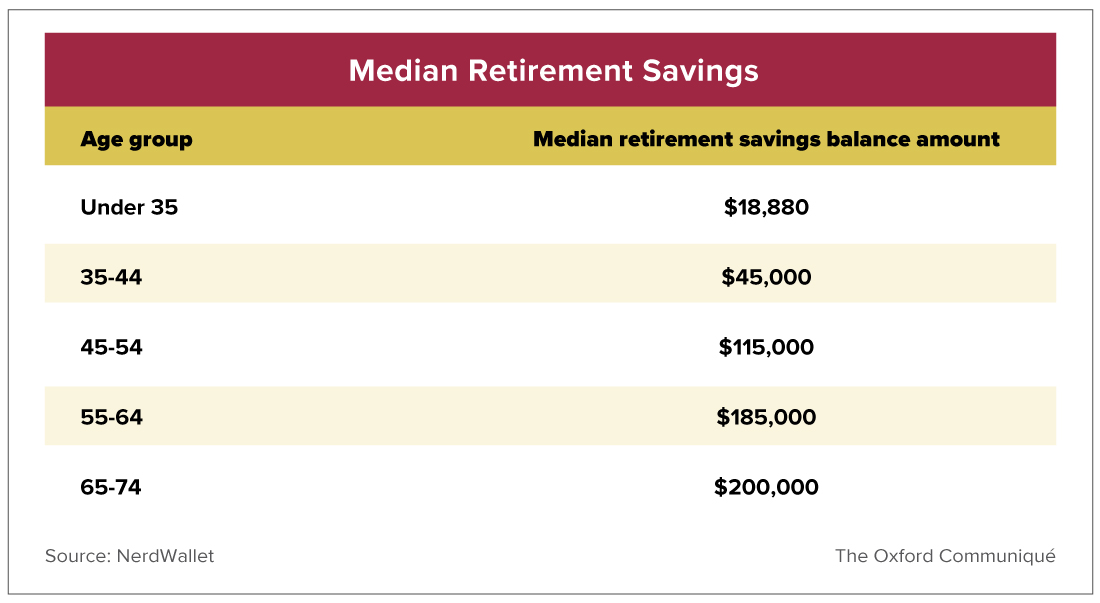
But it could very well be even worse than that…
A recent NerdWallet study found that 60% of Americans don’t have a retirement savings account at all. So those median numbers are indicative of only the 40% of people who do.
And with the economy on shaky terms over the past few years, having enough money to comfortably live out their golden years seems like a pipe dream to many Americans. It may seem like the only way to get ahead is to win the lottery or inherit a fortune from a rich relative.
But the fact is any American can make one move in the stock market and retire on it. I’ve done it three times. Once with Apple (Nasdaq: AAPL) in 1996 and 1997… again with Netflix (Nasdaq: NFLX) in 2005… and finally with Amazon (Nasdaq: AMZN) in 2005 and 2006.
It’s all about buying the right stock at the right place at the right time.
There are always companies on the market with great potential, and I’ve found one that I believe could change your family’s future forever.
It’s called Exscientia (Nasdaq: EXAI), and it could be your ticket to a secure retirement…
The Biggest Medical Advance Since Penicillin
Medical technology has advanced by leaps and bounds since the turn of the 19th century. Life expectancies worldwide have skyrocketed as a result. But each stride made can often be traced back to one technology that unlocked whole new frontiers in medical technology.
In 1796, you have the invention of the vaccine by Edward Jenner. Then you have the first anesthetics going on the market in 1846. And that was all before the development of germ theory in 1861. And then you have the development of the first X-ray in 1895, which opened up the field of internal medicine.
Then you have Alexander Fleming’s penicillin in 1928, organ transplants and stem cell therapy in the 1950s, and antiviral drugs in the 1960s.
But the next advance in medicine could be the biggest of all…
Using AI to develop new drug treatments in faster time frames at lower costs than ever before. Exscientia – founded in Oxford, England, in 2012 – is the premier company using AI to develop new drugs that “no one has ever seen,” as one publication put it.
As it stands, drug development is incredibly time-consuming and expensive. The average cost to develop a new drug across the top 20 global biopharma companies is $2.3 billion, but it can go all the way up to $12 billion. And it normally takes 10 to 12 years for a new drug to get to market. And that’s if it even sees the light of day. A full 90% of new drugs fail in trials.
That’s because modern drug development is an exercise in trial and error. The scientists working for these companies spend countless hours testing thousands of molecules, hoping that one will show promise. But only a tiny fraction of possible drug candidates can actually be tested, and all the other potential molecules have to be binned.
These companies are wasting years and billions of dollars to maybe find a drug that can both help people and make a profit (after recouping the billions of dollars spent on development, of course).
But that’s exactly why Exscientia is using AI to bring about the next big breakthrough in medicine…
Automating the Trial and Error
What Exscientia is actually doing is using the power of AI to rapidly calculate vast quantities of data and produce usable information to develop new drugs. The technology is extremely complex, but Massachusetts Institute of Technology’s own AI can identify effective drug possibilities 1,000 times faster than a human scientist. As technology expert Dr. Peter Diamandis puts it…
What if we could generate novel molecules to target any disease, overnight, ready for clinical trials? Imagine leveraging machine learning to accomplish with 50 people what the pharmaceutical industry can barely do with an army of 5,000.
Welcome to the future of artificial intelligence and low-cost, ultra-fast and personalized drug discovery.
With AI, scientists don’t have to waste time and money testing drug candidates that won’t amount to anything. They can eliminate all the molecules AI rules out and eliminate a lot of trial and error by focusing only on what AI has identified as potentially useful.
AI can potentially reduce the time between concept to product for new drugs. And it can save companies hundreds of millions of dollars that could be better spent developing more new drugs.
It also means more drugs can be developed for rarer diseases. Drugs for the diseases with smaller addressable markets could be produced at lower costs, saving or improving thousands of lives the world over.
AI is even capable of seeing things scientists can’t and dreaming up molecules the human mind never could. Instead of searching for a needle in a haystack, scientists could have the proverbial needle handed to them by a machine that was able to sift through all the straw in a matter of minutes.
The benefit to humanity, and not to mention the profit potential, is enormous.
And Exscientia is the company best positioned to profit from this medical revolution…
A Ghost in the Machine
Exscientia’s proprietary AI is among the most precise and advanced systems in the world. It begins its drug creation process with precision targeting, meaning it uses genetic data and global medical literature to anticipate and confirm disease-target associations.
That means it can identify which populations and diseases will respond best to a particular theoretical drug based on the genetic and environmental associations between the condition a drug is meant to treat and those who suffer from it.
After all, the 8 billion people on this planet are all genetically unique. Some people can smoke for decades and never develop lung cancer, while other people can develop lung tumors without ever so much as a single drag on a cigarette.
Exscientia’s AI can eliminate a lot of the guesswork and identify the environmental and genetic factors that cause disease susceptibility in a given population or individual.
Then, the AI is given genetic samples from a prospective patient, and using those samples, it can generate highly precise views of potential patient responses to a given molecule.
Once potential drug chemical molecules have been identified, the AI can design said molecules down to the atoms and bonds that form them. The machine is capable of considering patient tissue, animal models, 3D data and in vitro screens far faster and with less margin for error than a human scientist could.
The AI can then generate a number of possible molecules to be tested that simultaneously address multiple clinical requirements. It then presents only those that show potential and eliminates any molecules that would be useless to treat a given disease.
Those molecules are tested, and the data is compiled. And then that data is run back through the AI to further refine the potential chemical combinations until an effective drug is developed. Exscientia’s systems can quickly and efficiently explore which chemical avenues are most likely to balance the varied and complex requirements for each drug discovery project.
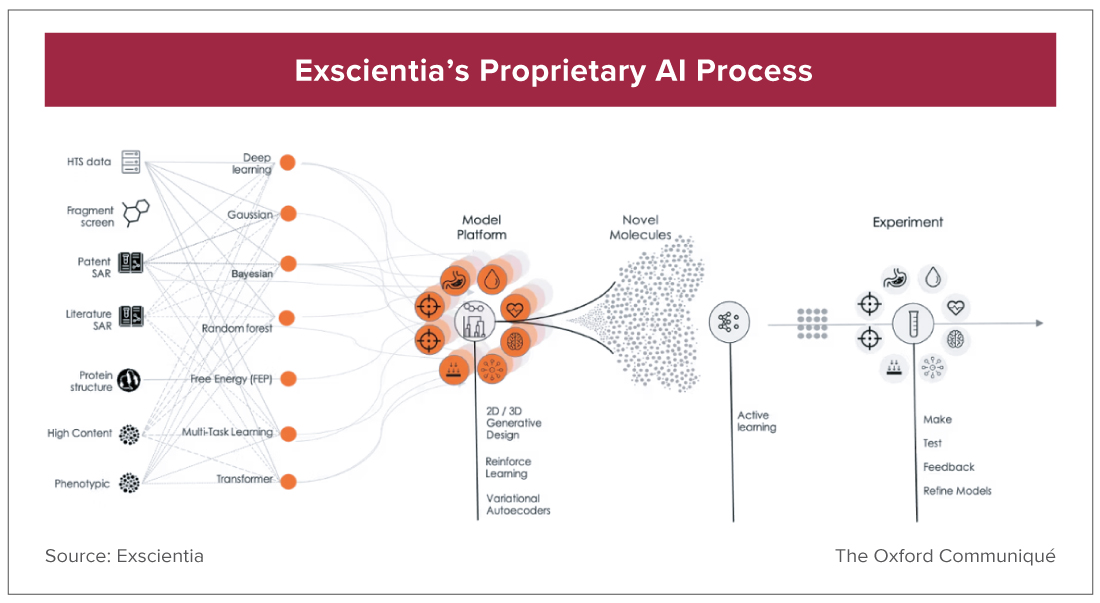
Once promising chemicals are identified, the AI focuses on designing and exploiting only the ones that can produce the best compounds.
It delivers rapid, unparalleled progress from initial drug discovery to a clinical candidate. The AI can do in days or weeks what would take human scientists months or years. The scientists can then take what the AI has developed and further refine it to be run through clinical trials.
Through continual feedback, experimentation and prediction, the AI’s machine learning model can be refined and deliver solutions even against the most complex medical problems.
Put simply, the longer the AI is in use and the more drugs it develops, the more it will learn. The more it learns, the smarter it becomes. And the smarter it becomes, the more capable it will be to solve more complex drug development problems for conditions ranging from cancer to inflammatory diseases.
And the pharmaceutical industry is beginning to catch on to Exscientia’s potential. It has partnered with some of the biggest pharmaceutical companies in the world, and the drugs it’s developing in collaboration with them will be funneling hefty royalty payments into Exscientia’s pockets for years to come…
Friends in High Places
As you might imagine, the incredible technology Exscientia is using has attracted the attention of some major players in the pharmaceutical industry.
French drug giant Sanofi (Nasdaq: SNY) is perhaps the biggest partner Exscientia has landed. The two companies first partnered up in 2019 to improve efficiency and reduce costs in Sanofi’s drug development. The partnership came with a $238 million payment to fill Exscientia’s coffers.
But the agreement clearly paid off for Sanofi, as the company agreed to pay Exscientia to aid in developing 15 experimental oncology and immunology drugs. Researchers will use Exscientia’s AI to identify targets and select payments. The goal is to cut the time to develop these new drugs down from the 10 to 12 years it takes now.
Sanofi paid $100 million upfront, but the milestone payments for successful treatments can go up to $5.2 billion in total, giving Exscientia ample funding for years to come. The top–end royalty rate Exscientia could collect here is 21%. That’s recurring revenue that will continue for decades. And Sanofi is far from the only Big Pharma heavy hitter lining up for a deal with Exscientia.
German pharmaceutical giant Merck (NYSE: MRK) announced an AI drug discovery collaboration project with Exscientia in late September. Exscientia will be paid $20 million upfront for the initiation of three projects and up to $113 million in potential milestone payments in the discovery phase. In all, Exscientia is eligible to receive up to $674 million from those three projects.
Bristol Myers Squibb (NYSE: BMY), one of the largest drug companies in the world that’s known best for the antipsychotic Abilify, signed a $1.3 billion partnership with Exscientia. In exchange for $50 million upfront, up to $125 million for near-term to midterm milestones and tiered royalties on net sales, Exscientia will design new drugs for Bristol Myers Squibb.
Among the most promising drugs to emerge out of this program is EXS4318, a potentially first-in-class protein kinase C-theta inhibitor for treating inflammation.
The drug started development under Celgene, which paid $25 million upfront to Exscientia. But when Bristol Myers Squibb acquired Celgene, it inherited the project and Exscientia was brought to its attention.
And there are several smaller companies collaborating with Exscientia on more niche drugs that could help millions around the world. First and foremost is the company’s partnership with Sumitomo Pharma Co. (OTC: DNPUF), a Japanese pharmaceutical company.
The two have developed a treatment for obsessive-compulsive disorder (OCD) that they managed to take to clinical trials within one year. Normally, that would take five years using conventional drug development methods.
American pharma company Rallybio (Nasdaq: RLYB) is working with Exscientia on some rarer diseases. The most promising at the moment is the ENPP1 program for hypophosphatasia.
It’s a devastating condition that can be life-threatening. It’s characterized by poor mineralization, which can cause malformed and weak bones. In the most severe cases, it causes life-threatening complications in newborns. In cases where it’s not detected until later in a child’s development, it often causes rickets, pain, stunted growth, fractures and mobility issues.
In short, it’s horrible. But Exscientia and Rallybio’s drug could bring relief to the people suffering from this rare condition.
Finally, Exscientia is working with Apeiron Therapeutics to develop a treatment for ovarian cancer. About 20,000 women receive a new diagnosis of this rare but very serious cancer each year, and about 13,200 women die of it annually.
The biggest players in the $1.48 trillion pharmaceutical industry are lining up around the block to partner with Exscientia. But the company is no slouch and also has a slew of its own drugs in production.
Exscientia, which is already developing new treatments for solid tumors, including breast cancer, is a strong partner for Apeiron.
It has also launched its third collaboration with the Bill & Melinda Gates Foundation, this one worth $70 million, to create a portfolio of as many as five antiviral drugs.
Exscientia has near-limitless potential. It costs only about $6 per share at the time of writing, but with the impact this company is making on the market, it could very easily grow exponentially as its drugs are developed and go to market.
And it has a good launchpad from which to make its moonshot…
A Solid Foundation With Room to Build
Exscientia is a young company. It was founded in 2012 but already has more than 30 wholly owned, co-owned and partnered programs in the works. Five of its compounds are in the clinical stage.
On average, Exscientia has 10% royalty rates locked into its contracts for drug development with its partners. That means it can continue to collect 10% royalties from sales of the drugs it’s developing.
For fiscal year 2023, Exscientia brought in revenues of $25.6 million. It also holds $463 million in cash, cash equivalents and deposits to fuel its growth as of December 31, 2023. And it has $6.5 billion in potential milestone payments from its partners to add even more fuel to that fire in the coming years.
But long-term slow growth isn’t why people invest in biotechs. There’s a quirk with these stocks that makes them particularly appealing: catalysts.
A catalyst in the biotech space is news – usually of positive clinical results for a drug in development, a new partnership, the beginning of human trials, Food and Drug Administration (FDA) approval, etc. – that sends a company’s shares skyward.
Two of its drugs are in Phase 1 or 2 clinical trials. The first is EXS-4318, q PKC-theta drug to treat inflammatory diseases. The second is GTAEXS-617, a CDK7 inhibitor for solid tumors. Any positive results from those trials are sure to send Exscientia’s stock surging.
And given that Exscientia reduces discovery time from target identification to trial candidate by 70% and improves capital efficiency in drug discovery by 80%, more catalysts will be coming faster and cheaper for Exscientia and its partners.
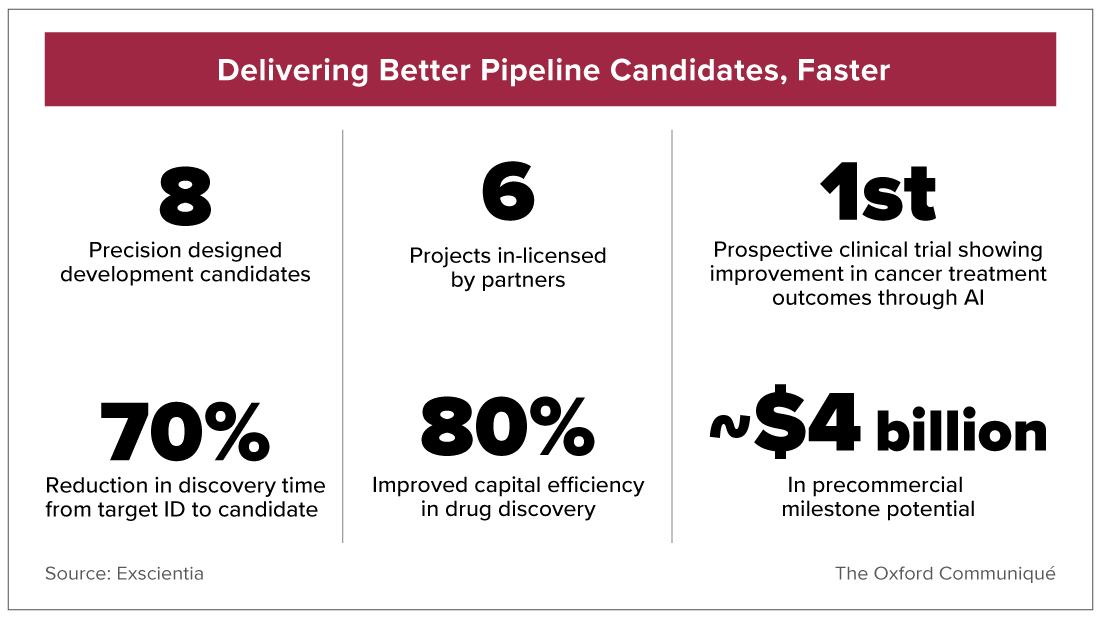
In anticipation of those coming catalysts, institutional investors are piling in left and right…
Wall Street Is Shuddering in Anticipation
The potential here is incredible, and Wall Street has been champing at the bit to buy as many shares as it can to capitalize on it.
BlackRock holds 653,830 shares. Japanese investment giant SoftBank has purchased 5.68 million shares. And the Bill & Melinda Gates Foundation has grown its position to 1.6 million shares.
In all, a total of 25 investing institutions, ranging from mutual funds to trading houses, have bought up nearly $12.4 million worth of shares in the last 12 months. Big things are on the horizon for Exscientia, and Wall Street wants to buy in now while shares are well under $10.
If you’re looking for the right stock at the right place and the right time, Exscientia is it.
And with its price as low as it is, you don’t have to bet the farm on one single stock. In fact, please do not do that. When you get in for just a few dollars per share, a small investment can go a long way.
That’s been my strategy for the biggest successes in my own portfolio. And now it can be yours…
How to Buy the Stock to Retire On
Fortunately, there’s no trick to buying Exscientia. It might be based in the U.K., but it’s listed on the Nasdaq in the U.S., so you can buy it through nearly any broker available in the U.S.
If you already have a brokerage account, buying shares of Exscientia is as simple as going to your broker and ordering shares by phone or online.
However, if you’ve never bought a stock before, buying your first one can be an intimidating process. But it doesn’t have to be. These days, with readily available brokers that often charge no commission and cater to every level of investing, it’s easier to get into the stock market than ever.
You can shop around online to find the broker that works best for you, but any will do. If you want a basic, bare-bones trading app that will let you buy and sell stocks, options, crypto, etc., you might try Robinhood or Webull. If you want something a bit more involved, you should check out Charles Schwab, Fidelity or TD Ameritrade.
No matter what broker you pick, the process for signing up for an account is pretty simple. All of them will require some personal information from you, like your demographic data, occupation, Social Security number, etc. But the process to sign up is usually as simple as following on-screen prompts.
Once you’re approved to trade, you’ll need to link a bank account to your brokerage account and transfer some funds over to buy shares. Then it’s as simple as selecting the stock you want, choosing how many shares you want to buy and clicking “Buy.”
It’s that simple, which is just another reason to buy Exscientia today…
Now, one thing to note is how biotech stocks work and the importance of patience here. Exscientia is a long-term play. Even with AI, drug development takes time…
Biotechs tend to get cheaper while they are in the development phase. They’re spending money to develop drugs, and they aren’t taking in much revenue. But when they release positive results from clinical trials or a new drug hits the market, their prices can surge.
Right now, Exscientia is in the development phase more often than not, but as its projects go through clinical trials and get approval from the FDA, its share price will grow… fast. The time to get in is now… while Exscientia is trading at bargain prices.
Action to Take: Buy Recursion Pharmaceuticals (Nasdaq: RXRX) at market.