 You are now logged out.

The Ultimate SpaceX Pre-IPO Play: Get in Before the Big Launch
Editor’s Note: SpaceX IPO’d on June 12, 2026. The report below, published in February 2026, highlights what Dr. Mark Skousen identified as the ultimate play to profit from this major development. But, as he explains, “This is not just about a single IPO date.” It’s a long-term opportunity. View the report as it was originally published below.
The biggest IPO in history is almost here…
After years of building SpaceX from the ground up, Elon Musk is finally taking it public, with the IPO now expected on June 12.
And just like the company’s products, profits for the public company could go to the moon and beyond.
Estimates show the company could raise a record $50 billion on its IPO date and command an immediate valuation of roughly $2 trillion.
That would be the largest amount raised by an IPO on the American exchanges – and by a huge margin. The current record for an IPO is Alibaba, raising $25 billion and creating a valuation of $169 billion.
SpaceX will be nearly 10 times that size on day one.
The IPO is going to make many people rich, but not if you buy on the first day of trading.
The real money is made by the investors who get in early… before the IPO.
And with June 12 fast approaching, some investors may think they’ve already missed the opportunity.
But the reality is…
We are still in the sweet spot before the IPO frenzy fully takes hold.
Historically, the biggest wave of retail speculation doesn’t happen until the final days leading up to a major public debut – and often accelerates once nonstop financial media coverage begins.
That means investors positioning themselves today may still have a rare opportunity to gain exposure before the broad public rushes in.
More importantly, this is not just about a single IPO date.
SpaceX is building what could become one of the most important technology ecosystems of the next decade – spanning satellite internet, AI infrastructure, orbital computing, and global communications.
So while June 12 could act as a major catalyst…
The long-term opportunity may still be in its very early stages.
You see, a funny thing tends to happen when a company goes public…
Its stock opens, immediately shoots up in the first few minutes, and then spends the next few days, weeks, or even months collapsing.
We saw this pattern with Circle, CoreWeave, and Figma in 2025.
One of the latest examples is Bullish, which had its IPO on August 13, 2025. The company set the value at $37 a share when it went live at 1 p.m., raising roughly $10 billion.
Then, blast off…
The first publicly traded shares were sold to normal retail investors for $90 a few seconds later. Then, within 10 minutes, the price hit a euphoric high of $118 a share.
But that’s where the IPO stalled…
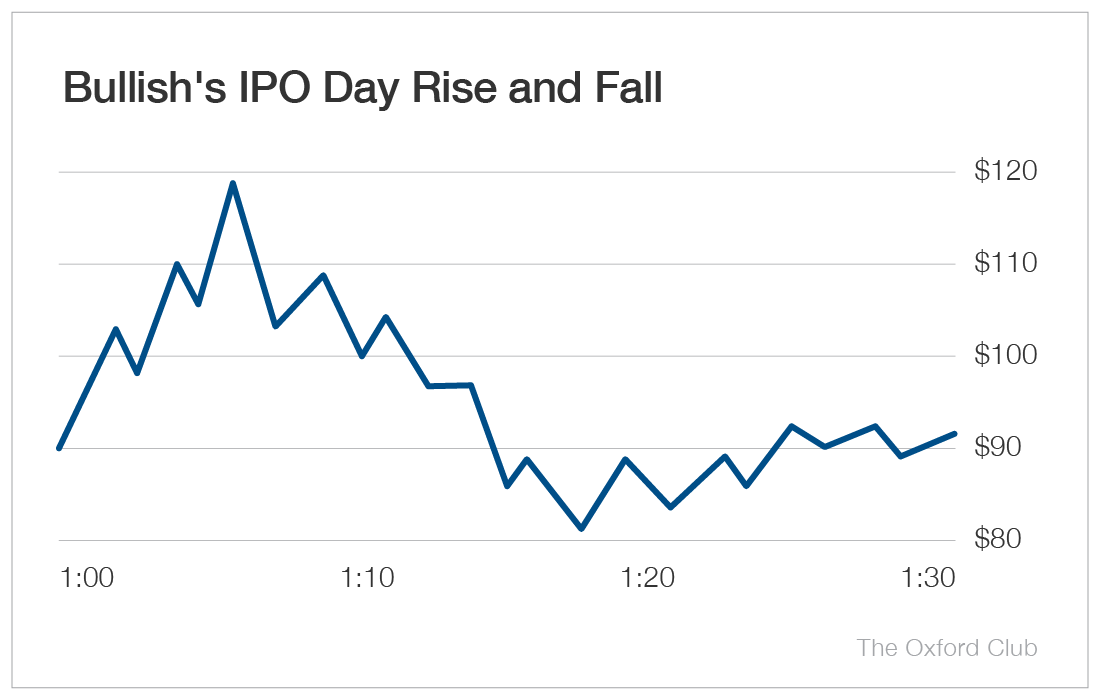
Everyone who got in before the IPO began selling their shares to lock in profits. The stock ended the day at $73.
Six months after the IPO, the stock traded for $30 a share.
So other than short sellers, the only people who made money on Bullish were those who got in before the IPO happened.
The problem is pre-IPO shares for hot companies can be nearly impossible to get for the average investor. Not only do you need to be an “Accredited Investor” with at least a million dollars in assets, but you often also have to make a sky-high minimum investment to get a stake.
But there is a way to get into SpaceX today that most investors don’t know about.
First, let’s review why everyone wants a piece of SpaceX right now.
No Limits
Space exploration has exploded in the last half-century.
It’s incredible to think that humans built the first airplane only around 120 years ago.
Just about 60 years later, we landed on the moon.
Those first space flights were fueled by human ingenuity, massive government funding, and some intense competition from the Soviet Union.
And the U.S., Russia, and other countries began filling the skies with satellites and a permanent space station.
But after those first flights to the moon, many NASA-based programs were gradually shut down. The last mission of the space shuttle program ended in 2011.
And for several years, the United States had no manned space missions. The cost was just too high.
Enter SpaceX, which revolutionized space travel by creating reusable rockets.
When NASA launched rockets and spacecraft into orbit, much of each rocket’s parts were designed to fall in the ocean, never to be reused.
Imagine if you needed to replace half of your car’s engine every time you drove to the store!
But Musk and his team found a way to have the rocket parts return to the launch pad to be used over and over again.
This is why NASA now uses SpaceX for most of its projects.
In fact, NASA is SpaceX’s biggest customer, spending $3.4 billion in 2024 alone on SpaceX missions – like resupplying the International Space Station and the Artemis moon exploration project.
But SpaceX’s biggest revenue generator is the network of low-flying satellites that create the Starlink Network.
Starlink is SpaceX’s answer to the demand for data and internet access worldwide. Many in the U.S. use fiber optic cables for internet access, but Starlink offers access in remote areas where running cable doesn’t make sense.
This includes many oppressed countries, like Iran and Venezuela, where Starlink can function when the government shuts off local internet access.
And it’s a big business. Starlink is expected to generate $10 billion to $12.4 billion in revenue this year. That’s roughly 75% of SpaceX’s top line.
The company is also the go-to for many commercial ventures looking to launch satellites for their own networks, adding another $3 billion to $4 billion in revenue.
It continues to grow too. Starlink revenue for 2026 is expected to hit $22 billion to $24 billion. That’s a 53% increase in one year.
And as the SpaceX IPO approaches, Musk made another bold move – merging SpaceX with xAI, his artificial intelligence company. That merger values SpaceX at $1.25 trillion.
The move is meant to help streamline data center development in space.
As you likely know, data centers gobble up tons of energy just for cooling purposes. So building them in the freezing temperatures of orbit could significantly lower energy costs.
It’s called the Orbital Data Center project, and it will rely heavily on Starlink’s preexisting network to allow data to flow from the data centers in space to all of us back here on Earth.
And demand for data centers just keeps going up…
We’ve seen companies like CleanSpark, Cipher, IREN, CoreWeave, and more convert from crypto mining companies to data computation service providers.
Overall, it’s estimated that $5 trillion will be spent on AI infrastructure by 2030.
And based on chip orders, Nvidia believes that annual spending on data centers alone could be between $3 trillion and $4 trillion just four years from now.
Now Musk sees a way to economize the AI revolution in space, where the freezing temperatures will provide a natural solution to cooling.
Plus, by putting the data centers high enough in space – where sunlight can be constant – they can utilize solar technology to keep the data centers running efficiently.
So between more efficient data centers, better AI design, and more worldwide access to data, we are seeing what some have described as consolidation into the “Muskonomy.”
Musk is not just the creator of an electric car company anymore. He’s at the forefront of the AI revolution with all the elements to profit from it.
And SpaceX is the key to it all.
With all these advancements happening quickly, it’s no wonder everyone is clamoring to get in now.
But unless you’re an accredited investor, how can you have a chance at the type of returns pre-IPO investors are bound to rake in?
One way is through a fund that already holds a massive stake in pre-IPO SpaceX shares.
The Ultimate SpaceX Pre-IPO Play
One such fund is the Baron Partners Fund (Nasdaq: BPTRX).
To date, 29% of this fund is made up of pre-IPO SpaceX shares, representing $9.7 billion in total investment.
Better yet, the fund gives us access to Tesla, Hyatt Hotels, Charles Schwab, MSCI, Arch Capital, and more.
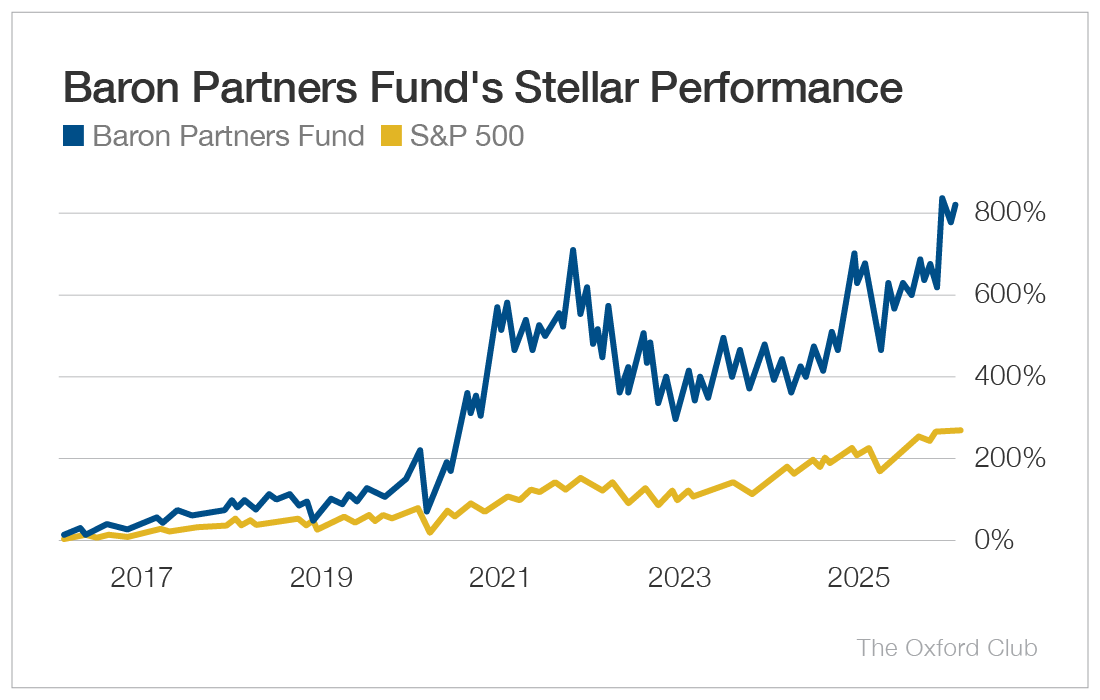
As I write, the fund is up over 30% in the past year – double the return of the S&P 500 over the same time period.
Over the past 10 years, the fund is up an incredible 819%… compared with 272% for the S&P.
And it paid out two large dividends in 2025 totaling over $8 a share – for a yield of over 3%.
But the Baron Partners Fund is not just about pre-IPO opportunities. It has a history of making good early investments.
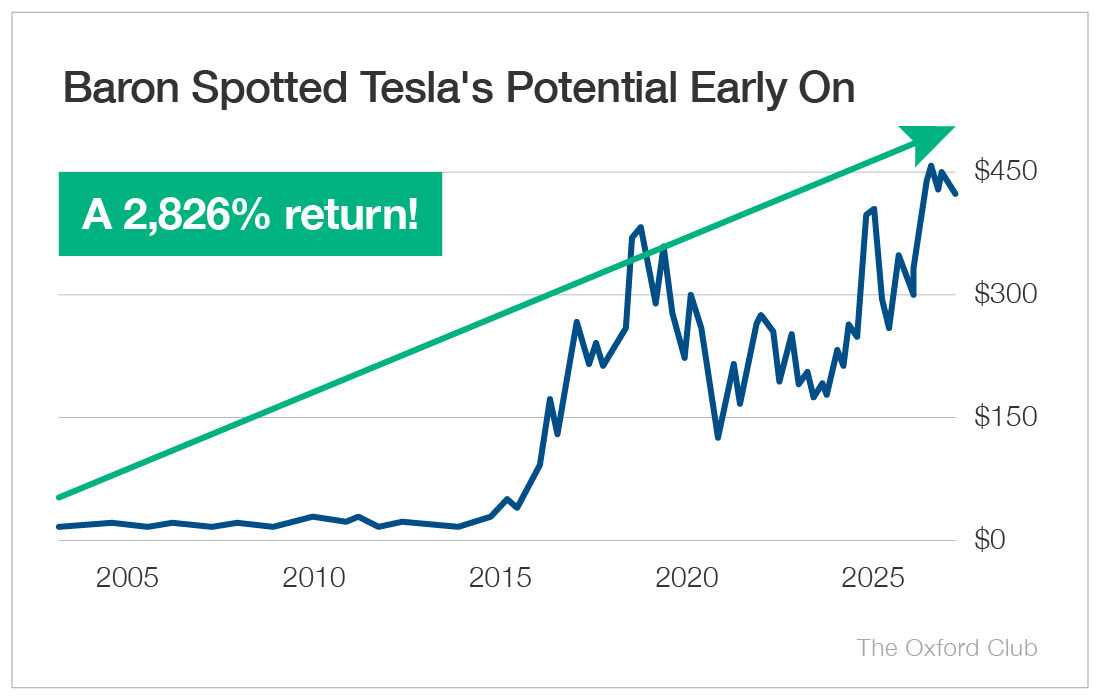
Baron became a huge backer of Tesla starting in the first quarter of 2014.
Tesla’s price at the time, split-adjusted, was just $15.
That’s a return of 2,826%!
Today, the fund’s large stake in SpaceX provides investors with rare exposure to one of the most anticipated IPOs in history.
But it’s important to understand…
This is not just a short-term trade tied to the SpaceX IPO.
Baron has a long history of identifying transformational companies early – and holding them as they grow over many years.
In fact, it’s an investment that has worked out very well for me personally and for subscribers who followed my recommendation in the past. Based on SpaceX’s growth prospects and its massive pre-IPO stake in the company, I remain extremely bullish on the fund today.
And I will remain bullish on it well beyond the IPO of SpaceX.
That’s because the same strategy that led Baron to SpaceX – and earlier to Tesla – continues to position it for future winners.
So while the upcoming IPO could act as a major catalyst…
The real opportunity here is the fund’s ability to compound returns over the long run.
Recommendation: Buy the Baron Partners Fund (Nasdaq: BPTRX) at market.
Two Important Caveats About Baron Partners Fund
Now, there are two things you should know before you invest in Baron Partners Fund.
- Investment Minimums
Depending on your brokerage, the minimum investment can be around $2,000 or more.
That may not be a dealbreaker for many investors… but it does limit access for smaller accounts.
- Not Available on All Platforms
The good news is that most major brokerage firms – like Fidelity, E*TRADE, Charles Schwab, and Merrill Lynch – do allow you to purchase BPTRX.
However, some other platforms – including Robinhood and smaller brokerages – do not support trading this fund.
It’s also worth noting…
Baron has been known to turn away individual investors who try to invest directly through them.
So your best bet is to go through a traditional brokerage account, where shares can be purchased just like any other mutual fund.
A BONUS SpaceX Pre-IPO Play
If you can’t access Baron… or if you want to complement that position…
There is another opportunity worth considering: ERShares Private-Public Crossover ETF (Nasdaq: XOVR).
Unlike Baron, which is best suited for long-term investors looking to hold transformational companies for years…
XOVR may be better suited for shorter-term traders who want exposure to the growing momentum surrounding SpaceX and other late-stage private companies ahead of major catalysts like IPOs.
The ETF is designed to provide investors exposure to private companies before they go public, alongside innovative publicly traded firms operating in similar high-growth areas.
That includes companies operating in many of the same high-growth areas driving SpaceX’s future:
- Satellite networks
- Data infrastructure
- Artificial intelligence
- Global communications
And that’s important…
Because SpaceX is no longer just a rocket company.
It’s building a massive ecosystem through Starlink, AI integration, and orbital infrastructure.
Notably, SpaceX exposure inside XOVR has now grown to just over 20% of the portfolio.
That elevated weighting is largely the result of fund flows and the structure of private holdings inside the ETF.
When investors redeem shares from a fund:
- The manager typically sells the easiest assets first
- Public stocks can be sold quickly
- Private holdings like SpaceX generally cannot
As a result, the publicly traded positions may shrink faster than the private positions during periods of outflows – causing SpaceX to represent a larger percentage of the remaining portfolio.
For traders looking to capitalize on increasing speculation ahead of the SpaceX IPO, that dynamic could make XOVR especially attractive in the weeks surrounding the public debut.
And unlike some private investment vehicles, there’s no large investment minimum required.
Recommendation: Buy the ERShares Private-Public Crossover ETF (Nasdaq: XOVR) at market.
The Bottom Line
The SpaceX IPO has the potential to be one of the most important financial events of the decade.
We’re talking about a company at the center of multiple massive trends:
- Global internet through Starlink
- The explosion in AI and data infrastructure
- The future of space-based computing and communications
And as history shows…
When companies of this scale finally go public, the biggest gains are rarely made after the headlines hit.
They’re made by those who are positioned before the IPO ever happens.
Right now, investors have a rare window to gain exposure ahead of what could be a trillion-dollar debut.
Opportunities like this don’t come around often.
And with June 12 now on the calendar, that window is beginning to narrow quickly.
But importantly, it has not closed yet.
Investors still have time to position themselves through funds with meaningful pre-IPO exposure before Wall Street’s full attention turns toward SpaceX.
Once the IPO arrives and the media frenzy begins, gaining this kind of indirect exposure could become far more difficult – and potentially far more expensive.
That’s why the next several days may represent one of the final opportunities to act before the biggest IPO in modern market history officially launches.