 You are now logged out.

How to Build a Million-Dollar Portfolio From Scratch
The Investment Secrets of Superior Investors: How They Maximize Profits and Minimize Losses

It may surprise you that numerous surveys of investors indicate that most people think of themselves as logical and rational, weighing risks against rewards in order to maximize value and profit for themselves.
And when they make investment decisions, they think they’re being intelligent, analytical, thorough individuals with perfect self-control in pursuit of their goals – unaffected by emotions and feelings.
Talk about delusional… These people are pulling the wool over their own eyes!
Unfortunately, when it comes to investing, most of us have almost none of these ideal investor qualities. In fact, it’s highly likely you have many self-destructive investment habits that you may not even be aware of.
Don’t despair. It’s nothing to be ashamed of.
As you’ll soon see, we’re all guilty of bad investment habits. However, do understand that your bad habits are costing you money.
More importantly, understand that successful investing involves only a few real secrets. Almost all of the world’s best investors use the same basic principles. Learn them and quickly get yourself on the way to building a million-dollar portfolio.
Secret #1: Use a Proven, Time-Tested Investment Strategy
For starters, can you admit that you have some self-destructive investment habits? Or, at the very least, confess that you’ve made several “boneheaded” investment mistakes in the past that could have – and should have – been avoided? Well, you’re not alone. Unfortunately, most of us are making the same mistakes… over and over again.
We’re not psychologically wired to make rational decisions with our money. We’re actually foolish, sentimental, illogical and badly flawed.
According to behavioral economists, we say we’re going to do thorough research, pick fundamentally solid companies and remain logical about our decision to sell. And we mean it. But then we do no such thing!
Without going into the gory details, study after study shows that nearly all individual investors make irrational stock market decisions, thanks to factors like regret avoidance, which explains why you do “nothing” with your current portfolio; hindsight bias, which explains why you think you’ve done a remarkable job managing your portfolio – even when you haven’t; and loss aversion, which explains your reluctance to sell losing positions.
The fact is, what drives a lot of investors’ behavior is not simple, rational greed, but a desire to avoid feeling stupid!
It turns out we feel worse when we make dumb moves than when we fail to make smart ones. Behavioral studies completed at the University of Chicago even determined that “losing money feels twice as bad as making money feels good.”
So the first step toward improvement is admitting that, most likely, you’re no “ideal investor,” and that you’d better start doing things differently if you want to build a million-dollar portfolio.
At The Oxford Club, we follow an investment formula that won Harry Markowitz, Ph.D., the Nobel Prize in economics in 1990. Since we started using this formula, combined with The Oxford Club’s investment philosophy, we’ve achieved remarkable results.
Secret #2: You Must Asset Allocate Your Portfolio
At the heart of Markowitz’s formula is asset allocation.
Those two words represent the holy grail of investing. They’re the secret of how so many of our longtime Members got rich and stay rich.
Quite simply, asset allocation is the process of determining the most effective, optimal mix of investment opportunities, including stocks, bonds, cash and real estate, arranged in a diversified mix that suits your investment style, your risk tolerance and how fast you need to cash in returns.
How important is asset allocation? Extremely.
Ibbotson Associates, a highly regarded financial research firm, did a study to identify the primary reasons for the success or failure of different investment portfolios. The answers it came up with certainly weren’t what Wall Street wanted to see. It found that only 5% of investment returns could be explained by “investment selection.” Far more importantly, it found that asset allocation accounted for nearly 90% of investment returns!
Let’s take the first steps to breaking down your total investment funds into asset classes. An asset class is a group of securities that have similar financial characteristics. There are a lot of asset classes available today. But the five principal types of long-term investments are stocks, bonds, real estate, precious metals and cash (meaning highly liquid and secure short-term instruments such as T-bills, money market funds and CDs). When astutely mixed together, they can smooth out the volatility (or variability) of your returns – even while increasing them!
And that’s the whole point of proper asset allocation.
Investors who are looking forward five to 10 years or more should consider something along the lines of:
- 60% stocks
- 20% bonds
- 10% cash/Treasurys
- 5% precious metals
- 5% real estate.
Mastering the Rebalancing Act
So what happens when one asset class does extremely well while another does poorly? Do you abandon the “dog” and put more money in the top performer? Quite the opposite.
You rebalance your asset allocation only once every 366 days. This way, your moves will qualify for long-term capital gains tax rates. When your annual reallocation date arrives, simply reset your portfolio to how it was originally established.
At the end of each year, you sell off enough of the appreciated asset classes to return them to their predetermined allocated level. This strategy has some very powerful advantages.
For one thing, it requires you to always sell high and buy low – something that eluded a great number of investors during the dot-com and real estate crashes of the recent past.
Asset allocation is not a market-timing tool. Yet it can, and should, take into account everything from current market conditions and falling interest rates to whether the economy is slowing or expanding rapidly.
Having said that, if you find yourself at the tail end of a bear market and you want to reallocate your portfolio before or after the suggested 366 days… go ahead and take advantage of the situation.
Who doesn’t like to grab a bargain if the market is holding a sale?
Secret #3: Never – Ever – Lose Big Money in the Stock Market
Buying stocks is easy. The hard part is knowing when to sell. But it’s essential to building a million-dollar portfolio.
For investors who lose money, the biggest reason is usually a failure to protect profits and cut losses. Many investors are unaware that they can do that by using a safe and effective strategy: the trailing stop, or what we refer to as our “safety switch.”
While most investors think of trailing stops as “stop losses,” that’s only half the story. Trailing stops also help us protect our profits as our investments move up.
The main element of The Oxford Club’s trailing stop strategy is a 25% rule. We will sell positions in our shorter-term-oriented Oxford Communiqué Oxford Trading Portfolio at 25% off their closing high since we purchased the stock. For a stock purchased at $10, your initial stop is $7.50. Over the next several months, if the stock moves higher, you periodically raise your trailing stop to correspond with the new highs.
So if the stock’s highest close is now $15, your trailing stop is $11.25 (15 multiplied by 0.75), virtually assuring you of a profit if the stock drops. However, let’s say the stock continues to meander higher and now has a closing high of $25, making your stop $18.75. At this point, imagine the stock runs into unexpected trouble. Shortly thereafter, it closes below $18.75, triggering your sell stop. (We also base our sell decision on the closing price, not intraday prices.)
All great traders and investors consistently cut losses short and let their profits run, and The Oxford Club has found that trailing stops are one of the easiest and most effective ways of doing that. Let me add that there is no “magic” to a 25% trailing stop. That’s what we use at The Oxford Club, but you can use whatever percentage you are comfortable with. The important point is to have an exit strategy, and a designated trailing stop is a great discipline to help you stick to it.
(Note: Two of our recommended portfolios in The Oxford Communiqué – the Oxford All-Star Portfolio and the Gone Fishin’ Portfolio – do not use trailing stops. They use a “rebalancing” strategy suited for those investors with a long-term-oriented approach.)
Secret #4: Size Does Matter… Understand Position Sizing
Position sizing is the technical term that answers the question of “how much.” Essentially, position sizing means determining how big a position any single holding in your portfolio should be.
We know nothing about your individual net worth, investment experience, risk tolerance or time horizon. But we do have a position-sizing formula you can use to determine how much to invest in a particular stock: no more than 4% of your equity portfolio. That way, using The Oxford Club’s suggested 25% trailing stop, you never have more than 1% of your portfolio at risk in any given position.
One of the main reasons to have a position-sizing strategy is to help you have equal opportunity and equal exposure across the portfolio.
If you want to be conservative, invest less. If you want to be aggressive, invest more. But not too much more. If you have a stock that seems to have a much higher probability for success, then maybe invest a little more… but again, not too much.
The saddest stories we hear in the financial press are those of people who took a serious financial hit late in life because they were overconfident. In short, they liked an investment so much they plunked too much into it. Big mistake.
Yes, you could hit the jackpot that way, and we suppose some people have. But that’s a roll of the dice, and we don’t recommend it.
Secret #5: Exploit Clear Trends
At The Oxford Club, we spend a great deal of time trying to identify very clear trends that are likely to shape the economy over the next decade. Once a trend is identified, we analyze specific companies that we think will be big beneficiaries of that trend. From that group, we narrow it down to the best of the best, and these stocks become our recommendations for The Oxford Club’s portfolios.
We seek out sectors that have tremendous growth trends behind them. That means they will persist regardless of what’s happening in the economy right now, regardless of the Federal Reserve’s next move and regardless of the estimates for the next few quarters.
During the last several years, The Oxford Communiqué has focused on these trends, which have already brought us some of our best individual stock gains. But there are plenty more double- and triple-digit gains to be had if you just know where to look…
Secret #6: Cut Investment Expenses and Leave the IRS in the Cold
For example, we opted for the closed-end Templeton Emerging Markets Fund (NYSE: EMF) instead of the open-end Templeton Developing Markets Fund. Both funds invest exclusively in emerging markets.
Both were run by Mark Mobius, the top manager in the sector, until he retired in late January 2018. In the years since, his successors have kept things growing fast.
The Templeton Developing Markets Fund has a high front-end load. The Templeton Emerging Markets Fund – like all closed-end funds – has none.
In fact, there is nothing in our portfolio that has a front-end load, back-end load, 12b-1 fees or surrender penalties.
Furthermore, you can act on any of our recommendations through a no-load fund company or a deep-discount broker.
In short, we’re cutting portfolio expenses to the bone. Lower investment costs are the one surefire way to increase your net returns.
Five Tax-Managing Tips
But another way is to tax-manage your investments. That means handling your portfolio in such a way that reduces the IRS’ cut.
Here’s how you do it:
- Stick to quality. Higher-quality investments mean less turnover, and less turnover means less in capital gains taxes. The less you trade your core portfolio, the fewer tax liabilities you incur. As Warren Buffett warns, “The capital gains tax is not a tax on capital gains, it’s a tax on transactions.”
-
Try to hang on for at least 12 months. Anything sold in less than a year is a short-term capital gain, taxed at the same rate as ordinary income. At the federal level, that can be as high as 37% or 40.8% once you include the 3.8% Net Investment Income Tax (NIIT). Add in the highest state and city taxes (New York and New York City), and the bill can climb to 55.6%.
By contrast, long-term gains are far more favorable. The top federal rate is 20%, or 23.8% with NIIT. Even in New York City, the maximum effective rate is about 38.6%. Better yet, do your short-term trading in an IRA, where gains are sheltered from taxes altogether.
-
When you stop out in less than 12 months, offset your capital gains with capital losses. The IRS allows you to offset all of your realized capital gains by selling any stocks that have joined the kennel club. You can even take up to $3,000 in losses against earned income. Not selling your occasional losers is not only poor money management but also poor tax management.
- Avoid actively-managed funds in your non-retirement accounts. Managed funds often have high turnover, and federal law requires them to distribute at least 98% of realized capital gains each year. You can get hit with a big capital gains distribution even in a year when the fund is down. In parts of Texas, this is known as the “double whammy.”
- Own high-yield investments in your IRA, pension, 401(k) or other tax-deferred account. There’s no provision in the tax code to offset your dividends and interest. So do the smart thing: Own big income-payers like bonds, utilities and real estate investment trusts (REITs) in your IRA.
Your remaining choices are simple ones like owning tax-free bonds rather than taxable bonds if you reside in the upper tax brackets.
If you reduce your annual investment expenses and tax-manage your portfolio, the effects will be dramatic. For example, The Vanguard Group conducted a study that indicates that the average investor gives up 2.4% of their annual returns to taxes. If you trade frequently, the percentage is likely much higher. We can also estimate that most investors give up at least 1.9% a year in commissions, management fees, 12b-1 expenses and other costs.
Time Is Money
The old expression “Time is money” is particularly true in investing. Some experts think time is the most important factor in investing. The reason is compounding.
Each year, you earn a return on your original investment. And as time goes by, you also earn a return on those returns. That’s the power of compounding.
But remember: Compounding can also work against you. A few percentage points lost every year to taxes, fees, or commissions makes a massive difference over time.
What counts is your purchasing power – after expenses, taxes, and inflation. By keeping expenses low (around 0.3% annually) and tax-managing your portfolio, you can retain an additional 4% of your returns every single year.
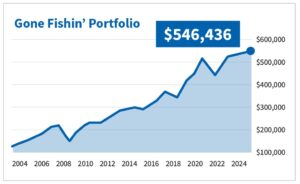
The U.S. market has returned roughly 10% annually for the past 200 years. The chart above shows how a $100,000 stock portfolio grows at that rate using our cost-efficient, tax-managed strategy.
The result? After 20 years, the portfolio compounds to $546,436. That’s more than five times your original investment — achieved without taking on extra risk or chasing higher returns.
And for investors starting with larger amounts, the difference is staggering. A million-dollar portfolio following the same strategy compounds into more than $5.4 million.
This isn’t the result of picking the “perfect” stock. It’s simply the power of compounding — when you let your money grow without letting taxes and expenses eat away at it.
Secret #7: Have a “Rainy Day” Investment Stash
Many of the investment books for beginners tell their readers to keep three months’ pay in a savings account in case a layoff or an unexpected medical expense occurs. Good advice if you just want to keep up with your bills. But it falls short if you want to become a successful investor.
What if an ugly bear market rears its head? Do you have any reserves to handle that? Most likely, no!
Good financial planning means not only having a rainy day fund for unexpected family emergencies – but also having a stash of cash to handle unexpected stock market turbulence.
Being fully invested is a common mistake that many investors make. You should always have cash on the sidelines ready to put to work. The tail end of a bear market is a fantastic time to pick up some beaten-down bargains.
Having that cash will be the difference between a mediocre portfolio and an outstanding one.
There’s still money to be made in the throes of a bear market… if you can keep your head while everyone else is losing theirs. Stick to our investment formula: Asset allocate, use position sizing, use trailing stops and exploit clear trends. In a bad downturn, you’ll start hitting trailing stops and get knocked out of many of your positions – but don’t despair. You are preserving capital and building cash to use when the next bull market begins.
We don’t recommend averaging down in a prolonged bear market. Instead, wait for stocks to hit bottom and start working their way back up. You may miss investing at the bottom, but you’ll also avoid repeatedly averaging down. And if the next bull market cycle is truly underway, there’ll still be plenty of upside left. This is a good method of systematically getting your cash back in the game.
If you don’t currently have an investment stash and you find yourself in the midst of a bear market, there are some ways to quickly remedy this situation.
- If you’re still working, consider increasing the percentage of your pay going into your 401(k). Allocate this new money to some domestic and international index funds. You’ll be buying low and reaping the rewards in the next bull market.
- Max out your eligible IRA contribution. Most IRA custodians will let you do this using a systematic investment plan, which allows you to invest a small amount each month. Put the funds into your self-directed brokerage account, or periodically buy into stocks on your watch list. Your capital gains will accumulate tax-free.
Mind you, once the market starts heading up again, we’re not investing in any old beaten-down stocks – we’re moving into stocks from our watch list.
This brings up another key point about maintaining an investment stash. Always keep a watch list of stocks you’re following. Your watch list should contain companies you have a high level of confidence in — businesses you’d like to own at the right price.
Market pullbacks speed up this process, often dragging down excellent companies to bargain levels. We saw this most recently in 2022, when rising interest rates and recession fears pushed dozens of high-quality companies — including leaders in technology, energy, and healthcare — to multi-year lows. Patient investors who bought those dips have since enjoyed substantial rebounds as the market surged to new record highs in 2025.
Start Creating Your Own Million Dollar-Portfolio Right Now
Like the direction of your life, your financial future is largely decided by the decisions you make along the way. One of the most important investment principles you need to comprehend is that nobody can outsmart the market. Nor can you predict what stocks will do in the short term.
But The Oxford Club’s experts and Research Team have been using these seven secrets for years to generate market-beating returns in every type of market. Along the way, we’ve helped Members build million-dollar portfolios. They’ve told us so in numerous testimonials we’ve received. And we hope to do the same for you.
Fact is, we’re more than happy to continue to do the heavy lifting for you, bringing high-quality investment ideas to your attention. But it’s essential for you to realize that the basis for our success – as well as that of countless Oxford Club Members and the world’s best investors – boils down to these seven investment secrets or principles… principles you can easily use and put into action in your own portfolio.