 You are now logged out.

Nvidia’s Secret Partner: This Single AI Stock Could Help Fund Your Retirement

Artificial intelligence is transforming nearly every corner of modern life – how we work, learn, diagnose disease, design products, communicate, and interact with technology. In just a few short years, AI has shifted from a futuristic concept to a central force reshaping the global economy.
But behind the stunning pace of progress sits a structural challenge almost no one outside the semiconductor industry is talking about. In fact, it’s one of the biggest limiting factors to AI’s expansion.
AI hardware is hitting the limit of what today’s semiconductor infrastructure can support.
Nvidia’s newest chips – including its ultra-powerful Blackwell architecture – deliver unprecedented computational performance. These GPUs are designed to train and run the world’s largest AI models, from advanced robotics to foundational language models like GPT-5.
But all that performance comes with a cost.
The heat, energy demand, and data-transfer requirements of these advanced chips are now so extreme that the connections between chips have become the bottleneck. Traditional link technology simply cannot handle the speed or volume of data moving between GPUs.
And when the connections fail, the entire AI system slows, overheats, or breaks down.
This is the growing problem inside every major AI data center, supercomputer cluster, and GPU-driven research lab around the world.
And it’s precisely where a little-known company – one now working directly with Nvidia – has stepped into the spotlight.
The Quiet Company Solving AI’s Biggest Hardware Problem
That company is Astera Labs (Nasdaq: ALAB).
Astera has quietly developed the essential technology that allows next-generation AI systems to operate at full speed – without melting down the hardware around them. While Nvidia builds the “brains” of AI, Astera builds the wiring and connective tissue that allow those brains to actually function.
In many ways, Astera is becoming the pick-and-shovel provider for the AI boom – a foundational supplier whose technology is embedded inside nearly every large-scale AI deployment happening today. And its role is becoming more important with every new data center buildout.
AI models run on clusters of GPUs and CPUs. And as these chips get faster, the bandwidth and data-integrity demands placed on the links connecting them rise exponentially.
Without a new way to move massive volumes of data quickly and efficiently between chips, even the most advanced GPUs underperform – or fail outright.
Astera Labs is the company solving this mission-critical problem.
Its hardware enables thousands of high-performance AI chips to communicate seamlessly without loss, lag, overheating, or signal collapse. The company’s Aries, Taurus, Leo, and Scorpio product families expand bandwidth, improve data integrity, and reduce energy waste – the three factors now determining whether large-scale AI models can run reliably.
This is exactly why Amazon, Intel, AMD, and – importantly – Nvidia have partnered with Astera Labs. And it’s why nearly every major cloud provider is integrating its technology into new AI-optimized data centers.
In short: Astera has become foundational to the future of AI hardware.
Astera’s Rapid Growth (and Why Big Money Is Backing It)
Although Astera Labs only went public in 2024, the company has already established itself as one of the most important young firms in the semiconductor ecosystem.
According to company filings, Astera generated $115.8 million in revenue in 2023, up 45% from the prior year. That alone would be notable for a hardware company still in the early stages of scaling production.
But the story gets far more compelling.
In 2024, Astera’s revenue trajectory accelerated dramatically:
- First quarter: Revenue surged more than 180% year over year.
- Second quarter: Revenue grew 335%.
- Third quarter: Revenue soared 958%.
These are rare early-stage growth rates – especially for a company serving enterprise-grade customers (such as Nvidia, Amazon, and Intel).
And the company has seen even more growth in 2025…
In the third quarter, it generated $230.6 million in revenue (up 104% year over year) and net income of $91.1 million. Over the trailing 12 months ending in September, it posted roughly $723.0 million in revenue (up ~136.5%). Looking forward, Astera is guiding for fourth quarter revenue at $245 million to $253 million.
It isn’t simply that demand is increasing. Rather, the industry is undergoing a once-in-a-generation infrastructure upgrade, and Astera is positioned at the center of that buildout.
The company also maintains a strong balance sheet, with $886 million in cash – giving it the resources to scale manufacturing and support major new customer deployments. Margins remain exceptional for a company this early in its lifecycle, and losses continue narrowing quarter over quarter.
One of the strongest endorsements comes from Sutter Hill Ventures, the same Silicon Valley fund that backed Nvidia in the late 1990s – long before it became the most important semiconductor company on Earth.
Sutter Hill is known for a highly concentrated strategy. Instead of spreading capital thinly across hundreds of startups, it often places a large portion of its assets into one or two high-conviction ideas at a time.
Today, Sutter Hill holds a meaningful 12.6% stake in Astera Labs – a rare signal of long-term belief from one of the industry’s most disciplined early-stage investors.
Institutional confidence is high for good reason.
As more companies adopt Blackwell-based GPU clusters – and as cloud providers continue building the AI supercomputers of the next decade – Astera’s technology will play an increasingly central role. Essentially, every new GPU expands the need for Astera’s interconnect products.
The company is, in effect, becoming the connective backbone of the AI revolution.
Why the Firm’s Position Is So Valuable for Investors
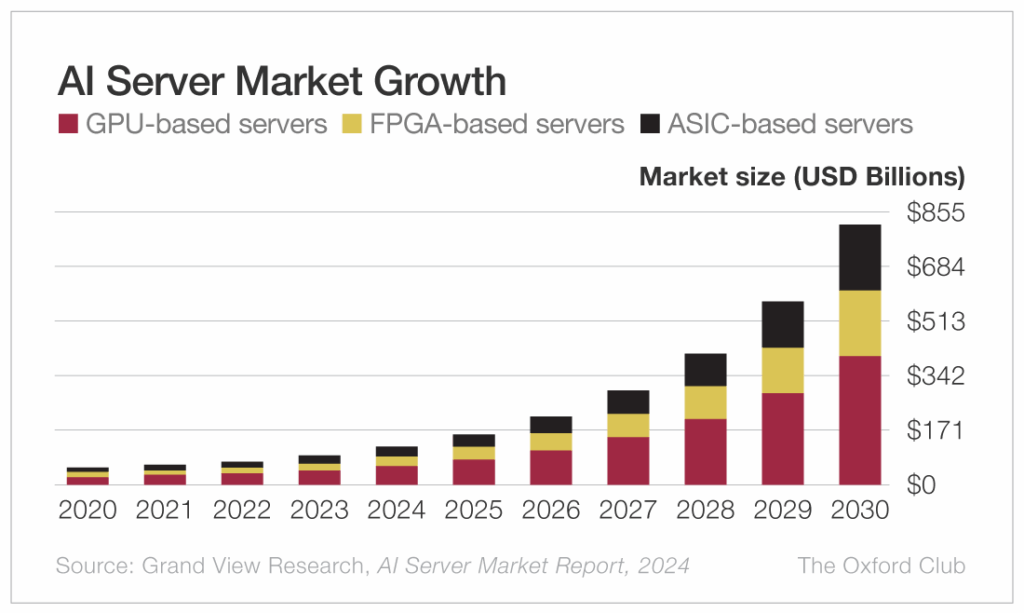
AI infrastructure spending is accelerating globally. The world is racing to build the servers, data centers, memory systems, network fabrics, and power grids needed to support next-generation AI.
But none of these systems work – no matter how advanced the chips are – without high-performance data-movement technology.
Astera dominates this niche.
Even more compelling is the vendor-agnostic nature of Astera’s business. The company does not depend on Nvidia alone. Its solutions work across:
- Nvidia GPUs
- AMD and Intel accelerators
- Custom ASICs
- Cloud-provider-built chips
- High-bandwidth memory systems
- PCIe, CXL, and Ethernet-based AI fabrics.
That means Astera wins regardless of which chipmaker leads in any given segment of the market.
This is exactly the kind of position long-term investors look for: a critical supplier embedded in the fastest-growing part of the global technology stack.
As AI models expand in size and complexity – and as companies deploy tens of thousands of next-generation GPUs – the need for Astera’s technology only grows. It is not tied to a single AI trend, a single customer, or a single product cycle.
Rather, Astera benefits from the entire AI revolution, across every layer of the semiconductor and cloud-computing ecosystem.
The Case for Astera Labs
This company offers an unusually strong combination of…
- A mission-critical role in AI hardware
- Explosive, verifiable revenue acceleration
- Vendor-agnostic product adoption
- Strong institutional backing, including Sutter Hill Ventures
- Expanding use across the largest technology companies in the world
- High gross margins and a cash-rich balance sheet
- Broad exposure to the AI infrastructure boom.
This is not a household name – but neither were Nvidia, Cisco, or Broadcom during the early years of their breakthroughs.
History shows that companies solving deep infrastructure problems tend to become the quiet engines behind massive long-term returns. They often operate behind the scenes, but their technology becomes indispensable.
AI will continue reshaping every major industry, from healthcare to logistics to finance to manufacturing. And Astera, by enabling the hardware at the center of that transformation, is positioned to be one of the most important – and potentially rewarding – companies to watch over the coming decade.
If you missed the rise of earlier infrastructure giants, this may be a second chance to participate in the next one.
Recommendation: Buy Astera Labs (Nasdaq: ALAB) and set a 25% trailing stop to protect your principal and your profits.