 You are now logged out.

It’s Not Too Late to Maximize Your Retirement Account

Building up your retirement account – and starting early in particular – is the most important thing you can do to create a nice-sized nest egg for your golden years.
Each type of retirement account discussed below grows tax-free, giving you a huge opportunity to let the power of compounding work its magic.
Unfortunately, the percentage of people contributing to any type of retirement account is in the low double digits and the number of people contributing the maximum amount is in the low single digits.
Even if you haven’t yet started saving for retirement (or you worry that you haven’t saved enough), starting or adding more funds now will pay off in a big way later.
Before we get into some strategies that will help you accelerate your savings, let’s cover the three basic types of retirement accounts. After reading the descriptions below, review the strategies and decide which accounts work best for you.
Traditional IRAs
A traditional individual retirement account, or IRA, is a tax-advantaged account that the government created specifically to help people save for retirement. When used properly, IRAs can save you thousands of dollars in taxes while creating thousands in savings.
Taxpayers are allowed to contribute up to 100% of their earned income up to a set limit per year. In 2026, that limit is $7,500 for anyone under the age of 50 and $8,600 for anyone age 50 or over. The reason for that higher limit for the “older” crowd is to encourage catch-up saving for folks who put saving off. To account for inflation, these limits are raised over time.
Traditional IRAs let you lower your current taxable income. For example, if you made $120,000 last year (and weren’t covered by a retirement plan at work) and contributed $6,000, your taxable income would drop to $114,000. That means a person in the 24% tax bracket would save $1,440 in taxes.
Even more importantly, money put into an IRA grows tax-free until it’s withdrawn.
Now, to start withdrawing from your IRA, you must wait until you’re 59 1/2 to avoid a 10% penalty. (You can wait longer if you choose.) Once you start taking distributions, you have to pay income tax on them.
Then there are required distributions. After turning 73, you must start taking some money out. The IRS website provides a worksheet to determine your required amount. Since most retirees don’t receive work income anymore, they’re in a lower tax bracket and the required distributions are taxed as such.
The distinctive advantage of a traditional IRA is the upfront tax deduction received on contributions. If you properly plan your income and cash flow, you’ll save thousands you would otherwise have to pay Uncle Sam, all while building a large nest egg for yourself.
Roth IRAs
Roth IRAs are similar to traditional IRAs. The key difference is that they don’t lower your current taxes.
Instead, the tax benefit comes later, as you won’t be taxed on withdrawals when you take the money out during retirement. Taxes have already been paid on what you contributed, so the government doesn’t tax you again − nor does it tax you on any of the earnings.
If you’re in a lower tax bracket than you expect to be in the future, it’s best to contribute to a Roth IRA. Once again, you can contribute up to $7,500 per year if you’re below age 50 or $8,600 if you’re 50 or older. That limit covers both kinds of IRAs, so if you’re 49 years old, you could contribute, say, $4,500 to a Roth and $3,000 to a traditional IRA (or vice versa). But that’s it.
If your modified adjusted gross income (MAGI) is above $153,000 for single filers or $242,000 for married filing jointly, your contribution limit may be lower.
With that said, one benefit Roths have is that they don’t involve any required minimum distributions. You can keep the money in the account for as long as you’d like and even leave it to family members in your will.
You can also withdraw your contributions on a tax-free, penalty-free basis at any time for any reason − though that rule doesn’t apply to any earnings you’ve made on those contributions. In order to withdraw earnings tax- and penalty-free, you have to be older than 59 1/2 and your initial contributions must have been made at least five years prior.
The distinctive advantage of a Roth IRA is that both your contributions and any earnings are tax-free on withdrawal (assuming you meet the age 59 1/2 requirement and satisfy the five-year rule). With a traditional IRA, both your contributions and any earnings are taxed at withdrawal.
Both traditional and Roth IRAs are easy to set up. Every bank, brokerage firm, and mutual fund company offers them, and the online setup process takes less than 20 minutes.
401(k) Accounts
401(k)s are like IRAs except that employers offer them and they have a few different limits and rules. For one thing, folks younger than 50 can put in up to $24,500 in 2026. For those 50 or older, that limit jumps to $32,500. Under a change made in the SECURE 2.0 Act, a higher catch-up contribution limit is allowed for employees age 60, 61, 62, and 63. In 2026, the higher catch-up limit is $11,250 instead of $8,000, allowing them to contribute a maximum of $35,750.
These contributions are made on a pretax basis by your employer based on your directions. Since they’re pretax, they directly lower your adjusted gross income (AGI) and therefore lower your taxes too. Because of the larger amounts you can put in, you could save thousands of dollars every year at tax time.
If you’re below 50 and in the 12% tax bracket, a maximum contribution of $24,500 would save you $2,940 in taxes.
If you’re 50 or above and in the 12% tax bracket, a maximum contribution of $32,500 would save you $3,900.
The savings are even bigger − potentially more than three times bigger − for people age 60 to 63 and those in higher tax brackets. (These figures are generally the same for other employer-sponsored plans, such as 403(b)s, 457s, and the Thrift Savings Plan.)
This all amounts to a terrific birthday present from the IRS. Remember, though, that withdrawals from a 401(k) are treated similarly to those from a traditional IRA and taxed when they’re taken out.
There are also Roth 401(k)s that follow similar rules to Roth IRAs: no upfront tax benefit, but withdrawals are tax-free. (Starting in 2026, if you are age 50 or over and your wages from your employer exceed $150,000, you will not be able to make catch-up contributions to a traditional 401(k). Those contributions would have to go to a Roth option inside the same plan or be forfeited.)
Once again, these accounts are easy to set up. Usually, it just involves reaching out to your human resources department.
How to Maximize Your Retirement Account
According to the Employee Benefit Research Institute (EBRI), there are two key characteristics of a seven-figure retirement account. A high percentage of million-dollar savers had constant participation and high contribution rates.
The EBRI also reported that one of the biggest mistakes people make when saving for retirement is that they can’t or don’t take full advantage of the benefits offered by the various retirement accounts at their disposal.
Making the most of these resources will provide you with your best chance of amassing a sizable retirement nest egg. However, how you go about investing in these accounts is very important. That’s why I’m also giving you some outstanding strategies to help you reach your goals.
The $2,000 Saver’s Rebate
This one’s a bit of a shocker.
In 2002, legislators were looking for ways to encourage Americans to save more money − and for good reason. The median American household has just $8,000 in savings.
As a result, Congress passed a law allowing citizens to collect a cash rebate each year if they simply socked a little money away for a rainy day. Lawmakers made the program permanent in 2006.
Many people who elected to save money last year are now eligible to receive up to a $2,000 cash rebate for doing so.
To join their ranks, just fill out a Retirement Savings Contributions Credit, or Saver’s Credit, form along with your taxes. These are available to anyone making contributions to an IRA or employer-sponsored retirement plan.
The credit amount is 50%, 20%, or 10% of your contributions to your IRA or retirement plan up to $2,000 ($4,000 if married and filing jointly), depending on your AGI as reported on your Form 1040 or 1040A. That means the maximum credit is $1,000 ($2,000 if married filing jointly).
The income thresholds in 2025 were $79,000 for married filing jointly, $59,250 for heads of household, and $39,500 for singles and married individuals filing separately. If your income was below your respective threshold, you may be eligible for the Saver’s Credit.
The thresholds for income earned in 2026 are slightly higher.
How to Add $155,000 to Your Retirement Account
What we’re talking about here is reducing the cost of your 401(k).
Retirement plan providers have been overcharging investors for decades, creating a huge drag on returns. As a result, many 401(k) plans are much too expensive.
The average investor’s annual charge is 0.83% of assets. In small plans, it’s often much more – as high as 3%. In large plans, it’s a little less.
There can also be additional “wrap fees” of up to 1% of your assets. And that’s to say nothing about the mutual funds inside 401(k)s. Many plans offer only funds that charge fees of 1.5% or more – far higher than the median 0.77% for stock funds.
Consider this jarring figure from think tank Demos: An ordinary American household with two working adults will cough up almost $155,000 in 401(k) fees over a lifetime.
Worse still is that a stunning 70% of those polled in an AARP survey said they didn’t think they were being charged anything!
Fortunately, thanks to a rule issued by the Labor Department, investors have started receiving reports that detail all the fees their providers are charging. Every investor must get a report.
It’s a landmark moment that should go a long way toward maximizing regular savers’ nest eggs.
Be sure to check to see what you’re paying in fees. If the fees aren’t reasonable, make changes to your plan. If needed, put pressure on your employer to offer additional investment options that charge less.
The Instant Return… Instantly Get a 100% Return on Your 401(k) Investment Every Year
This is the easiest money you’ll ever make.
Find out if your employer matches contributions to your retirement account.
Many offer an immediate 401(k) matching contribution up to a certain percentage of your pay.
Generally, they’ll match anywhere from 3% to 6% of an employee’s pay up to a certain dollar limit or percentage of their pay (e.g., 50% to 100% of employee contributions up to 3% of their salary).
According to U.S. News Money, a 30-year-old employee earning a $50,000 salary who saves $5,000 per year and gets a 3% 401(k) match will accumulate $747,662 by age 65, assuming 6% annual investment returns. An employee who saves the same amount without getting an employer match will retire with just $575,125.
That’s a $172,537 difference.
It seems obvious that employer contributions make it much easier to amass a bigger nest egg… but it’s mind-boggling how many people don’t take full advantage of this.
Your employer match is an immediate 100% return on your investment. You automatically make 100% on those matched dollars before you’ve even invested the money. That’s why it’s critical you contribute up to the amount your employer will match (at the very least).
You also earn a tax-free return on those funds in addition to what you’ve contributed.
You’re crazy if you don’t take advantage of this. It’s the simplest, most reliable way you can find to double your money.
Make sure you contribute enough in your 401(k) to receive the maximum contribution from your employer. This is free money to you… and it will make a huge difference in the long run.
How to Keep the Government From Taking a 20% Cut of Your 401(k)
Here’s the right way to do a retirement plan rollover.
The whole point of a 401(k) is to save tax-free money for retirement, so once you’ve accumulated a nice nest egg, don’t let this mistake happen.
It occurs too often already, and it can take a big bite out of your savings.
I’m talking about a particular decision involved in transferring your retirement savings out of your 401(k). If you ever do this, be sure you do a direct rollover.
In other words, ask your former employer to directly transfer the money to an IRA or different 401(k).
If it makes out the check to you, 20% of your account balance will be withheld for income tax. You’ll then have 60 days to deposit the cash – including the amount withheld – in a new tax-deferred retirement account.
If you miss the deadline, Uncle Sam keeps the 20% and you become responsible for any additional income tax due.
If you’re under the age of 59 1/2, you’ll also have to pay a 10% early withdrawal penalty on any amount not deposited in a new retirement account.
Bottom line: If you’re going to roll over an old 401(k), make sure you always have the check made payable to the new custodian.
One Simple Mistake Retirees Make That Accidentally Doubles Their Income Tax Rate…
This strategy revolves around when you withdraw money from your retirement accounts, how much you withdraw, and which accounts you withdraw from.
Retirees need to carefully weigh their retirement account withdrawal options when it comes time to take money out. That’s because the IRS taxes Social Security benefits beginning at very low-income levels.
If combined income (AGI + nontaxable interest + one-half of your Social Security benefits) is between $25,000 and $34,000 for a single individual or between $32,000 and $44,000 for a married couple, 50% of Social Security benefits are taxed. Combined income above these maximum amounts results in up to 85% taxation.
Figuring out where you withdraw money from will make a big difference in understanding your personal tax bracket and Social Security tax.
Here’s a great way to stay in a lower tax bracket and eliminate – or at least reduce – your Social Security taxes…
First, hold off collecting your Social Security payments until age 70. That will ensure the maximum Social Security benefit. When you retire (say, at age 66), use your traditional IRA as the main source of cash.
Yes, you’ll have to pay tax on those withdrawals, but you’ll eventually have to do that anyway. Since your income won’t be simultaneously inflated by Social Security payments, your withdrawals should be taxed at a lower rate.
Once you reach age 70 and start collecting Social Security, you can reduce the amount being withdrawn from your traditional IRA and start tapping into your Roth, where distributions are tax-free.
However, keep in mind that when you reach age 73, you have to start making required minimum distributions from your traditional IRA. Be sure to figure that into your calculations.
Why You Should NEVER Invest in Your IRA or 401(k) Right Before the April 15 Tax Deadline…
The saying “time is money” definitely applies to your retirement accounts. It’s all about the power of compounding.
If you make your IRA contribution on the first day possible (New Year’s Day of the tax year) rather than the last (April 15 of the following year), your money will have an extra 15 1/2 months to grow tax-deferred. Over a decade, that just about gives you an extra 13 years of compounded growth. Over three decades, it’s nearly an extra 39 years.
Here’s what it would mean for two investors. Tom and Jerry both contribute $5,000 and get the same return of 9% – the one difference being that Jerry makes his full contribution on January 1, while Tom waits until April 15 of the following year.
After 30 years of last-minute $5,000 IRA contributions, Tom will have $687,000, but Jerry will have about $762,000 – a $75,000 difference. Over 40 years, the difference increases further, with Jerry accumulating $1,889,797 versus Tom’s $1,696,998.
The moral of the story: The sooner investors make contributions, the better off they’ll be.
Rake In 37% Returns Every 12 Months With Practically No Risk!
There are very few layups in the investment world… so when you see one, it’s imperative that you take it.
This one involves a guaranteed instant 37% return with no risk, but you’d be surprised how many people overlook or underfund this opportunity.
Here’s the “secret”: You must always – with no exceptions – fund your IRA to the maximum allowable.
To see why, let’s do the math together.
Currently, a traditional IRA allows for a maximum of $7,500 ($8,600 if you’re 50 or older) to be deposited each year. Let’s assume you’re in the 32% federal tax bracket and your state has a 5% income tax for a combined income tax rate of 37%.
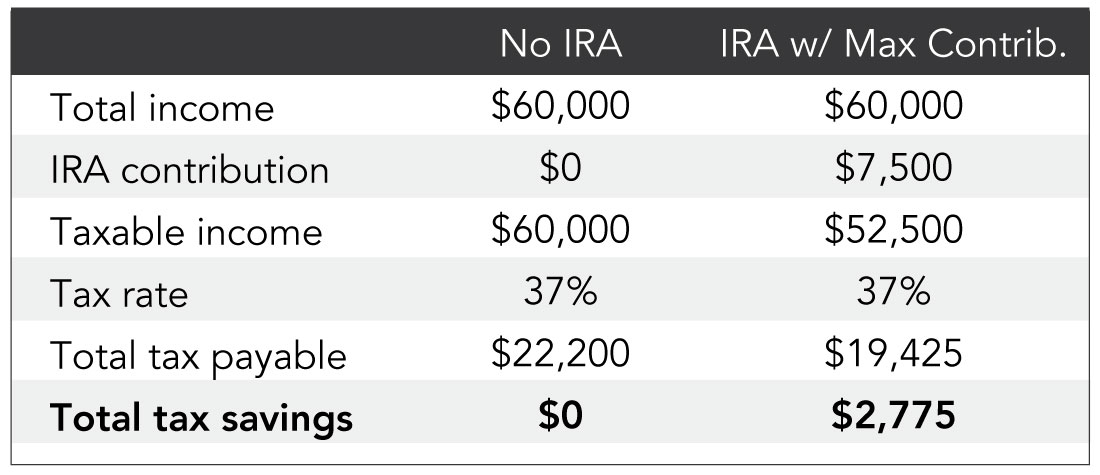
If your annual taxable income is $60,000, your tax would be $22,200 ($60,000 x 37%). But if you put the full $7,500 into an IRA, your taxable income drops to $52,500 and your tax falls by $2,775 to $19,425.
That’s exactly like making 37% risk-free ($2,775 / $7,500 = 37%).
How to Take Money Out of Your Retirement Plan and Not Pay a Single Cent in Taxes
While it may sound too good to be true, there’s more than one way to withdraw money from your retirement plan without incurring taxes or penalties.
The first and most obvious way is to open a Roth IRA. As mentioned earlier, you may withdraw your contributions to a Roth (not necessarily your earnings in the Roth) on a tax-free, penalty-free basis at any time for any reason.
But there’s one more tax-free withdrawal possibility: You can also get money out of your Roth under a first-time homebuyer’s clause. By meeting some very basic criteria, you can withdraw up to $10,000 from the account as long as it’s been open for five years and the funds go directly toward acquiring the home (e.g., down payment, closing costs, etc.).
In this report, we’ve gone over the techniques and strategies that everyday people use to build million-dollar fortunes… even if they aren’t the top income earners in America. Use these powerful and actionable wealth-building and cash-saving secrets to maximize your own retirement account.