 You are now logged out.

Marc’s 2026 Prospectus: How to Generate Income in a Low-Interest Era

As we enter 2026, income investors face a challenging landscape. With interest rates trending lower, traditional fixed-income investments are yielding less and less, forcing investors to seek other ways to generate meaningful returns.
The good news? There are still plenty of compelling opportunities out there.
Though valuations are elevated, the underlying economic fundamentals remain solid, and the Federal Reserve’s accommodative stance provides a supportive backdrop for stocks. In this environment, income generation isn’t just about collecting dividends anymore. It’s about employing sophisticated strategies that can deliver double-digit returns even as bond yields shrink.
In this prospectus, I’ll issue my outlook for three key areas in 2026: the broad market, income-generating options strategies, and small cap stocks. Each offers distinct advantages for investors who are seeking to build wealth and generate cash flow in the year ahead.
The Broad Market: Still Room to Run
I remain bullish on the broad market.
Yes, stocks are expensive by historical standards. After rising 24% in 2023 and 23% in 2024, the S&P 500 is up 14% year to date and a stunning 34% since its low in April. But elevated valuations alone are not a reason for decline. High valuations simply mean that when a correction does occur, it may be more pronounced.
Until then, I expect the market to continue its upward trend.
The U.S. economy remains on solid footing, despite some data gaps from October due to the government shutdown. While the shutdown likely created a temporary drag on economic activity, we should see a rebound effect as previously delayed spending flows back into the economy and creates positive ripple effects across various sectors.
Perhaps most importantly, interest rates are falling and appear likely to move even lower. This is no small matter. The Federal Reserve’s shift to a more “dovish” policy stance creates a powerful tailwind for equities.
As the old Wall Street adage goes, don’t fight the Fed. When the central bank is easing, it pays to maintain your exposure to stocks.
Stocks typically rise when rates are falling. Plus, lower rates make it easier for companies to borrow in order to fund growth and to refinance existing debt at lower rates, which improves earnings and cash flow. Additionally, lower rates typically help the consumer by freeing up some cash for them to spend. That gives a boost to the economy and, ultimately, corporate profits.
For investors, this means staying invested and continuing to build positions in quality companies. The bull market has room to run, supported by declining rates, solid economic fundamentals, and the momentum that comes with making new highs. This is not the time to move to the sidelines.
Generating Income With Options: Your New Fixed-Income Alternative
As interest rates decline, traditional savers face a harsh reality: Their income streams are drying up. Money market funds, CDs, and even Treasury bonds are offering progressively less attractive yields. This is precisely why investors need to embrace alternative income strategies, and options writing stands out as one of the most powerful tools available.
Some options strategies allow you to generate meaningful income, particularly in a bull market environment. Think of them as acting like an insurance company − you collect premiums in exchange for taking on risk. Let me walk you through three specific strategies that can dramatically boost your portfolio’s income generation.
- Covered Calls: Participate in Upside While Collecting Income
The covered call strategy is refreshingly simple. You buy shares of a stock, and you sell out-of-the-money call options on the same stock. This approach allows you to participate in some of the stock’s upside potential, collect dividend payments, and pocket the premium from selling the call option. It’s a three-pronged income strategy.
The beauty of covered calls is their versatility. In a moderately bullish market, you can generate double-digit returns in just a few months. Even if the stock gets called away because it rises above your strike price, you’ve still profited from the stock’s appreciation up to that level, plus the premium you collected, plus any dividends received along the way.
- Naked Puts: Get Paid to Wait for Your Ideal Price
Selling naked puts is one of my favorite strategies for investors who have specific stocks they want to own. Here’s how it works: You sell put options on stocks you’d like to purchase, selecting a strike price below the current market price. That strike price represents your target entry point for the stock. (With options, “covered” means you already own the underlying stock and “naked” means you do not own the underlying stock.)
If the stock drops to your strike price, you will be required to buy it at your target price. Plus, you keep the premium you collected, which further reduces your net cost. If the stock doesn’t decline to your strike price, you simply keep the premium − just like an insurance company keeps your premium when your house doesn’t burn down.
This strategy transforms patience into profit. Instead of hoping a stock drops to your target price, you’re getting paid to wait. It’s a win-win scenario that puts time and probability on your side.
- Credit Spreads: Defined Risk, Consistent Returns
Credit spreads take the insurance company analogy even further. With this strategy, you’re essentially doing two things at once: selling insurance to someone else to collect the premium and buying your own insurance to cap your potential losses. You always know your maximum risk, and you actually get paid to make the trade.
If the house doesn’t burn down, you keep the full amount you received when you opened the trade, which is the difference between the two premiums. If the house does burn down (which is rare), you may take a loss, but it could be a small one, because the insurance that you bought pays off and usually covers most of the loss.
The trades we make in Weekly Income Alert are credit spread trades. In our backtest, we found that these trades would’ve had an excellent win rate of 86%. But since we launched the service in May 2025, we’ve done even better.
As I write this, our official Weekly Income Alert track record shows a 92% win rate and an average gain of 15% in three weeks.
Successful trades compound quickly when you’re generating double-digit returns every few weeks, and even when these trades don’t work out perfectly, we’re often still able to pocket gains. (To learn more about these “5-minute Friday trades,” check out my detailed breakdown here and my tutorial video here.)
The final thing to mention is that any option-selling strategy, including all three I mentioned above, excels in times of volatility. And with the never-ending stream of news coming out of Washington these days − from tariff announcements to Fed speculation to government stakes in publicly traded companies − I expect 2026 to be a great year to collect income from these types of trades.
In short, these options strategies represent a paradigm shift for investors. With interest rates set to decline and volatility always lurking around the corner, they offer a path to generating substantial income with defined risk.
Small Caps: The Catch-Up Trade of 2026
While large cap stocks, led by the “Magnificent Seven,” have been making headlines over the past few years, small cap stocks have been quietly lagging behind, creating what I believe is one of the most compelling opportunities for 2026.
The Russell 2000 Index (the most widely tracked small cap index) has significant catching up to do, and several factors suggest it’s poised to do exactly that.
Consider this: Over the past three years, while the S&P 500 has expanded by 86%, the Russell 2000 has risen by just 39%.
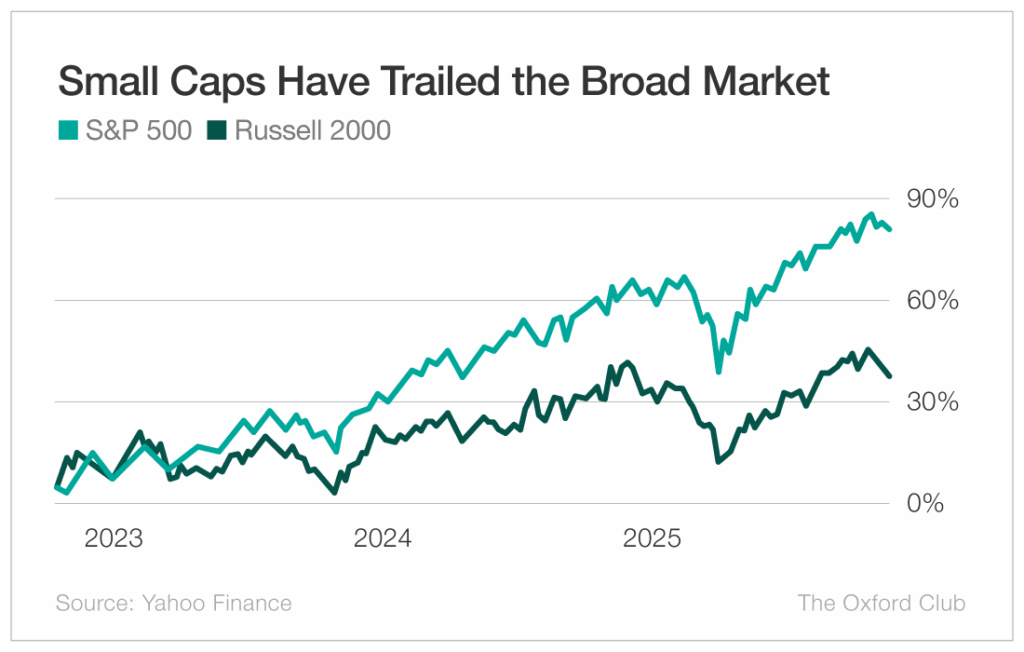
That gap is unsustainable. As the broad market continues to hit new highs, I expect investor psychology to shift. Risk appetites should increase, and capital will begin flowing toward smaller, more aggressive growth opportunities. It’s a pattern we’ve seen repeatedly throughout market history.
The fundamental backdrop for small caps is also improving dramatically. Lower interest rates are especially bullish for smaller companies, which often rely heavily on borrowing to fund their growth. As the Fed continues to cut rates, it will become easier for these companies to borrow money, improving their profitability and making expansion more feasible.
Even more compelling is the earnings picture. Small cap companies are reporting positive earnings growth and are expected to grow their earnings more rapidly than large cap companies over the next year. In fact, Russell 2000 earnings growth came in at 58% in the third quarter of 2025. That’s a dramatic acceleration that has yet to be fully reflected in stock prices.
The setup is clear. Small caps offer superior growth potential, they’re trading at a relative discount to their large cap counterparts, and they’re poised to benefit disproportionately from falling interest rates. As investors adopt a more risk-on attitude, small caps should see substantial inflows.
That’s great news for the Russell 2000 credit spread trades we make every week in Weekly Income Alert, and it’s great news for anyone looking for the best places to invest in the coming year.
Positioning for Success in 2026
The year ahead offers tremendous opportunities for investors who are willing to adapt their approach and learn new strategies to capitalize on the current environment. While falling interest rates pose challenges for traditional income investors, they create favorable conditions for equity investors and options traders alike.
As always, the key is taking action. The strategies outlined in this prospectus aren’t theoretical. They’re practical approaches that can be implemented immediately to improve your portfolio’s income generation and growth potential. Don’t let falling interest rates force you into lower returns. Instead, use them as a catalyst to explore strategies that can deliver the income and growth you need.
Here’s to a prosperous 2026.