 You are now logged out.

Make Big Tech Pay! How to Send Big Tech’s Rent Straight Into Your Pocket

Every AI-generated image, every chatbot answer, and every cloud workload needs a physical home.
The problem is there’s almost nowhere left to store the data.
According to real estate research firm JLL, data centers worldwide are running at close to 97% occupancy. Big Tech has poured hundreds of billions of dollars into AI servers… only to discover there’s barely any room left for them.
As a result, rent for U.S. data centers has climbed more than 60% since 2020, according to JLL’s research. Across the industry, the data center rental market is approaching $40 billion a year − and that bill is on pace to swell to over $65 billion by 2030.
Microsoft, Meta, Alphabet, and Amazon alone are expected to spend hundreds of billions of dollars on AI infrastructure this year. Some of that money will purchase land and equipment that these companies will own outright. But a growing share of it is going toward renting space in buildings owned by someone else.
JLL projects global data center capacity will nearly double from 103 gigawatts today to about 200 gigawatts by 2030, with AI workloads accounting for half of that total. Even with all that new construction, occupancy is expected to stay near these historic highs because demand continues to rise faster than new buildings can be powered up.
In other words, the same companies that built the AI boom are now the ones getting squeezed by it.
My research on this situation has led me to one company that’s positioned to collect more of that rent than almost anyone else in the business. It owns more than 300 data centers around the world, and its tenants include several of the most recognizable companies on the planet.
Better yet, because it’s structured as a real estate investment trust (REIT), federal law requires this company to distribute at least 90% of its taxable income straight to shareholders every year.
The more rent Big Tech is forced to pay, the more cash ends up in investors’ pockets.
That company is Digital Realty Trust (NYSE: DLR), and it’s set up to be one of the biggest beneficiaries of Big Tech’s desperate real estate scramble.
The Landlord Big Tech Can’t Say No To
Digital Realty Trust, headquartered in Austin, Texas, is the largest publicly traded data center REIT in the world by number of facilities. It owns, operates, or manages more than 300 data centers across more than 50 metropolitan areas in 25-plus countries, giving it one of the broadest global footprints in the industry.
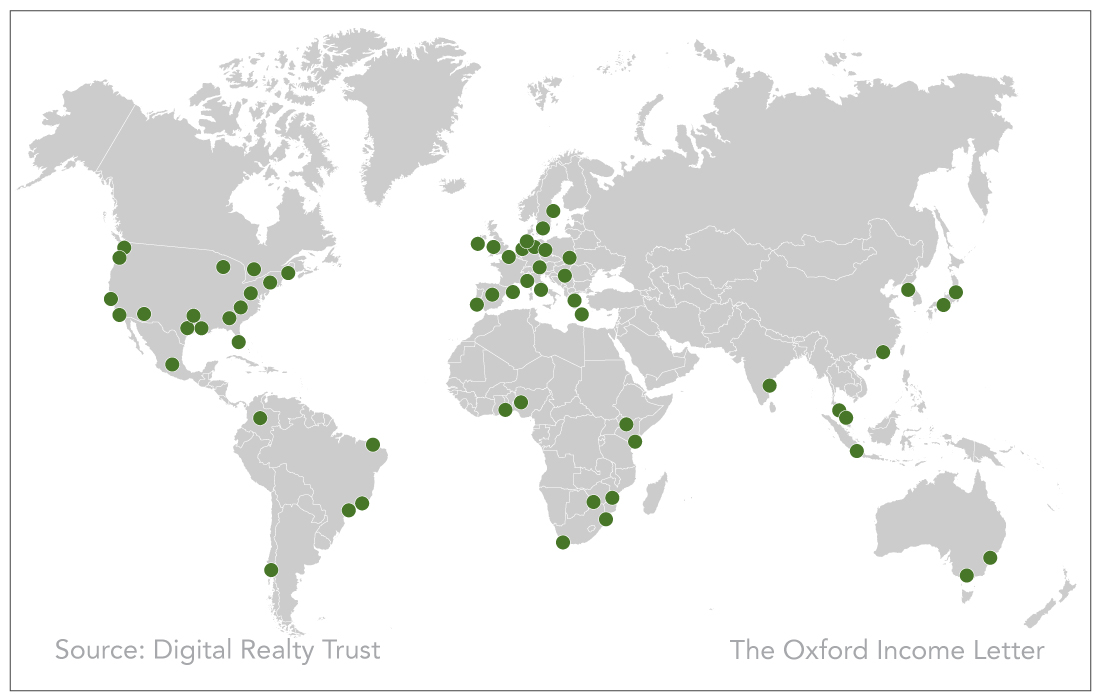
The company doesn’t write software or run cloud services itself. It owns the buildings, the power infrastructure, and the connectivity that Big Tech firms need in order to actually operate. Its PlatformDIGITAL network connects more than 5,000 customers to a single global footprint that they can tap into wherever their business is expanding.
That’s precisely why Digital Realty has become one of the AI buildout’s biggest beneficiaries. As internet and AI-driven traffic multiplies, so does demand for physical space, power, and connectivity. Only a handful of companies, including Digital Realty, can supply those resources at scale.
Among Digital Realty’s customers are some of the biggest names in technology, including Microsoft, Amazon, and Google. Importantly, these hyperscalers don’t rent month to month. They sign long-term leases, locking in up to 15 years of contracted, predictable rental income for Digital Realty.
One of its recent deals shows just how valuable those leases have become.
In June 2026, Digital Realty bought out Blackstone’s remaining stake in three data centers in Northern Virginia − the world’s largest data center market − for $3.5 billion. All three properties are 100% leased to investment-grade hyperscale tenants on 15-year contracts, with rents escalating by more than 3.5% annually.
The company is also staking out new ground. In the second quarter, it paid $475 million for land in the Kansas City metro area, securing 600 megawatts of utility power that could grow to as much as 2 gigawatts over time.
In the company’s second quarter earnings release, president and CEO Andy Power said, “These growth vectors are driving double-digit bottom line growth, and we are focused on extending this runway for years to come.”
That’s the model in a nutshell:
- Build or acquire premium data center space in the markets Big Tech needs most.
- Lock in long leases with blue chip tenants.
- Let the rent checks compound year after year.
Northern Virginia illustrates the squeeze well. It’s home to the single largest concentration of data centers on the planet, yet available power there is so constrained that new tenants often have to wait years to begin operations. Landlords who already control developed, powered land − as Digital Realty does − hold a decisive advantage.
By the way, Digital Realty’s list of tenants runs deeper than just the largest hyperscalers. Its more than 5,000 customers also include network carriers, financial firms, and a growing wave of AI startups. That diversification spreads the company’s income across thousands of leases rather than a handful of giant ones.
Locking In Record Rents
Digital Realty’s latest results show just how much leverage the company currently has over its big-name tenants.
Second quarter 2026 revenue jumped 29% year over year to $1.9 billion, and core funds from operations (excluding a one-time joint-venture gain) rose 14% to $2.13 per share. Both figures were comfortably ahead of Wall Street’s expectations. Management raised full-year 2026 core FFO guidance for the second consecutive quarter to a range of $8.15 to $8.20 per share.
Perhaps the most telling number is Digital Realty’s renewal spread − essentially the rent increase a landlord charges a tenant to keep its space − which hit a record 25.4% in the second quarter. That’s pricing power most businesses only dream of.
The company’s development pipeline − the new capacity it’s building to meet the heightened demand − has swelled to 1.4 gigawatts. Of that new construction, 63% is already pre-leased at an expected annual return of 11.5%. Its total leasing backlog, meaning rent under contract that hasn’t started flowing in yet, stood at nearly $1.9 billion at the end of the quarter.
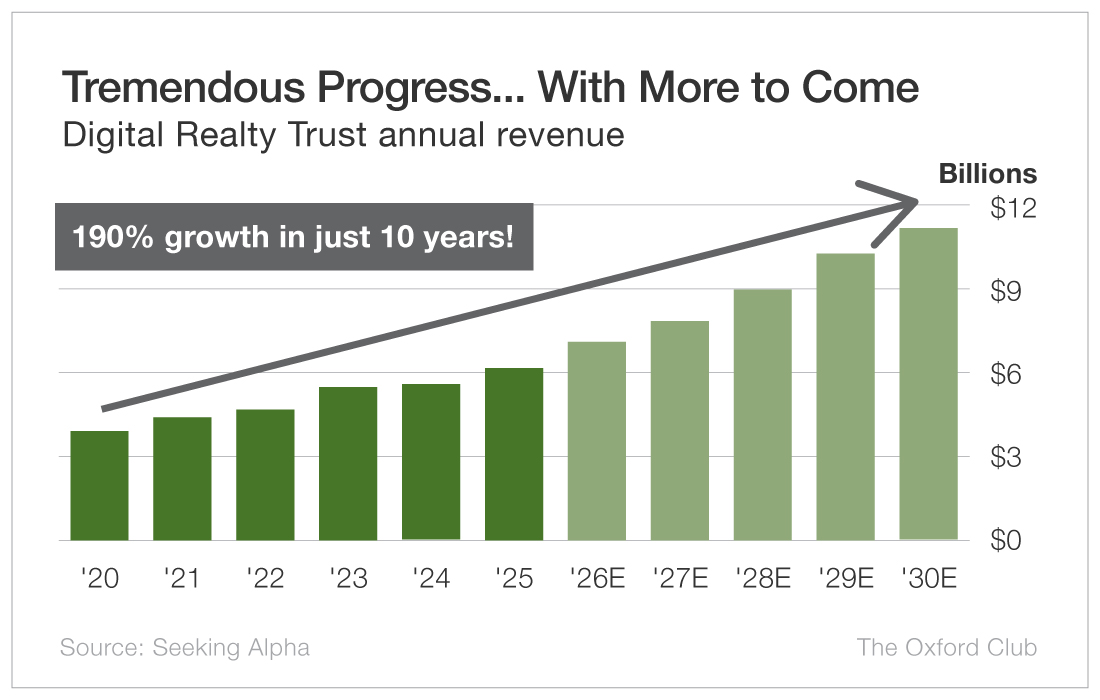
Zoom out, and the growth curve only gets steeper. Digital Realty’s annual revenue is projected to climb from below $3.9 billion in 2020 to more than $11 billion by 2030, nearly tripling in a decade.
Funding that kind of expansion takes real financial firepower, and Digital Realty has built a balance sheet to support it. The company ended the second quarter with approximately $6 billion in available liquidity and a net debt-to-adjusted EBITDA (earnings before interest, taxes, depreciation, and amortization) of 4.7X. That’s a reasonable level for a REIT funding a multibillion-dollar pipeline.
Management has also raised roughly $2.5 billion so far in 2026 by selling shares at an average price near $185, giving the company more cash to plow into new development without leaning too hard on debt.
All of that rent flows through a structure that’s built to reward shareholders. As I mentioned, since Digital Realty is a REIT, it’s legally required under the U.S. tax code to distribute at least 90% of its taxable income to investors every year. The more rent Big Tech pays, the more cash the company must hand over.
A Dividend That’s Built to Grow Again
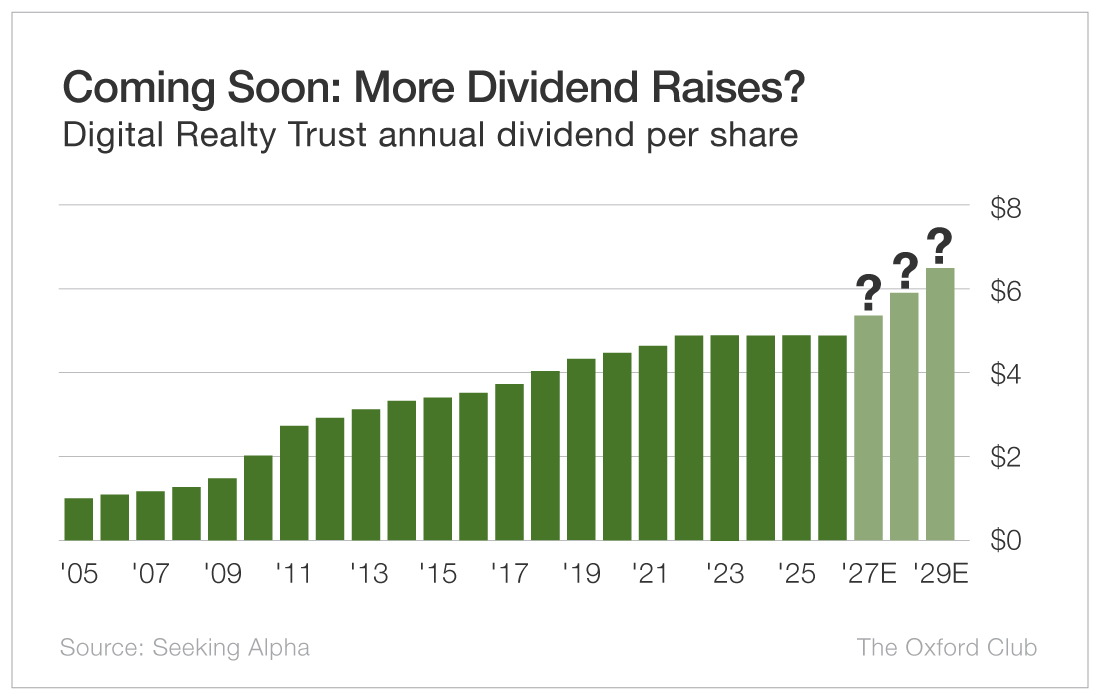
Digital Realty currently pays a quarterly dividend of $1.22 per share for a yield of about 2.7%. That puts the company on pace to distribute more than $1.7 billion to shareholders in 2026.
The dividend has held at $1.22 for several years as management has funneled cash into new development. But from 2005 to 2022, Digital Realty raised its dividend every year − sometimes multiple times per year − at an average clip of 10% annually.
With core FFO growing at a double-digit pace and a large, pre-leased development pipeline coming online over the next several years, Digital Realty has real room to resume that rapid dividend growth.
This isn’t the first time I’ve recommended Digital Realty Trust to Oxford Income Letter readers. I originally recommended the stock back in January 2014, citing its blue chip client list, its attractive valuation, and the fact that the world wasn’t getting any less technological.
Eight years later, we closed that position for a gain of more than 200%, including dividends.
The world is even more technological today, and Big Tech’s AI ambitions have only widened the gap between how much space it needs and how much is actually out there. Digital Realty owns a meaningful share of what’s left.
Now, Digital Realty probably isn’t the kind of stock that can make you a fortune overnight. But with a growing backlog, strong pricing power, and a multibillion-dollar pipeline, the company is positioned to keep sending Big Tech’s rent checks into investors’ pockets for years to come.
Recommendation: Buy Digital Realty Trust (NYSE: DLR) at the market. While this should be considered a long-term position, some Members may prefer to use a 25% trailing stop to protect their principal and profits. Hold the stock in a tax-deferred account if possible.