 You are now logged out.

Made in America: How to Profit from the Reshoring Revolution
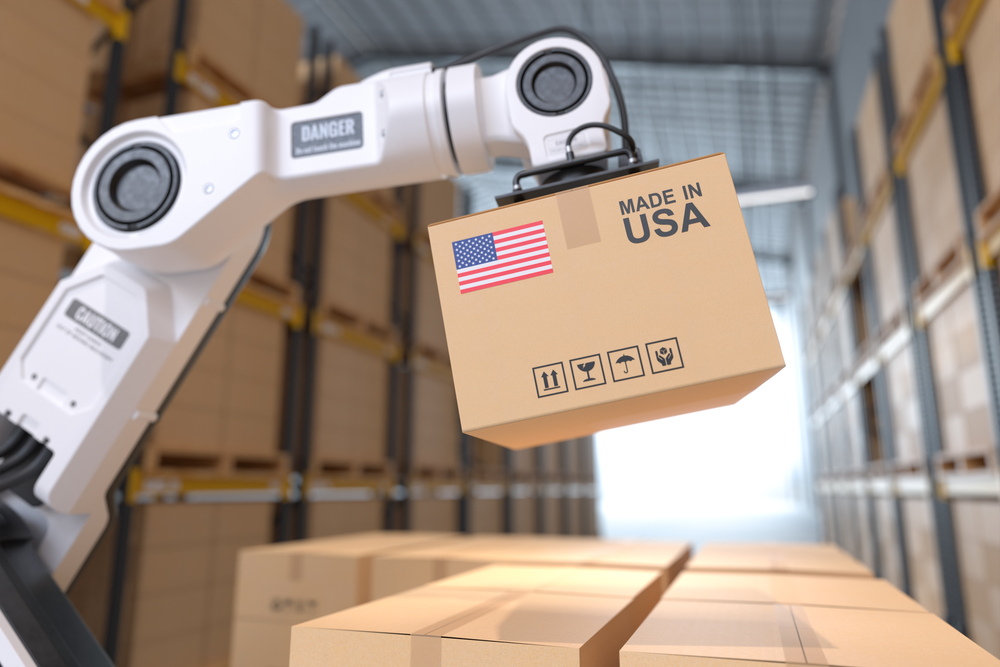
America is on the cusp of what I call a new “Renaissance.” Trillions of dollars are flowing back into our factories, chip plants, and small towns as companies move production home again.
The goal is simple: make more of what we use here in America – faster, cheaper, and with far less risk.
When big money and government support line up, investors get a rare chance to build life-changing wealth. In the 1990s, the internet boom turned a handful of little‑known companies into Apple‑ and Amazon‑size legends. Today, it is happening with automation and advanced manufacturing.
The biggest winners won’t be the headline names you see on TV, however.
The actual winners will be the companies that supply the tools and brains for this new wave of smart factories.
And the pick in this report is innovating in a space that I believe will be as revolutionary as the assembly line, the steam engine, and the internet.
In fact, as more plants and chip fabs are built on U.S. soil, this company stands in a toll‑booth position – collecting a fee each time this reshoring megatrend moves forward.
Here’s how it all works…
Domo Arigato, Mr. Roboto
As you know, robots have been around for a long time. Most modern factories are reliant on robot labor, in particular the auto industry… However, those machines are enormous and are designed to complete one specific task.
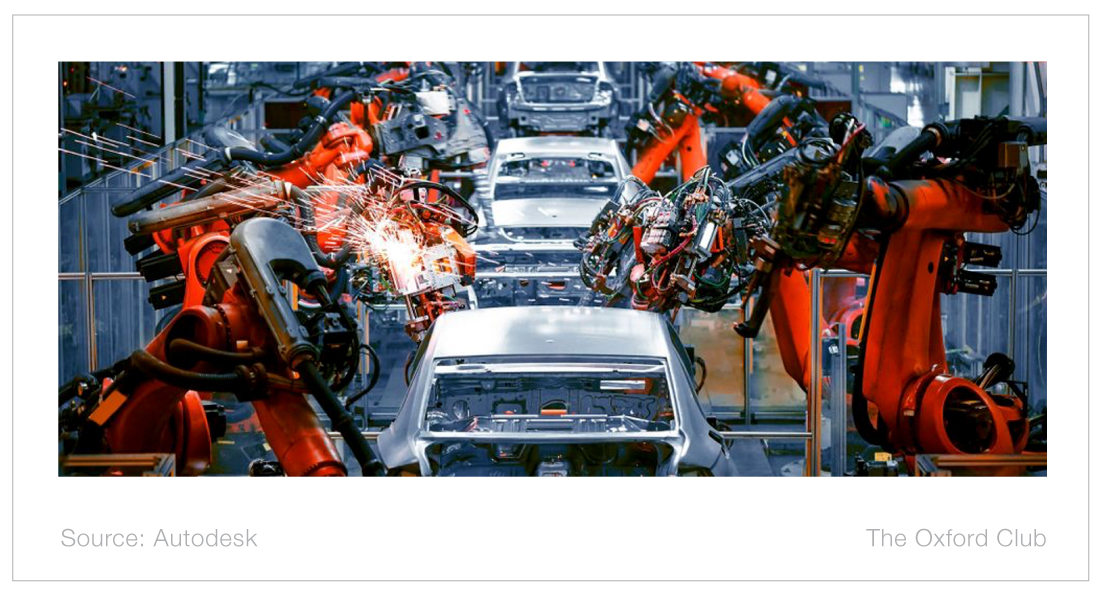
The future of robotics is in smaller, personal robots that work alongside their human counterparts.
But AI is boosting the capabilities of robots at a scale we haven’t seen before. And renowned billionaires are investing heavily in the space. Jeff Bezos recently led a $400 million funding round for an AI-driven robotics startup – a clear signal that major investors see enormous potential in this space. Bill Gates, through his investment vehicles and philanthropic initiatives, has backed multiple automation and advanced-manufacturing ventures. And Elon Musk is prototyping some of the first consumer-grade personal robots…
And at the center of this AI-driven robotics revolution is a company that has quietly become the global leader: Teradyne Inc. (Nasdaq: TER).
The Laws of Robotics
To readers of science fiction, the idea of personal robots working alongside humans is nothing new. Isaac Asimov predicted as much in his classic science fiction masterwork, I, Robot, back in 1950. But in large part, the technology remained in the imaginations of writers and filmmakers until recent years.
The issue hasn’t been hardware, believe it or not. Personal robots like the Roomba have been around for decades now. Humanoid robots have existed for years. But in both cases their intelligence is limited by very specific programs. A Roomba can vacuum your living room. Boston Dynamics can make a machine run or jump. But those machines aren’t capable of much else without a human operator.
That’s where AI – artificial intelligence – the technology that will make general-purpose robots a reality, comes in. And Teradyne is the company making it possible.
Based in Massachusetts, Teradyne is at the bleeding edge of robotics. It has emerged as a leader in a new type of robot called a “collaborative robot,” or “cobot” for short. Far from the job-stealing machine that haunts the nightmares of modern Luddites, cobots don’t replace humans but instead work alongside them.
They look like a scaled-down version of the industrial machines used in auto manufacturing. But unlike those machines, cobots can be used for myriad applications.
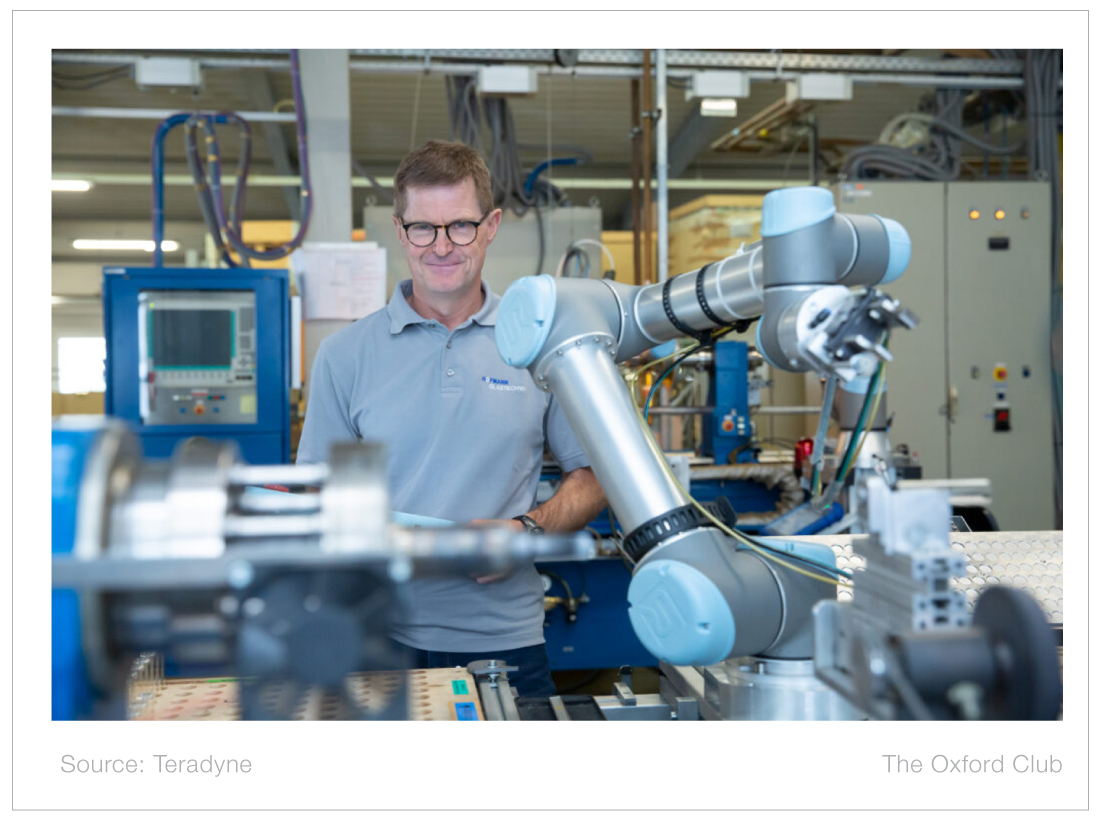
Cobots can be programmed for product assembly, gluing, sealing, painting, finishing, CNC, injection molding, packaging, palletizing, grinding, deburring, drilling, quality inspection, welding, and more. Teradyne’s cobots can be used for nearly any industrial purpose you can think of…
They increase the efficiency of humans rather than replacing them. And more efficient manufacturing leads to more supply, lower prices, and higher profits. It’s good for the economy across the board.
And they’re only getting better. Teradyne has partnered with Nvidia to integrate its AI chips into its cobots. The result will be smarter, more capable cobots. Teradyne’s Universal Robots subsidiary has now deployed more than 80,000 collaborative robots worldwide and still commands roughly one-third of the global cobot market.
Why Teradyne’s Robots Won’t Kill American Jobs
Cobots are being deployed at breakneck speed. But they are no threat at all to the job market.
And it’s only one arm of Teradyne’s business.
Looking back, there have been many technological innovations that threatened jobs.
One such example is Henry Ford’s assembly line.
The assembly line allowed Ford to produce new cars quickly and inexpensively. As a result, the entire horse-and-buggy industry – which employed hundreds of thousands of workers – went out of business.
But nobody misses that industry today, because the automobile led to widespread increases in employment and wealth in the 20th century.
Robots will do the same. They won’t replace American workers, but they will make American manufacturing competitive again. Cobots will help us make more products in America for lower costs.
But robotics is only one side of Teradyne’s story. The company’s largest and most profitable business – and the one most critical to the AI boom – is semiconductor testing.
Robots are a fast-growing part of Teradyne’s business, but its biggest revenue generator is actually semiconductor testing equipment. Semiconductors are the most critical component of modern computer chips.
They are in everything electronic these days. But before they can be sold to the companies that will use them, which includes the automotive, computer, smartphone, industrial, and communications industries, they must be tested for memory and performance.
And Teradyne offers several platforms for testing semiconductors at any scale, from an individual chip to a system of them. It offers end-to-end solutions, from concept to shipping product, and allows its customers to shorten the time to market while maintaining a high standard of quality.
The company’s balance sheet bears that out…
More Than Meets the Eye
In the most recent reported period – the fourth quarter of 2025 – Teradyne generated $1.1 billion in revenue, up 44% from the same quarter a year earlier. Semiconductor Test contributed $883 million, Product Test $110 million, and Robotics $89 million, with AI-driven System-on-a-Chip and memory applications leading demand.
For full year 2025, Teradyne posted $3.2 billion in revenue, an increase of roughly 13% versus 2024.
Fourth-quarter 2025 GAAP net income was $257.2 million, or $1.63 per diluted share, while non-GAAP earnings came in at $1.80 per share. Even after a cyclical slowdown in 2022-2023, Teradyne has maintained a mid-single-digit compound revenue growth rate over the past decade, with strong profitability and free cash flow supporting dividends and buybacks.
As the U.S. reshapes supply chains and invests heavily in domestic manufacturing, Teradyne stands to benefit. Cobots amplify human productivity, lower costs, and make U.S. factories globally competitive – exactly the environment where Teradyne thrives.
Robotics is the next major leg of the AI revolution, and Teradyne is positioned at the heart of it – powering both the physical machines doing the work and the semiconductor systems that make modern AI possible.
Bottom Line
The reshoring boom is not an idea on a whiteboard. Money is already being spent on new U.S. factories, chip plants, and automated warehouses. And that spending is set to grow for years. Teradyne’s robots help those sites run with fewer errors and lower costs. Its test systems sit at the heart of the AI chips that power modern industry.
That makes Teradyne a rare kind of stock: a profitable, established business sitting in the middle of a huge national project.
As America rebuilds its industrial base in this new Renaissance, Teradyne doesn’t need to guess the next hot gadget. It just needs factories and chipmakers to keep ordering its tools.
For investors who want a simple way to ride the “Made in America” wave, this is one of the clearest toll‑booth opportunities I see today. And it’s the type of business that has historically turned large policy shifts – from the early internet to the mobile revolution – into life‑changing gains for patient investors.
Recommendation: Buy Teradyne Inc. (Nasdaq: TER) at market. Set a 25% trailing stop to protect your principal and your profits.