 You are now logged out.

The Best of The Oxford Income Letter: January-June 2025
A Land (and Income) Grab at a Huge Discount
By Marc Lichtenfeld • Chief Income Strategist • February 2025
In the Forecast Issue last month, I mentioned that I’m bullish on commodities, especially energy and food. I’m returning to the food theme this month, as I expect strength in agricultural commodities. That will be great for America’s farmers, and it should result in a revival of American farms.
The agriculture space is ripe for a rebound in 2025 due to decreasing supply and increasing demand. Farmland is rapidly being depleted as urbanization spreads and encroaches on rural areas.
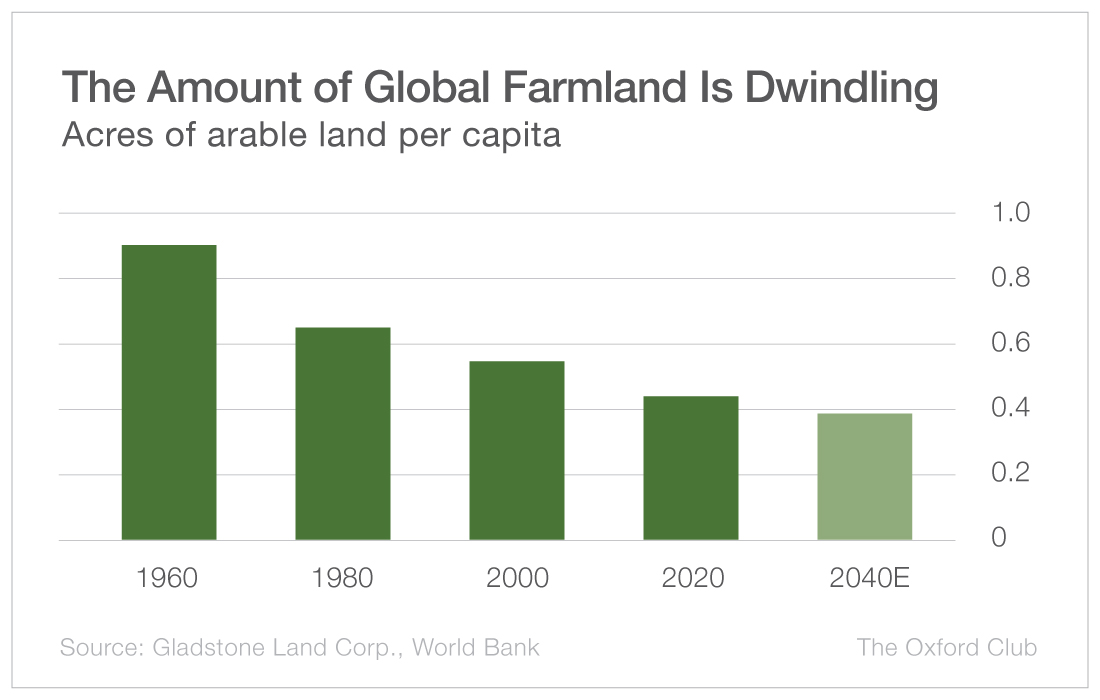
From 1997 to 2022, there was an 8% decline in U.S. farmland, from 954.8 million acres to 880.1 million acres. More recently, 141,733 farms covering more than 20 million acres disappeared between 2017 and 2022. That acreage is roughly equivalent to the size of Maine.
However, during that span, the total value of U.S. agricultural production increased 40%, from $389 billion to $543 billion, due mostly to technological advancements. As AI evolves, it should help make existing land even more productive.
Meanwhile, presumptive Secretary of Health and Human Services Robert F. Kennedy Jr. wants to reduce America’s consumption of processed foods and improve nutrition. That could cause demand for produce to increase, especially if school lunch programs and other organizations deliver more wholesome food and the nation embraces a healthier lifestyle. (Personally, I’ll give up my Cheez-Its when Kennedy pries them out of my cold, dead, orange-stained hands.)
Importantly, the Trump administration is also intent on decreasing foreign ownership of U.S. farmland, particularly if the owners are Chinese companies. Incoming Secretary of Agriculture Brooke Rollins is a vocal opponent of Chinese ownership of American farmland.
At the end of 2022, 30 million acres of agricultural land in the United States were foreign-owned, with another 13.4 million under lease to foreign entities.
If these foreign-owned farms are required to be sold, American farmers and companies may be able to pick them up on the cheap.
Gladstone Land Corp. (Nasdaq: LAND) is one of very few publicly traded companies with a focus on acquiring and leasing farmland − and it pays a 5.3% dividend yield to boot.
Gladstone is a real estate investment trust, or REIT, that owns 168 farms consisting of 112,000 acres in 15 states, including California, Texas, and Florida. Its farmable land currently has a 99.5% occupancy rate. The company also owns 54,000 acre-feet of water in California.
Its properties include…
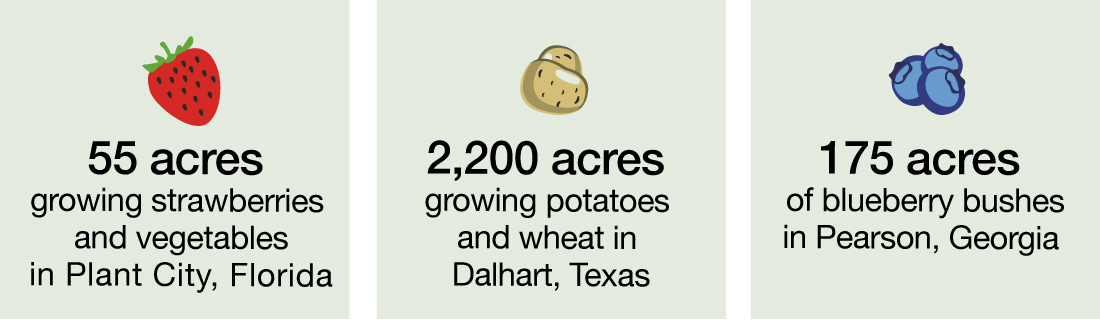
Gladstone’s farms are leased to farmers who grow fruit, vegetables, nuts, and other crops – most of which end up in American supermarkets. In other words, they’re not growing soybeans that will be exported to feed Chinese hogs.
A Strong Inflation Hedge for $0.69 on the Dollar
As of the end of the third quarter, the stock’s net asset value, or NAV, per share was $15.57. That means at its current price of less than $11, it’s trading at a 31% discount. We’ll learn the year-end NAV when the company releases earnings on February 19.
In the third quarter, Gladstone generated $0.17 per share in funds from operations, or FFO, which is the cash flow metric used by REITs. For the first nine months of the year, the company brought in $0.47 per share in FFO and paid out $0.42 per share in dividends.
Gladstone’s $0.0467 per share dividend is paid monthly. The company has boosted its dividend in each of the past 11 years.
If inflation reignites this year as I expect, Gladstone is well positioned to benefit. Farmland is a good hedge against inflation and a potential bear market because it is a noncorrelated asset, meaning it doesn’t follow the broad market. In fact, farmland is 60% less volatile than stocks.
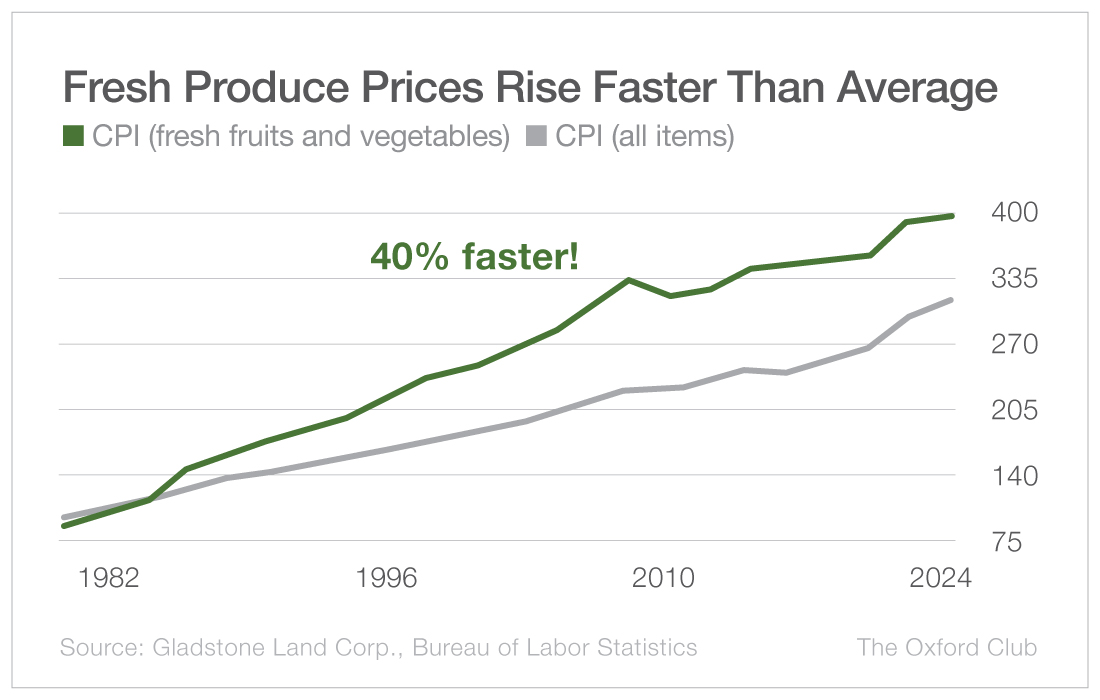
Fresh produce prices have also risen 40% faster than other consumer prices since 1980. That’s not great news for those of us who are trying to eat healthy, but it is positive for farmers and owners of farmland.
Currently, prices are very favorable. On the company’s third quarter conference call, CEO David Gladstone said, “Overall demand for prime farmland and growing berries and vegetables [remains] stable to strong. In fact, the vegetable and berry side is relatively stronger than just about any time I’ve seen in the past.”
In short, farmland ranks right alongside gold as one of the best hedges against inflation − except farmland can produce income, whereas gold does not.
Another thing I like about Gladstone is that Wall Street hates the stock. Only two of seven analysts rate it a “Buy,” which is a good thing. I prefer stocks that are being ignored or are not liked by analysts.
Wall Street analysts are notoriously late to the party, often upgrading stocks after they’ve surged or business has already improved. Getting in now means there is plenty of room on the bandwagon and we can add the stock to our portfolio at a great price.
Eventually, when the analysts come around, the stock will be a lot more expensive.
I’m excited to own this terrific dividend payer at a 31% discount.
Safety Net
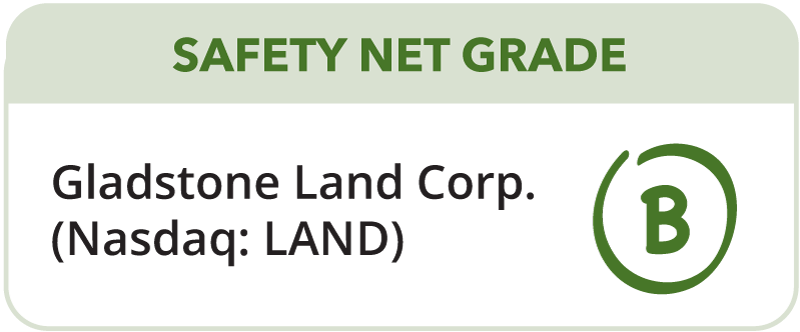
Starting this month, I’ll be including the Safety Net rating of each new stock I recommend. (In case you aren’t familiar with my Safety Net system, it measures the likelihood of a company cutting its dividend. It does not measure the safety of the stock itself.)
Gladstone Land’s FFO declined in 2023 and is forecast to have declined again in 2024. Safety Net penalizes companies with falling cash flow. However, because Gladstone has raised its dividend every year for more than 10 years, it gets a one-point upgrade.
The company is expected to pay out $0.56 per share in dividends in 2024 versus $0.59 in FFO, so the payout ratio is below my 100% limit.
As long as FFO doesn’t continue to fall, the dividend should be safe.
Though Gladstone raises its dividend every year, the annual increase is usually small. As a result, the stock won’t qualify for the 10-11-12 System, so we’ll add it to the High Yield Portfolio.
Action to Take: Buy Gladstone Land Corp. (Nasdaq: LAND) for $11.20 or lower, and add it to the High Yield Portfolio. Place a trailing stop 25% below your entry price.
Hold the stock in a tax-deferred account if possible. If not, it’s fine to hold it in a taxable account; you’ll just have to pay taxes on the dividends.
America’s Latest Credit Downgrade Is Much Ado About Nothing
By Marc Lichtenfeld • Chief Income Strategist • June 2025
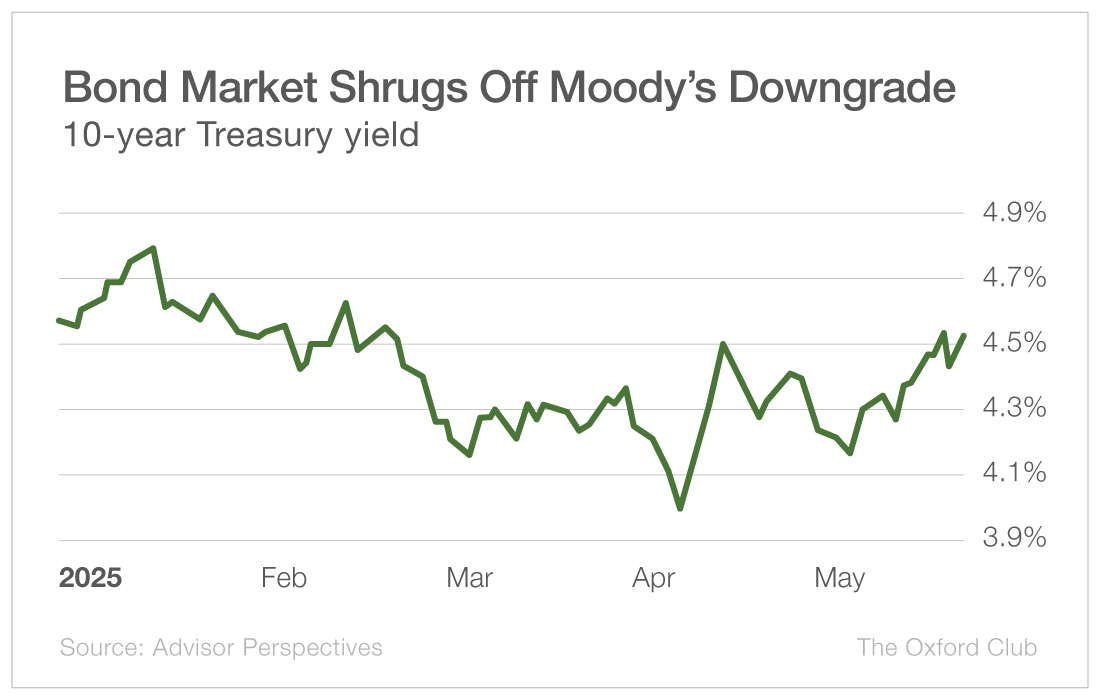
When Moody’s stripped the United States of its last AAA credit rating on May 16, the financial media went into overdrive. Headlines screamed about America’s fiscal crisis and soaring borrowing costs.
Meanwhile, Treasury yields barely budged.
As a bond investor, you need to separate the noise from what really matters for your portfolio.
Moody’s decision wasn’t a surprise. The agency had been telegraphing the move for months with a negative outlook on U.S. debt. The downgrade also brings all three major rating agencies back into alignment. S&P downgraded the U.S. back in 2011, and Fitch followed suit in 2023.
The underlying concerns about America’s fiscal trajectory aren’t new either. Every Federal Reserve chair since Alan Greenspan has warned Congress about unsustainable spending. For years, an aging population, underfunded entitlement programs, and rising interest costs have created an increasingly challenging equation.
What changed wasn’t the fundamentals; it was Moody’s willingness to acknowledge what markets already knew.
Here’s the reality that rating agencies can’t change: There simply isn’t an alternative to U.S. Treasurys for global investors. No other market comes close to providing the liquidity and scale that institutional investors require.
The total value of outstanding marketable Treasurys is more than $28 trillion – over three times larger than the entire global universe of AAA rated bonds at $8.9 trillion.
Consider some of the countries with AAA ratings. Germany recently voted to dramatically increase government borrowing, and others, like Switzerland, Australia, and Denmark, have tiny bond markets. So even if you wanted to diversify away from Treasurys, where would you realistically go?
This is why foreign central banks and sovereign wealth funds continue buying U.S. bonds despite the downgrade. They don’t have a choice.
We’ve been here before, and the playbook is predictable. When S&P downgraded the U.S. in 2011, Treasury yields fell 24 basis points the next day as investors fled to safety during a stock market sell-off. (A basis point is one-hundredth of a percentage point.) When Fitch issued its downgrade in 2023, yields rose 6 basis points before quickly stabilizing.
The Moody’s downgrade followed the same script. Yields initially jumped by 6 to 7 basis points, then finished 3 basis points lower the following day.
The pattern is clear: initial volatility, followed by a return to economic fundamentals.
Let this serve as a reminder that Federal Reserve policy, inflation data, and growth prospects – not rating agency headlines – drive Treasury yields.
This latest downgrade is no reason to abandon high-quality bonds. If anything, it reinforces why diversification matters and why shorter-term strategies make sense in the current environment.
With the Fed likely to remain on hold longer than many expect, any eventual rate cuts will benefit the front end of the yield curve more than longer-dated bonds. This suggests that it’d be wise to focus on shorter-maturity, high-quality corporate bonds, as they offer attractive yields with less interest rate risk.
Securitized products, such as asset-backed securities, AAA rated collateralized loan obligations, and commercial mortgage-backed securities, provide alternative ways to access the short end of the curve. These investments are more attractively priced than traditional corporate bonds and benefit from inherently shorter maturities.
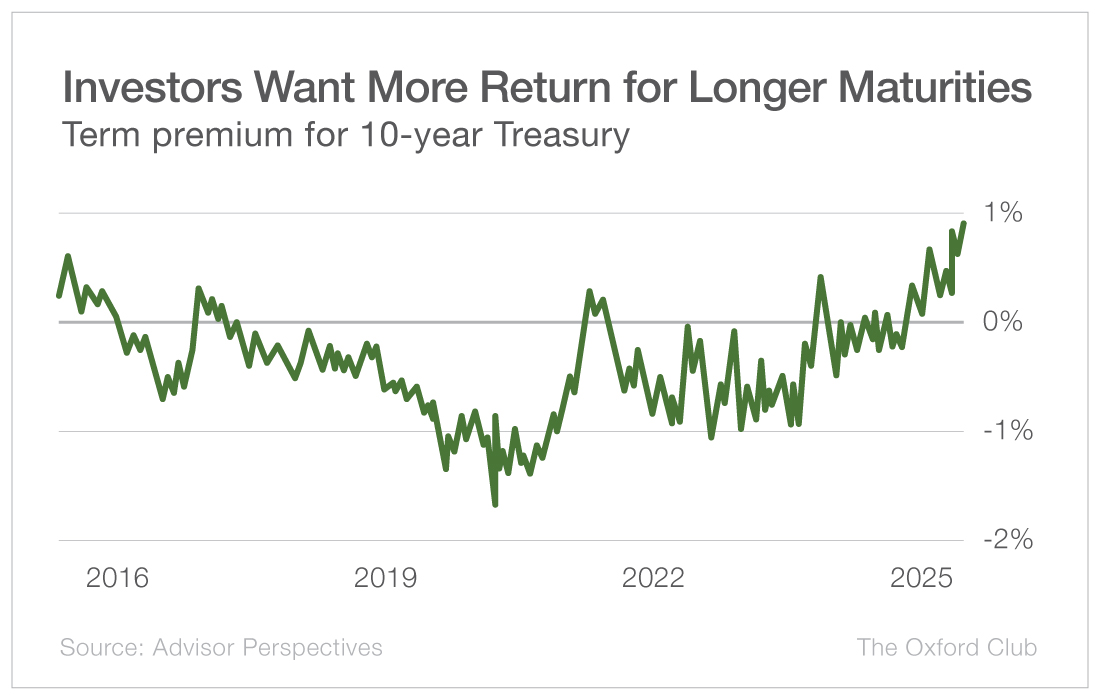
Importantly, the “term premium,” which is the additional compensation investors demand to own an asset for a longer period of time, has climbed near 1% for 10-year Treasurys – the highest level since 2014. That extra compensation reflects legitimate concerns about future borrowing needs, but it also creates opportunities for patient investors who are willing to lock in current yields.
The companies that issued the bonds in our Fixed Income Portfolio continue to generate the cash flows needed to service their debts. High-quality corporate bonds are offering attractive yields with manageable credit risk, and municipal bonds provide tax advantages that become more valuable as rates rise.
Many investment guidelines were rewritten after the 2011 downgrade to prevent forced selling after future rating changes. Moody’s also left the country ceiling for the United States at AAA, allowing top-tier corporates like Microsoft and Johnson & Johnson to retain their highest ratings.
In short, credit ratings matter, but they don’t determine investment success. Economic fundamentals do. The U.S. economy remains resilient, unemployment is still low, and corporate balance sheets are healthy.
Rather than worrying about rating agency opinions, focus on locking in attractive yields from high-quality bonds and building a diversified portfolio.
Adapting to a New Era of Dividend Investing
By Anthony Summers • Director of Trading • February 2025
Something strange has happened to the stock market over the past few years.
The S&P 500’s dividend yield has dropped to 1.23% – the lowest level we’ve seen since 2001.
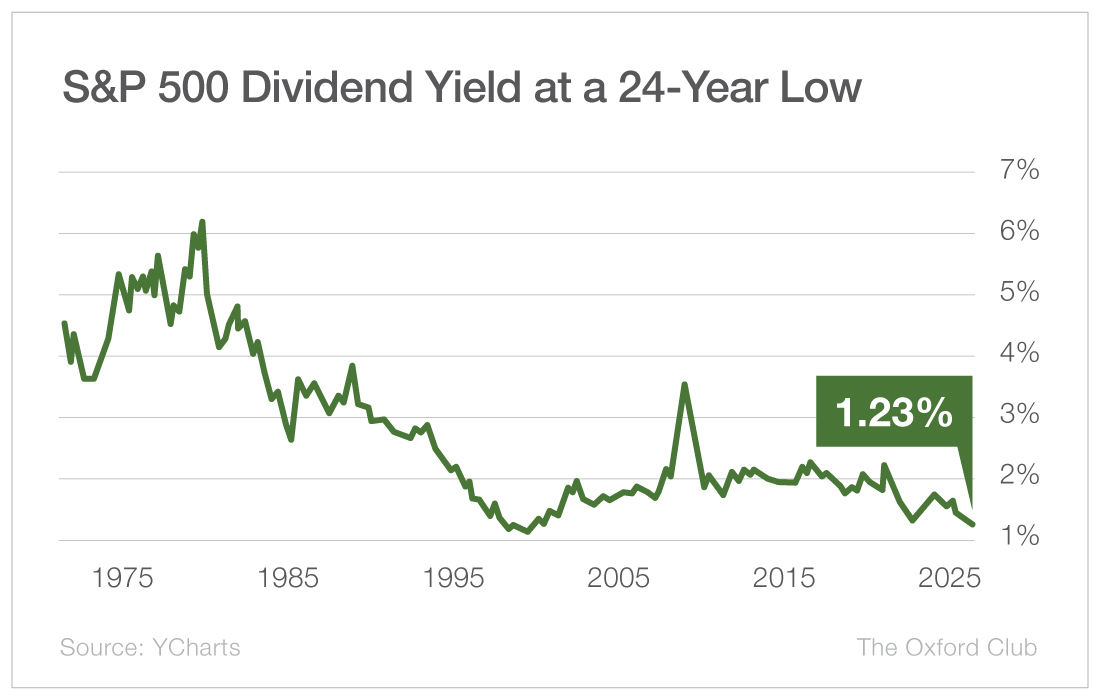
And it’s not just because stock prices have gone up. The market has fundamentally changed in ways that many income-focused investors haven’t fully grasped yet.
Let me explain why this matters and what you can do about it.
Think back to the old days, when you could build a solid retirement portfolio around blue chip dividend stocks. Companies like Coca-Cola, AT&T, and Procter & Gamble were the backbone of many income portfolios.
Those days are fading fast.
The S&P 500 looks completely different today than it did just a decade ago. Technology companies, which made up about 18% of the index in 2014, now account for more than 30%. Meanwhile, consumer staples and utilities, two mainstays for dividend investors, make up just 5.4% and 2.4%, respectively.
This shift toward tech has dramatically changed what it means to be a dividend investor.
Why? Because tech companies typically pay very small dividends – if any at all. Instead of paying out their excess cash to shareholders, they prefer to reinvest it into growth or buy back shares.
Even more telling is what’s happened to so-called high-dividend strategies. If you buy a high-dividend ETF today, you might be surprised to learn that “high” now means about 2.7%. That’s a far cry from the 4% to 5% yields these strategies used to deliver.
Think about that for a minute. Even if you explicitly focus on dividend-paying stocks, you’re still looking at yields well below what you can get from a simple Treasury bond these days. For the first time in over a decade, bonds are actually paying more than dividend stocks.
But here’s the real kicker: To get those higher dividend yields, you often have to give up exposure to the market’s fastest-growing companies. Most dividend funds have only tiny allocations to technology stocks – the very sector that’s been driving much of the market’s growth and innovation.
This puts income investors in a tough spot. Do you chase yields and potentially miss out on growth? Or do you accept lower yields in hopes of capturing bigger capital gains?
There’s no easy answer, but there is a smarter way to think about it. Instead of focusing solely on dividends, investors need to look at their total return potential – combining modest dividend yields with bond income and potential price appreciation.
Consider this three-pronged approach:
- Build a core portfolio in dividend payers with strong fundamentals and growing payouts.
- Include a very healthy dose of bonds, which are now offering some of the highest yields we’ve seen in a decade.
- Add a strategic allocation in growth stocks (yes, even those tech companies with little to no yield).
This might feel like heresy to investors who primarily seek out dividend income. But the market has changed, and our strategies need to change with it. With corporate bonds yielding over 5% and Treasurys above 4%, bonds can now provide the steady income that dividend stocks used to deliver.
Of course, change is the nature of investing. As market conditions shift, so should your portfolio strategy. Adaptability is essential to long-term success, so don’t let old rules of thumb keep you from adapting to new market realities. The days of exclusively living off of stock dividends may be over, but that doesn’t mean you can’t build a solid income portfolio.
Remember, successful investing isn’t about clinging to what worked in the past – it’s about understanding how markets evolve and adjusting your strategy accordingly. Today’s market may not be as friendly to traditional dividend investing as it once was, but it still offers plenty of opportunities for those who are willing to keep an open mind.
A Note From Chief Income Strategist Marc Lichtenfeld: On June 12, 2025, I issued an exciting announcement – a new feature of The Oxford Income Letter that is designed to put more money in readers’ pockets.
Starting with the July issue, for the first time in the 12-year history of The Oxford Income Letter, I’m going to be adding some growth stocks to the portfolio.
The reasons are simple. The timeline on our income stocks is indefinite. We’d like to hold them for as long as possible if they cooperate and continue to pay dividends. But if we can cash in a big winner in a shorter amount of time, we can invest those profits back into dividend payers and generate even more income.
Moving forward, our portfolios will now mirror the “three-pronged approach” Anthony discussed in the February issue, as July will mark the debut of our new Strategic Growth Portfolio.
These growth recommendations will not come at the expense of income-producing investments. I’ll still issue at least one new dividend stock pick each month, just like always. But starting in July, you’ll also receive the occasional growth stock recommendation when I believe it’s too good an opportunity to pass up.
Marc’s Mailbag
Q: Hi, Marc. Along with your colleagues, you show a ruthless, “Mike Tyson leaping left hook” brutality when it comes to observing 25% stop losses. I am, by nature, a compulsive bottom feeder, and my interest is often piqued when smart people start bailing on a stock that seems caught in a downdraft, even if there are (hopefully temporary) glitches in the fundamentals. Having subscribed to many dozens of newsletters over the past 35 years, The Oxford Income Letter (the whole Oxford Club gang, really) has become my all-time favorite. I trust the thoughtful, even-keeled, well-reasoned advice, and I’m glad to have found you.
How do you have such confidence that a 25% drop is where to set a stock free? A 25% drop is the beginning of where I start nibbling. Starting a position when a company is in the dumpster seems like a brilliant move, but my wife will explain that many of my ideas are brilliant only to me. Perhaps a change in philosophy is due?
Thanks for doing what you do. Not only have you made my life better, but many of your lessons live on in my kiddos. My 19-year-old daughter at NC State changes her own oil in her apartment parking lot and sends the savings to her Verizon DRIP. Thank you. − Joey, January 2025
A: Thanks, Joey. I assume you’re talking about Mike Tyson circa 1988, not the 58-year-old who barely threw a punch against a circus act in November.
The 25% stop loss figure comes from the idea that you should never invest more than 4% of your portfolio in any one position. That way, the worst-case scenario for any stock is that it causes your portfolio to drop by 1%.
A 1% decline is easy to bounce back from. If the stock slides more than that, the loss gets larger and it becomes more difficult to get back to even.
Starting a position after a stock has been hammered can be a sound strategy, but I need more of a reason to buy than the fact that it’s 25% cheaper than before. If you can find a quality company that generates enough cash flow to afford (and grow) its dividend, buying the stock while it’s “on sale” can be a very good − perhaps even brilliant − idea.
Lastly, not many 19-year-olds have the foresight to invest like that, even if their parents explain the benefits. Your daughter sounds very smart. The Wolfpack is lucky to have her.
Q: Hello Marc and team, as I am planning my dividend portfolio purchases, I’m seeing that most of your “Buy” recommendations recommend a tax-deferred account, which I believe would equate to an IRA.
I’m 53 years old, and I would have access to withdrawals at 59.5 years old, so all good there. But I’m curious what is behind the recommendation for some dividend stocks, like Cogent Communications (Nasdaq: CCOI), to be taxable, and some to be in tax-deferred accounts, like AbbVie (NYSE: ABBV), for example. Thanks for any light you can shed on this. − Andy, March 2025
A: This is one of the most common questions that I receive − and it’s a good one, so I’m happy to address it.
Any stocks that are recommended for a tax-advantaged account can also be held in a taxable account. But I recommend holding them in a tax-deferred account like an IRA or 401(k) if possible so you can delay paying the taxes on the dividends. If you hold them in a taxable account, you’ll have to pay the taxes on the dividends in the year you receive them.
I recommend holding partnerships, most international stocks, and other stocks whose dividends are mostly return of capital (like Cogent Communications) in taxable accounts for the following reasons.
Most foreign governments will take taxes out of your dividends before you receive them. When that happens, you will receive a foreign tax credit from the IRS − but only if the stock is held in a taxable account. If it is held in a tax-deferred account, the foreign government will still take taxes out of the dividend, but you will not receive a credit from the IRS.
(One exception to this is Canada, which does not collect taxes on dividends from American investors if the stock is held in a tax-deferred account.)
Partnerships and other companies whose dividends are a return of capital should also be held in taxable accounts, because return of capital is not taxed in the year it is received. It lowers your cost basis instead, which increases your capital gain and your tax when you eventually sell.
For example, if you buy a stock at $20 and receive a $1 distribution that is a return of capital, your new cost basis is $19. If you then sell the stock at $25, you will be taxed on a capital gain of $6, not $5.
If you buy a partnership with the intent of holding it for the long term to collect the dividends, you’ll generate tax-deferred income for years even if you hold the stock in a taxable account. That can help accelerate your compounding or simply provide you with the income you need.
Because partnerships’ distributions are already tax-advantaged, holding them in a tax-deferred account would take up space that could be better used by something less tax-efficient, such as a dividend stock (whose dividends are taxed in the year you receive them) or a bond (whose interest is taxed at the higher ordinary income tax rate).
Q: I’m a new subscriber, but given the market’s recent drop, I’m afraid to get started. Should I wait until things have settled down to buy some dividend stocks? − Sally W., April 2025
A: Welcome, Sally. Thanks for subscribing.
Your concern is completely understandable. No one wants to put money into the market only to see it go down immediately. But here is a very important thing to realize: If you wait until things have calmed down, you will almost always wind up buying higher.
Here’s why: After a pullback, we don’t feel optimistic until we’ve seen some proof that the market is rising again. Investors who’ve seen their accounts fall are understandably gun-shy to get back in or buy more shares. But that’s precisely when you should do it. If you wait too long, you miss a big part of the run-up.
If you’re a long-term investor, don’t be concerned that the market is in a downswing. Over the years, that won’t matter. The market has returned an average of 9.7% per year since 1900. That includes some pretty nasty bear markets.
The way to achieve those kinds of returns is not by waiting for the bear market to be over, but by investing during the bear market. That ensures you’re getting in at better prices than you would’ve previously. (You likely won’t get in at the absolute low, but you will get in lower than most people.)
That being said, to avoid stress, you may not want to fire all of your bullets at once. Think about how long you want to take to deploy your capital. Maybe it’s six months, one year, two years, etc. Divide your capital into months or quarters and commit to investing at regular intervals no matter what the market is doing.
Remember, if the market is tanking, you’re getting in low. It won’t feel good in the moment − in fact, it will be downright scary. But you’ll thank yourself in a few years when the position has risen considerably and you’re enjoying a big yield because you bought the stock cheaply.