 You are now logged out.

America’s Energy Surge: Powering the AI Century

In modern history, many periods have been defined by technology that fundamentally changed business practices.
During the 18th century, the steam engine allowed the first modern factories to be built and started the Industrial Revolution…
The 19th century saw the rise of many technologies that ushered in new phases of industrialization around the world. The railroad, advanced steel production, the combustion engine, and coal-fired power plants sped up the pace of business, travel, and everyday life.
And in the 20th century, we saw the rise of air travel, the modern assembly line, and, later, the development of the internet. The internet created as profound a change to how we live and work as the invention of fire in the Stone Age.
The next great technology is already here… artificial intelligence, or AI.
The 21st century will be the AI century. Even in its infancy, AI has changed the game. The technology has been widely available for only a few short years, but the global AI market is already valued in the hundreds of billions of dollars, with multiple forecasts projecting several-fold growth over the remainder of the decade.
But AI has one serious problem. And it’s likely not what you think…
Our hardware is capable of incredibly complex tasks.
Our software is up to the challenge.
But our energy grid is not.
America’s energy grid is practically ancient, and years of underinvestment and regulatory uncertainty have left the U.S. power grid ill-prepared for the surge in AI-driven demand.
See, AI is a glutton for electricity.
A ChatGPT query uses 10 to 25 times more energy than an ordinary Google search. Users ask ChatGPT roughly 10 million questions daily, which consumes the same amount of energy as it takes to power 180,000 American homes. And that’s just one AI service.
Generative AI is expected to drive a sharp increase in electricity demand over the coming years as data-center capacity expands globally.
Google’s AI uses the same amount of energy in a single hour as is needed to fully charge over 25,000 electric cars.
In fact, data centers alone already use more power than most countries. According to the International Energy Agency (IEA), global data-center electricity consumption has already reached levels comparable to those of large industrialized nations — and continues to rise. That’s more power than 185 of the world’s 195 countries consume, including the United Kingdom, Brazil, and Germany.
In short, the amount of energy needed to run AI is enormous. By the end of the decade, electricity demand from AI-driven data centers is expected to rise dramatically, placing unprecedented strain on existing power infrastructure.
America is facing an energy crisis in the AI arms race. And there is only one solution…
Drill, Baby, Drill!
With a more energy-friendly policy environment now taking shape, the rising tide will lift all ships: nuclear, coal, oil, etc…
But the biggest beneficiaries will be natural gas companies like The Williams Companies Inc. (NYSE: WMB)…
America possesses enormous reserves of natural gas. We have a full 3,000 trillion cubic feet of it underground right now. That’s more than Saudi Arabia or Russia. It’s enough to fill the Grand Canyon 20 times over. We have more than we could ever use to fuel our AI boom while exporting it to Europe.
Trump plans to unlock America’s latent energy potential by reversing former President Joe Biden’s policy and encouraging greater exports of U.S. oil and natural gas to global allies. We have the perfect setup for a big run in natural gas, and Williams is perhaps the best way to play it.
The company’s business is simple: It extracts and transports natural gas. It owns a vast network, 30,000 miles of pipelines, and dozens of facilities that connect the United States’ natural gas-producing regions from coast to coast.

Williams extracts natural gas from most of America’s major gas basins and the Gulf of Mexico, also known as the Gulf of America. It also transports natural gas through its pipelines, keeps it in its storage facilities, and exports it through America’s major energy hub, the Gulf Coast.
In all, Williams handles 30% of the natural gas Americans use every day.
Why is natural gas such a big deal? As an energy source, it’s the cleanest variety of fossil fuel. It produces less than half the greenhouse gases of coal and significantly less than oil. As a heating source, it’s four times cheaper than electricity and the cheapest method of heating a home by far.
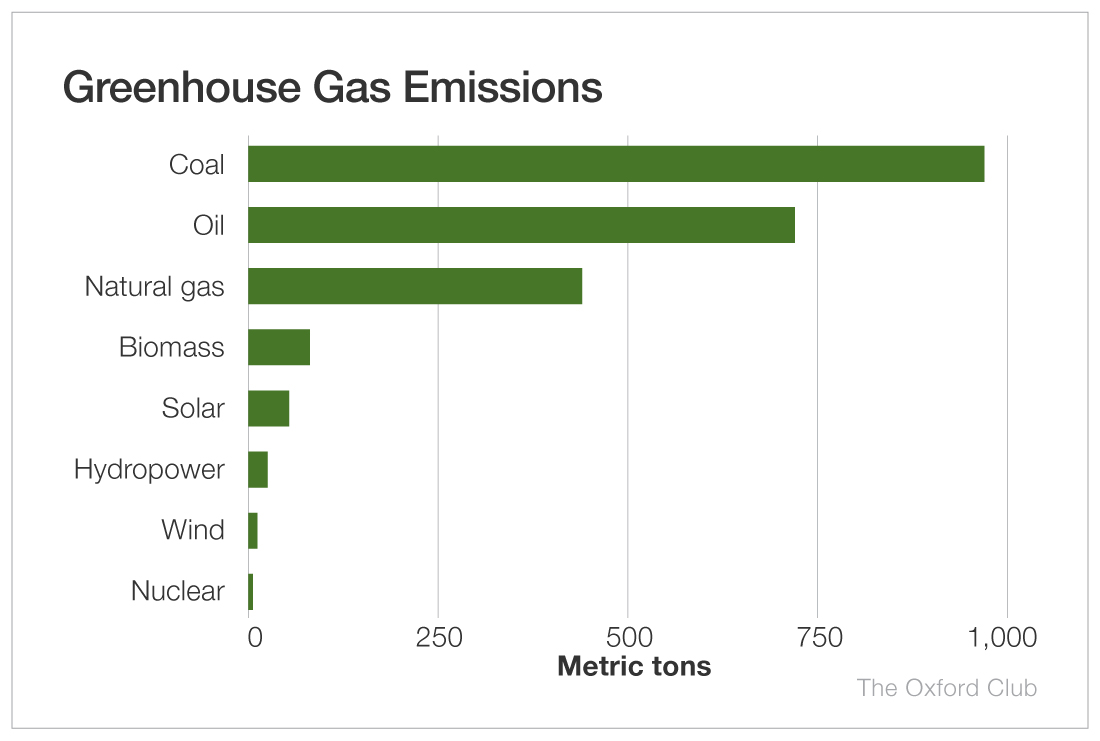
And Williams is dedicated to improving the environmental friendliness of natural gas as well. The company has invested tens of millions of dollars in carbon-capture and emissions-reduction initiatives. ION Clean Energy is developing technology to capture carbon in the air after fossil fuels are burned. That should give the green lobbies even less to complain about. Not only does natural gas produce less greenhouse gases than its fossil fuel counterparts, but now we can pull the carbon emissions it does produce out of the air.
What’s more, carbon capture is just one of Williams’ multibillion-dollar backlog of growth projects scheduled to come online over the coming years. And those are projects it accumulated through four years of an administration openly hostile to fossil fuels. Just imagine what Williams will be capable of under a friendly administration…
The company’s already impressive balance sheet will only grow… and grow quickly.
Cooking With Gas
Let’s start with revenue. Williams most recently reported Q4 2025 revenue of $3.2 billion, reflecting steady year-over-year growth driven by increased volumes and higher natural-gas demand. Net income continued to grow year-over-year, supported by higher throughput and disciplined cost control.
The company’s earnings per share have trended higher over time, reflecting operating leverage and a stable fee-based business model.
Other good news for Williams’ finances includes a 35% operating margin, a well-managed balance sheet supported by strong operating cash flow, and a competitive dividend yield.
President Trump’s pro-energy policies have laid the foundation for sustained profits. Given the firm’s positioning and the long-term demand outlook for natural gas, the company remains well-positioned to benefit from the AI-driven energy buildout.
Action to Take: Buy The Williams Companies Inc. (NYSE: WMB) at market. Use a 25% trailing stop to protect your principal and your profits.