 You are now logged out.
Advanced Energy TrendWatch – Q2 2017
Electric Vehicles and Renewable Energy
Electric Vehicles Are Almost at the “Tipping Point”
Every day, it seems like electric vehicles are in the news with increasing frequency.
And it’s no wonder…
Nearly every major car manufacturer has committed billions of dollars and issued rollout plans for numerous EV models.
The current EV battery technology is lithium-ion. That means lithium demand is already starting to soar.
That’s why I’m devoting three-quarters of this month’s issue to an update on EVs and three new lithium miners.
We already have one lithium miner, Lithium X Energy Corp. (OTC: LIXXF), in our portfolio. Why am I adding three more?
This one is an easy call.
With EVs on the verge of disrupting the $10 trillion transportation sector, lithium demand is about ready to launch into the stratosphere. And I want all my subscribers to come along for the ride.
Longtime readers know I’ve been fascinated by EVs for nearly a decade. My wife and I have owned two of them over the last four years.
Our driving experiences with them have been absolutely hassle-free. While low to almost no maintenance is a big incentive for owning an EV, it’s certainly not the only one.
Hate stopping for gas fill-ups for your gas-guzzler? With an EV, your gas station is hanging on the wall in your garage.
You can easily program your EV to recharge while you sleep. Some homes are equipped with dual-rate electric meters. If yours is one of them, it will cost you even less to recharge in the evening, when rates are lower.
If you’re taking your EV on a trip, you’ll find the number of EV charging stations is increasing exponentially. And there are plenty of other charging options I’ll discuss later on in this article.
I calculated that my wife saves 1.5 days per year by not having to stop and put gas in her car. Wouldn’t you like to have that extra time to do something with?
The slew of new EVs that will hit dealer showrooms this year and next will be sporting batteries with 250- to 300-mile ranges. And buying an EV is becoming less of a wallet breaker every year.
Battery costs are roughly one-third the cost of the typical EV. And those costs are dropping every year. Over the last six years, EV battery costs have fallen 80%, and more decreases are coming.
There’s Fast, and Then There’s EV Fast
If you like fast acceleration, an EV is your ticket to driving exhilaration. The acceleration will knock your socks off. Even a small EV, like the Nissan Leaf (our first EV), will out-accelerate most midlevel sedans with internal combustion engines (ICEs).
However, for a real treat, park yourself in the driver’s seat of a Tesla Model S or Model X (our current EV). Fasten your seat belt, take a firm grip on the steering wheel and step on the accelerator. What happens next will absolutely frighten you.
Ninety kilowatts of electrical energy is applied to two electric motors. If you have the acceleration set to “Ludicrous Mode” in the Model X, 532 horsepower will move you from zero to 60 mph in a mere 3.2 seconds. Not bad for a car with a curb weight of 5,381 pounds.
An EV’s fast acceleration is due to the torque characteristics of electric motors. It turns out that maximum torque is available at zero revolutions per minute, whereas an ICE’s torque is at its greatest at several thousand rpms.
That means an EV will almost always out-accelerate an ICE vehicle. It’s a real surprise to most people who’ve never driven an EV.
But fast acceleration – or our knowledge of how to make EVs – isn’t what’s bringing the adoption of EVs to a tipping point…
It’s the infrastructure necessary to recharge them. Though that’s being built, it’s still an issue in some areas.
Consumers aren’t going to rush out and buy these vehicles if they don’t have plenty of recharging stations available. The fear of getting stuck somewhere is a real issue with low-capacity batteries like the Nissan Leaf’s.
On the flip side, it’s the classic chicken-and-egg problem. Who’s going to spend lots of money to build EV chargers when few cars are going to use them?
Elon Musk, that’s who. The genius CEO of Tesla Inc. (Nasdaq: TSLA), Musk decided to not only build EVs, but build out a nationwide charging network at the same time.
Sure, it cost Tesla hundreds of millions of dollars to install 734 Superchargers with 4,605 charging points. But without them, potential Tesla buyers might balk at buying its vehicles.
It was a clever idea, and it worked. Early Tesla customers (like my wife and I) were promised free charging for the life of the car.
Once potential owners realized they had a nationwide network of charging stations, there was no reason not to buy one. While early Tesla buyers were grandfathered into free charging for life, new Tesla buyers are not.
Tesla now gives away 400 kilowatt-hours (kWh) of Supercharging credits per year with each new car purchase. That’s good for about 1,000 miles of driving annually.
After that, drivers will pay a fee per kWh that varies by state in the U.S. and by country overseas. If they don’t drive their cars on many trips, Tesla owners might not even use all their annual Supercharger credits.
Tesla is now selling so many cars that it’s outgrown the need to give away electricity. Besides, newer batteries power the cars further than ever, reducing the number of charges on a given trip.
And it’s not like car owners aren’t used to paying to drive. Gasoline isn’t free, and electricity isn’t either.
Here’s a statement that Tesla recently published regarding the pricing of Superchargers: “To put the affordability of Supercharging into perspective, customers will pay about $15 for a road trip from San Francisco to Los Angeles, about $120 from Los Angeles to New York, about 60 euros from Paris to Rome, and about 400 yen from Beijing to Shanghai.”
Chargers for Everyone Else
While Tesla chargers are great for Tesla owners, no other EV can use them. That’s because Tesla has a proprietary charging system and a special plug.
Tesla owners, on the other hand, can use any EV charger. So where’s the incentive for other manufacturers to install chargers?
While they were mulling this over, Washington, D.C., decided to jump-start this piece of the EV puzzle.
It all started in July 2016. That’s when the Federal Highway Administration sent out a request to all 50 states to nominate alternative fuel corridors.
The initial response, while not overwhelming, was excellent. Thirty-five states sent the Federal Highway Administration 85,000 miles’ worth of roadways they consider important alternative fuel routes.

As you can see, there are a few major holes in the first version. For instance, Florida’s 20 million residents have almost no identified corridors.
It sounds like Florida’s Department of Transportation was just too lazy to send in a response. Either that or it doesn’t believe Florida drivers are adopting EVs at the same rate that drivers elsewhere are.
However, Florida has a robust EV adoption rate of 0.52 plug-in EVs per 1,000 people. That means Florida has at least 10,400 EV owners.
And as you can see from the map below, those EV owners have more than 800 public charging locations with a total of 1,776 charging outlets. This doesn’t include privately owned stations at restaurants and hotels.

I’ll bet that if you superimpose an interstate highway map over the above charging locations, you’ll find most are close to major highways. Florida needs to get with the program here.
These stations already exist. They just have to be marked on the highway.
Texas’ 27 million residents have plenty of identified corridors already. While Texas has a lower EV adoption rate than Florida of 0.37, that still means there are at least 9,900 EVs in the state, with more arriving all the time.
There’s no question that a nationally identified alternative fuel corridor is a great start for identifying charging spots. And EV owners have plenty of other options to find free places to recharge.
EV owners very likely have the free PlugShare app on their phones already. It contains a database of more than 142,000 charging locations both here and abroad.
It tells them if the charger is public, high power and even if it is in use. It will also show every residential charger that PlugShare members elect to share with other members.
It turns out that EV owners are a friendly bunch of people – at least everyone I’ve met so far has been.
But charging stations are just the beginning of the options EV owners have for recharging. It turns out that, with a few adaptors, EV owners have hundreds of thousands of additional places they can go to for electrons.
Let’s start with America’s more than 13,000 privately owned and 1,600 state-run recreational vehicle parks. There’s an app for them, too.
The RV Parks & Campgrounds app helps EV owners find them anywhere in the U.S. Fees and availability are all included. Even in an emergency, EV owners can probably talk someone in a full park into letting them steal some electricity, just by showing them their car.
But wait, I’m not done yet. Marina finder apps will point EV owners to more than 3,700 marinas and boatyards. At most of them, they’ll be able to get close enough to a power outlet to borrow some electrons.
As I mentioned above, they’ll need adapters to connect to an RV electrical outlet or marina power outlet. They’ll also need a heavy-duty extension cord to run from the outlet to their EV.
A wire size large enough to handle 30 to 50 amps of charging current costs a few hundred dollars. Adaptor plugs cost a few hundred more.
Frankly, I think it’s a worthwhile investment. Remember, these are all potentially “free” sources of fuel.
Lastly, there are four different styles of plugs that cover all electric clothes-dryer outlets built since the 1950s. Why not buy one of each?
An EV owner can then run their charging cord into their friend’s laundry room while they stay there overnight. The next morning, they’ll have a fully charged EV ready to go.
Now we have charging networks popping up around the world. And car manufacturers have more than a hundred EV models in development.
EV Demand Takes Off
That’s all driving real EV demand from John Q. Public. In 2016, worldwide plug-in vehicle sales totaled 773,600 units.
That’s a 42% jump over 2015 sales. But here’s the real statistic we need to pay attention to: Plug-in vehicle sales grew 20 times faster than the overall market.
Even with that torrid growth, EVs make up just 0.86% of the world vehicle market. December 2016 was the highest month ever for EV sales, with 102,500 units sold.
Plug-in vehicle sales have more than tripled since 2013. As you can see from the graph below, the growth curve is starting to steepen for EVs.

Even though the numbers are still tiny compared to the overall vehicle market, the EV sector is growing at a rapid pace. That’s good news for the industry and even better news for us as investors.
So what’s the best way to invest in the EV market? The problem with charging stations is they are either proprietary or made by a company that has other businesses too.
Investing in a company that makes EV chargers would be a perfect EV pick-and-shovel play. However, there is really no good pure-play charging company that I like.
But the best way to play the coming EV boom is completely different from charging stations.
Every EV needs battery packs.
It seems every EV manufacturer has its own proprietary battery cell configuration. But that doesn’t matter, because the current battery chemistry for all EVs is lithium-ion.
Lithium hydroxide is one form of lithium used to produce the part of the battery called the cathode. Lithium carbonate is another.
And both come from the mining of raw lithium.
Before I delve into the three lithium mining companies I’m recommending in this issue, let’s do a quick review of how and where lithium is mined.
Lithium Mining Down Under
In its pure form at room temperature, lithium is the lightest of all metals. And it is the least dense of all the solid elements.
It is an extremely alkali metal, making it highly flammable and reactive. As a result, pure lithium is generally stored in mineral oil.
Because of its reactive properties, pure lithium is never found in nature. Instead it is found in compounds and minerals.
It is soluble and found in ocean water in small concentrations. The commercial mining of lithium is generally focused on clays and brines.
From 2015 to 2016, lithium production increased 12%. Worldwide production was 35,000 metric tons (MT) in 2016.
Lithium production comes from both hard rock mining and the evaporation of brines. Let’s focus on the hard rock operations first.
Australia has been the top lithium hard rock miner and the top lithium producer for the last several years, fulfilling roughly one-third of the current world demand for lithium. Its 2016 production was 14,300 MT. The U.S. Geological Service has identified about 2 million metric tons of lithium resources in Australia.
Headquartered in Australia, Talison Lithium Limited (OTC: TLTHF) is the world’s biggest lithium producer.
The majority of China’s lithium demand is met through Talison’s production. Talison produces lithium from its Greenbushes Lithium Operations.
Greenbushes has been producing lithium for more than 25 years. The lithium at Talison’s Greenbushes mine is contained in a mineral called spodumene.
It is the highest-grade lithium hard rock mineral resource in the world.
The Lithium Triangle
The other and more common way that lithium is produced is by extracting it from brine concentrates found around the world. In the U.S., there are salt beds with underlying brine concentrations found in California and Nevada.
China and Russia are developing brine resources, too. But nowhere is there a higher concentration of brine resources containing lithium than in the high-altitude salars of Bolivia, Argentina and Chile.
That’s why the region is known as the “lithium triangle.” See the map below.

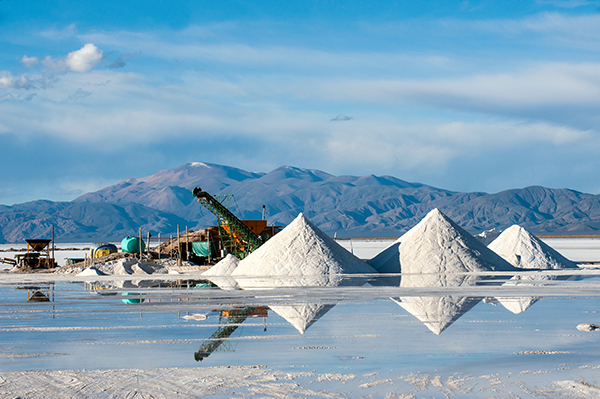
Producing lithium from salars is relatively simple. The brine is pumped to the surface and enclosed in evaporation ponds. The climate where the salars are located is high desert.
Rainfall there is measured in inches per decade, i.e., it almost never rains. This makes for excellent evaporation rates.
While the technology is simple, evaporation can still take 18 to 24 months. Once the brine is dried, the lithium carbonate can be extracted, along with iodine and other chemicals.
Let’s take a look at the first of our three new lithium miners.
The World’s Largest Lithium Miner
Albemarle Corporation (NYSE: ALB) is the first lithium producer we’ll be adding to our portfolio today. Founded in 1887, Albemarle has about 5,000 employees and customers in more than 100 countries around the world.
The company has a market capitalization of $11.7 billion. For 2016, its net sales were $2.7 billion. It currently sports a 1.2% dividend yield. Thirty-six percent of its 2016 sales came from its Lithium and Advanced Materials division.
Thirty percent came from its Bromine Specialties division, and 27% came from its Refining Solutions division. Finally, 7% came from miscellaneous other products.
The company’s lithium division is experiencing double-digit growth. In fact, earnings in this segment grew 34% in 2016 over the previous year’s earnings.
To enhance its position in the lithium space, the company acquired Rockwood Holdings. This gave Albemarle a market-leading position in lithium, bromine, catalysts and surface treatment. It is now the No. 1 lithium producer in the world.
In January 2017, the company acquired Jiangxi Jiangli New Materials, a Chinese lithium conversion company. This gives Albemarle additional capacity to convert lithium to the lithium-based chemical compounds used by various industries – for example, the lithium carbonate and lithium hydroxide used in battery production.
Jiangxi Jiangli New Materials currently has a throughput capacity of 15,000 metric tons (MT) per year. It can easily expand as required to match Albemarle’s growth.
Last September, the company announced that it had reached an agreement with Bolland Minera S.A. The agreement gave Albemarle exclusive acquisition and further exploration rights to a world-class lithium resource in Argentina.
The resource is located in Antofalla in the Catamarca province. The company believes that further testing will prove that this resource will be ultimately certified as the biggest lithium resource in Argentina.
Of course, owning a large lithium resource and being able to extract the lithium are two different things. And that’s where Albemarle shines.
John Mitchell, president of Albemarle’s Lithium and Advanced Materials global business unit, had this to say in a press release regarding the Argentine resource: “For the past 80 years, we have developed proprietary lithium extraction know-how, which will enable us to evaluate the lithium resource.”
To complement Albemarle’s Argentina lithium assets, the company announced in January that it had reached an agreement with the Chilean Economic Development Agency. The agreement gives Albemarle the authority to increase its lithium quota at its Chilean facility in the Salar de Atacama.
The updated agreement gives Albemarle sufficient lithium to produce more than 80,000 MT annually. Production would consist of battery-grade lithium products. The agreement covers 27 years of production at the company’s manufacturing facilities located in La Negra, Antofagasta, Chile.
Albemarle isn’t a newcomer to Chile. It began extracting and processing lithium in the country 36 years ago.
A few years ago, Albemarle and other producers were stymied by an uncooperative government that wanted high royalties and unreasonable taxes on lithium production, making it uneconomical to produce there.
The current Chilean government couldn’t be more different. It realizes that welcoming foreign investment in lithium mining will benefit the country.
So it began executing mining documents and permits with foreign companies that were ready and willing to mine Chile’s excellent lithium resources.
As a result, Albemarle now has access to what it calls “the best lithium brine reserve in the world.” With both Chilean and Argentine lithium assets, Albemarle is poised to capture 50% of the global market growth in lithium.
By 2021, Albemarle wants to be able to produce 165,000 MT of lithium annually. It’s a strong growth story for the company.
But Albemarle won’t be able to hit that production target with its Chilean and Argentine assets alone. Remember, lithium is produced from brines that underlie salars as well as from the mining of spodumene, a hard rock containing large amounts of lithium.
Fortunately, Albemarle owns the world’s largest active hard rock lithium mine. It’s the Greenbushes spodumene mine in Australia.
Last month, Albemarle announced that it will be expanding the Greenbushes mine and its production facilities. The expected throughput will increase from its current 80,000 MT per year to more than 160,000 MT per year.
Albemarle has a 50% interest in Greenbushes, with Tianqi Lithium Corporation owning the other 50%. Talison Lithium, the lithium producer I wrote of earlier, is a joint venture between the two companies. The Greenbushes expansion is set to begin in mid-2019.
As if that’s not enough, Albemarle owns the Clayton Valley, Nevada, lithium production facility. While currently small in scale, it is the first and only operating mine in North America.
In 2016, revenues from the Lithium and Advanced Materials division were $968 million. While the big growth area for lithium will be energy storage, lithium also has other uses.
For instance, glasses, ceramics, greases, lubricants, elastomers and pharmaceutical synthesis all use lithium. But the volume is all going to be driven by energy storage coming from the EV, home and commercial storage sectors.
Car manufacturers are beginning to sign long-term supply agreements in order to maintain a flow of lithium for batteries. And battery costs are declining at the same time as performance is improving.
In summary, Albemarle has the largest industry lithium reserves of both brines and hard-rock spodumene. Its expansion plan is in line with the expected increase in demand for lithium for EV batteries.
For that reason, I believe this top-shelf lithium producer deserves a spot in the Advanced Energy Strategist portfolio. Its unmatched global footprint will be almost impossible to duplicate.
Action to Take: Purchase shares of Albemarle Corporation (NYSE: ALB) at market. Use a 25% trailing stop to protect your principal and your profits.
An Emerging Low-Cost, Low-Risk Lithium Miner
The second company we are adding in this quarter’s report is Lithium Americas Corporation (OTC: LACDF). While the stock is more liquid on the Toronto Stock Exchange, we will track the OTC markets symbol in our portfolio.
Lithium Americas is advancing two independent brine mining projects. The first is the Cauchari-Olaroz project, located in Argentina.
Lithium Americas is partnering with Sociedad Química y Minera de Chile (NYSE: SQM) in a 50-50 joint venture partnership to construct and operate the Cauchari-Olaroz project. The Cauchari-Olaroz is fully permitted and ready to build. The map below gives you an idea of where it’s located in the lithium triangle.

The initial capacity of Cauchari-Olaroz is designed to be 25,000 MT of lithium carbonate per year. However, the project design is easily scalable to 50,000 MT per year.
Lithium Americas recently announced a debt financing project of $286 million from two investors to fund its share of the construction costs for Cauchari-Olaroz. Construction is expected to start before the end of June, with the first stage of production beginning in early 2019.
The company also owns a clay-based lithium resource in Nevada through its wholly owned subsidiary, Lithium Nevada Corp.
The area of mineral claims owned by Lithium Nevada covers approximately 37,641 acres. The initial area of focus and study covers an area of 3,627 acres.
The lithium in this deposit is in a rare clay material that includes hectorite and illite clay minerals. They both contain lithium and magnesium in varying concentrations.
Over the study area, the thickness of the mineral layer varies from less than 1 meter to more than 90 meters. The average thickness is roughly 30 meters.
Back in 2014, Lithium Americas Corp. evaluated preliminary results from a demonstration plant designed to prove the economic viability of producing battery-grade lithium carbonate from the clay deposits. Preliminary results suggested that a new study was necessary to further evaluate the process’s technology.
Lithium Americas is focused on advancing processing technologies that will enable it to produce lithium hydroxide at its Lithium Nevada project. The company owns a large deposit of clays containing lithium. As of today, the processing plant has not been built. Lithium Americas is currently focused on advancing its Cauchari-Olaroz project in Argentina.
The number of shares currently outstanding is 315.3 million. Over the last year, shares have traded between $0.37 and $0.95.
The current market capitalization of the company is $222 million. It has a fully undrawn credit line of $205 million.
The management and directors of the company own about 4.6% of all outstanding shares. The top 10 institutional holders own another 5.75%.
There are plenty of “lithium mining companies” that won’t ever mine an ounce of lithium. Lithium Americas Corporation isn’t one of them.
With its 50-50 partnership with Sociedad Química y Minera and its recent $286 million cash infusion, it’s on its way to becoming a viable lithium carbonate producer within the next few years. And that’s why I’m adding it now to the Advanced Energy Strategistportfolio.
Note: Since Lithium Americas Corp. is a microcap company, I strongly recommend you purchase shares using a limit order. Use a not-to-exceed limit price of $0.70 per share.
There’s no need to rush into your position. If you do, you will drive the price up and end up paying a premium for your shares. Keep your purchases to fewer than 300 shares at a time.
Action to Take: Purchase shares of Lithium Americas Corporation (OTC: LACDF) using a limit order. Don’t pay more than $0.70 per share. Use a 50% trailing stop to protect your principal and your profits.
A Brand-New Up-and-Coming Lithium Mining Powerhouse
Our third lithium miner is brand-new. In fact, it’s so new that it’s not even trading on U.S. stock exchanges yet.
The company I’m talking about used to be called Portola Resources Inc. But on March 22, 2017, the company announced it was changing its name to Lithium Energi Exploration Inc.(CVE: LEXI) and began trading on Friday, March 24, 2017, under its new symbol.
More importantly, the company recently closed on the acquisition of 316,295 acres of prime Argentina lithium brine assets. The acreage is in the Argentine province of Catamarca, right in the middle of the lithium triangle.
The company’s acreage consists of several different projects. The Laguna Caro Project is 43,883 acres. Its Antofalla North Project is 102,539 acres. And the Antofalla South Project is 170,780 acres.
All three projects are located very close to each other in the Salar de Antofalla. Located in the northwestern corner of the Catamarca Province, the Salar de Antofalla is one of the most prolific lithium mining areas in Argentina.

FMC Corporation (NYSE: FMC), one of the largest lithium producers in the world, operates its Fenix mine just 10 kilometers northeast of the Laguna Caro project. The Fenix mine is Argentina’s largest lithium extraction plant – as well as one of the world’s largest.
The company’s Antofalla North and South projects are just west of its Laguna Caro operation.
Albemarle Corporation stated in a recent news release that it believes the Salar de Antofalla will eventually be certified as Argentina’s largest lithium resource. And our little newly formed company is sitting right in the middle of this.
Lithium Energi currently has 46.9 million shares outstanding. The market cap is a very small CA$9.4 million.
This is a true microcap stock. Shares currently sell for CA$0.20 on the Canadian Venture Exchange.
This is the last lithium miner we will be adding to the Advanced Energy Strategist portfolio at this time. My recommendation is you purchase small lots of shares if you decide to enter into a position here. By all means, use a limit order to avoid overpaying.
Doing otherwise will most definitely move the shares higher in advance of their true value. You could end up greatly overpaying for the shares, cutting into your profits.
Action to Take: Purchase shares of Lithium Energi Exploration Inc. (CVE: LEXI) using a limit order. Don’t pay more than $0.40 per share. Use a 50% trailing stop to protect your principal and your profits.
A Different Kind of Pick-and-Shovel Play
The last company I’m profiling in this quarter’s report is one you’ve likely never heard of. However, it’s very likely that you’re using or benefiting from its products every day.
There are countless consumer and commercial products that depend on this company to gain an edge over their competition. Its products are used in the oil and gas, healthcare, retail, automotive, RV, personal care, food service, industrial, construction, and refurbishment sectors.
The company is a global innovator of performance-enhancing surfaces and chemistries. The company I’m talking about is Omnova Solutions Inc. (NYSE: OMN).
The company has two divisions.
Its Performance Chemicals division makes latex binders, acrylics, resins, hollow plastic pigments, fluorosurfactants, opacifiers and bio-based polymers. This division was responsible for $549 million (72% of sales) for the year ended November 30, 2016.
The Engineered Surfaces division makes coated fabrics, specialty laminates and performance films. During the last fiscal year, its revenues were $211 million (28% of sales).
Moving forward, the company is targeting high-growth markets that have demands for high-performance and high-margin products.
The first area of targeted growth is in coatings. Omnova Solutions makes masonry, intumescent (fire-resistant), direct-to-metal, primer, odor and stain blocking, and wood treatment coatings.
The global market potential for coatings alone in the above categories is $25 billion. And the annual growth rate is expected to be 3% to 4%.
The second specialty growth area is adhesives. These include tapes, release coatings, construction binders and roofing.
The market potential for adhesives is greater than $20 billion annually. The growth potential here is 4% to 5% annually.
The third area of specialty growth is sealants. These include caulking, casting, cement, gaskets, foam sealants and concrete.
The sealant market potential is greater than $5 billion annually. The annual growth potential is 3% to 4%.
Finally, the last specialty growth area is elastomers. These are used in transportation, industrial and consumer thermoplastic products.
The annual market potential is more than $10 billion per year. The growth in this segment is 3% to 5% annually.
The above specialty product segments all share characteristics that Omnova is looking for. The products are high margin, serve large and growing markets, and have a customer need for differentiation. And Omnova has a position within all of these markets.
Even though Omnova is not a big company (its market cap is only $431 million), it is a fantastic growth play. Over the last year, shares have risen a healthy 79%.
And after its most recent earnings announcement, I expect they could duplicate that growth again this year. In its Q1 2017 press release, the company reported continued year-over-year earnings growth.
Q1 2017 earnings per share were $0.08 compared with a loss of $0.03 in Q1 2016. The adjusted earnings were $0.05 per share compared to $0.04 per share a year ago.
It was the eighth quarter in a row of year-over-year earnings growth. Anne Noonan, Omnova’s president and CEO, commented about the company’s Q1 achievements.
“During the quarter, we took a number of steps to continue driving profitable growth. We began to implement our One Omnova support organization, designed to increase our ability to respond quickly and efficiently to market opportunities. We anticipate annual savings of approximately $3 million when fully implemented by the end of our second quarter.
“Laminates and films grew 8.9% in the first quarter on the strength of sales into the luxury vinyl tile market and broad strength in a number of other laminates markets. New products in Performance Chemicals continued to gain traction with an increased mix of specialty new products in the pipeline. Also, at the beginning of the second quarter, we acquired Creole Chemical, a small Texas-based specialty chemical company that offers specialty cementing and stimulation additives utilized in the upstream sector of the oil industry.
“Raw material costs were up for the quarter, and we responded with an increased focus on value pricing for the non-indexed portion of our business while optimizing inventory levels. As we progress into the second quarter, we will continue to execute on our pricing initiatives to drive profitable growth.”
Omnova Solutions is a relatively unknown company to most investors. However, I believe it has significant growth opportunities ahead of it as our economy continues to grow.
Bold infrastructure spending will also have a positive impact on Omnova’s future revenues. I think that Omnova could be another one of our triple-digit gainers this year, and that’s why I’m adding it to the Advanced Energy Strategist portfolio.
Action to Take: Purchase shares of Omnova Solutions Inc. (NYSE: OMN) at market. Use a 25% trailing stop to protect your principal and your profits.
Well, that wraps up this quarter’s report. I’m already at work screening stocks for our next report, which will be published sometime in early July.
Good investing,

David Fessler