 You are now logged out.

The $8 Billion Pipeline Empire Powering America’s New Cities

President Trump has called for “Freedom Cities” to be built across America − brand-new cities that will rise from the ground… fueled by cutting-edge technology… and designed to reassert America’s dominance in the global economy and beat China at its own game.
The idea sounds like science fiction. But it’s real.
And here’s the part no one in the mainstream media is talking about: These cities – and the AI revolution driving them – will demand more energy than nuclear, solar, and wind could ever deliver on their own.
Even Elon Musk – the world’s most famous advocate for electric vehicles and renewables – admits it plainly: Without oil and gas, “civilization would crumble.”
While Washington debates policy and many firms chase headlines and shiny tech breakthroughs, one overlooked company already controls the critical infrastructure that will make Trump’s Freedom Cities possible.
That’s why I believe this $60 billion giant – quietly sitting in plain sight – could become one of the backbones of America’s next great energy boom.
Why Natural Gas Is Still a Keystone Resource of America’s New Energy Boom
If America wants to beat China in the race to build the cities of the future…
If we want to power entire Freedom Cities from scratch…
And if we want to fuel the explosive rise of artificial intelligence and data centers…
We must continue to embrace natural gas.
Today, natural gas fuels about 40% of America’s electricity. In some states, including Florida, that number is closer to 75%. That’s not a “transition fuel.” That’s a vital component of the U.S. power grid.
And demand is about to surge even more.
The International Energy Agency projects that data centers could double their power use by the end of 2030, due in large part to AI and cryptocurrency. By the end of the decade, data centers alone may consume more than the entire country of Japan, which boasts the world’s fifth-largest economy by GDP.
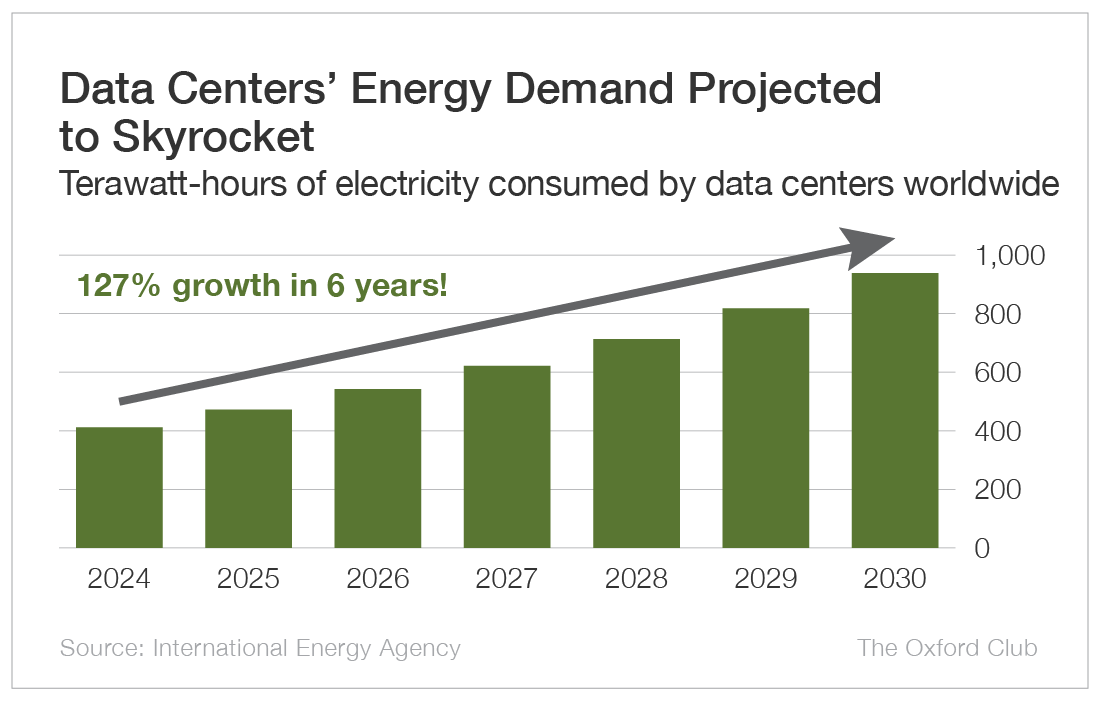
The Department of Energy warns that data centers could account for 9% of U.S. power demand by 2030, up from just 4% in 2023.
Utilities are scrambling, and grid operators are already warning of looming shortfalls. And natural gas is one of the fastest, cheapest, and most scalable ways to fill the gap.
Industry sources project that U.S. data center demand for natural gas will reach 3 billion to 6 billion cubic feet per day by 2030 − an amount comparable to powering the entire state of Florida.
According to my research, one pipeline giant has been proactively positioning itself to supply the lion’s share of that demand.
Simply put: America cannot build Freedom Cities, power the AI revolution, or cement its position as the world leader in innovation without natural gas. By extension, it can’t do so without this one critical company.
The Pipeline Powerhouse Behind America’s Next Energy Boom
When most people hear the name of this company, they yawn.
They think safe… boring… and slow growth.
But that’s exactly where they’re wrong.
Kinder Morgan (NYSE: KMI) is the largest natural gas infrastructure operator in North America. Its 70,000-mile network of pipelines is vast enough to wrap around the Earth’s equator almost three times. That network quietly moves about 40% of all the natural gas consumed in the United States.
There’s nothing boring about having a stranglehold on one of America’s most critical resources.
Unlike drillers, Kinder Morgan doesn’t depend on commodity prices. Its fee-based business model makes it more like a toll road: Gas flows through, and Kinder Morgan collects a check.
Since I began my research on Trump’s Freedom Cities, the company’s backlog of signed contracts has already risen from $8.8 billion to $9.3 billion. These aren’t pie-in-the-sky ideas. They’re long-term expansion projects that are already locked in and waiting to be built. That means billions in guaranteed revenue stretching years into the future.
Executives say the demand curve from AI and data centers is unlike anything they’ve seen in decades. To prepare, Kinder Morgan is designing expansions that could funnel the equivalent of an entire region’s gas supply into these facilities – securing years of fee-based revenue no matter where gas prices go.
In short, Kinder Morgan is laying the steel that will determine whether America’s energy system rises to unprecedented heights or collapses under the weight of new demand.
The Hidden Growth Story Wall Street Hasn’t Woken Up To
On the surface, Kinder Morgan looks comfy − a toll-road business cashing checks as gas flows across state lines.
But the opportunity gets even better when you consider how well the company is already doing – and how strong its foundation is.
In the most recent quarter, adjusted earnings per share jumped about 16% year over year to $0.29. Adjusted EBITDA (earnings before interest, taxes, depreciation, and amortization) followed with a healthy 6% gain to $1.99 billion.
The company also grew cash flow from operations and free cash flow by 13% and 5%, respectively, during the quarter. That’s all while it has been carrying a sizable – but manageable – debt load, with net debt-to-adjusted EBITDA sitting at around 3.9.
The runway is already built in. Kinder Morgan’s $9.3 billion project backlog is dominated by natural gas expansions under long-term, fee-based contracts. That means future cash flows are essentially set in stone, regardless of what happens to gas prices.
As a result, what looks like a quiet toll company is already generating steady profits, covering its costs, and locking in deals for years to come. It also has a 4.2% dividend yield and has raised the dividend eight years in a row.
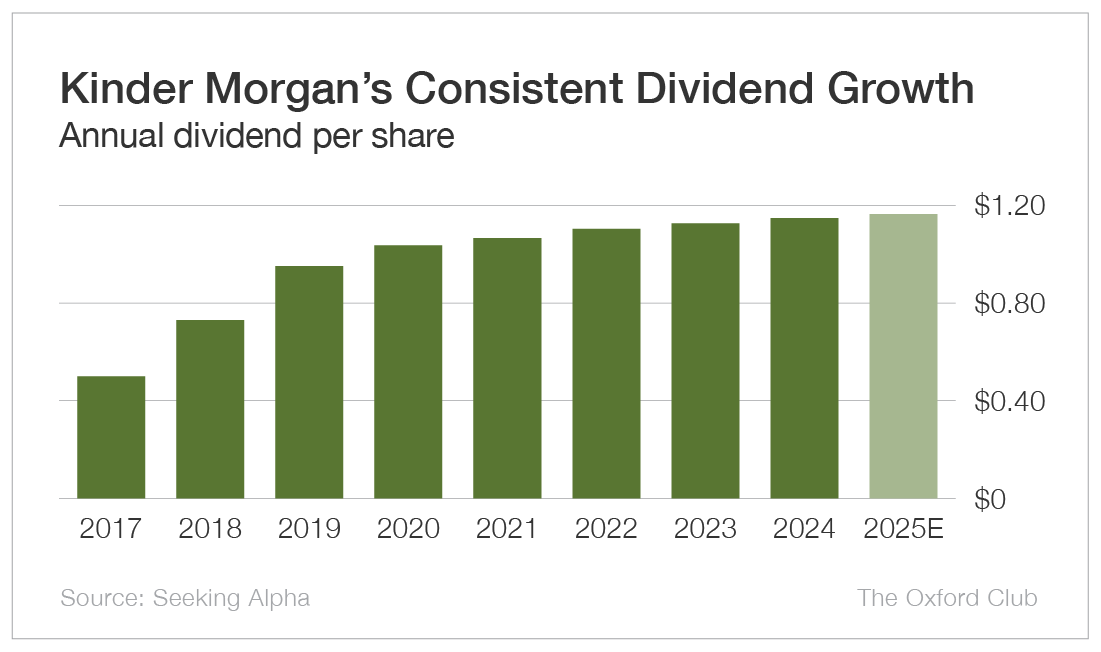
The foundation is solid. The trajectory is visible. And the upside for those who recognize it early is enormous.
That’s exactly why this story is so explosive: “Boring” infrastructure companies often hide the biggest growth stories of all.
Take Cheniere Energy (NYSE: LNG) as an example.
Back in 2011, it was dismissed as a stranded gas company with idle import terminals. Then the shale boom flipped the script. Cheap U.S. gas collided with surging global demand, and Cheniere’s overlooked facilities suddenly became the launchpads for America’s liquefied natural gas ambitions.
Since then? Investors who bought in early have seen gains of thousands of percentage points. From its low in October 2011, the stock has surged as high as 8,000%.
Why? Because the world changed overnight.
The shale boom unlocked a glut of American gas, global buyers were desperate, and Cheniere controlled the infrastructure that could deliver it. What Wall Street had written off as a dead-end utility turned out to be the key to a brand-new empire.
That same dynamic is now building under Kinder Morgan.
The new demand shock isn’t coming from overseas tankers – it’s coming from within America itself. AI clusters, hyperscale data centers, and even entire new cities will need reliable baseload power around the clock. And that load can’t wait on sunshine or breezes.
Kinder Morgan sits squarely in the middle of it all. Its contracts are expanding. Customers are lining up. Its steel arteries already touch nearly every major gas basin in the country.
What looks like a sleepy toll road is, in fact, an essential player that could determine how fast the AI boom – and Trump’s Freedom Cities – can scale.
How to Position Yourself Before the Boom Goes Mainstream
By now, the picture should be clear.
Freedom Cities and the AI boom are not distant visions. They are imminent demand shocks that are about to collide head-on with America’s power grid.
Utilities know it. Regulators know it. And Kinder Morgan – the quiet toll collector of U.S. energy – stands to profit from every single cubic foot of gas that flows through its pipelines.
The key here isn’t just scale. It’s certainty.
Kinder Morgan’s contracts stretch years into the future, guaranteeing revenue streams whether gas trades at $2 or $10. Its $9.3 billion backlog isn’t a “maybe” – it’s already signed. That means billions in future cash locked in before the first Freedom City even breaks ground.
Meanwhile, AI demand is reshaping the market. For the first time in decades, data center operators are coming to pipeline companies with urgent requests to secure future capacity. That’s unprecedented leverage for Kinder Morgan.
Yet Wall Street still values it like a tired utility.
That disconnect is the opportunity.
When the headlines finally shift from “AI boom” to “AI power crisis,” the companies holding the keys to reliable energy supply won’t look boring anymore. They’ll look indispensable.
Kinder Morgan will be at the top of that list.
The setup is simple. Kinder Morgan is the toll road of America’s AI future. That’s why now is the time to invest − before Wall Street wakes up.
Recommendation: Buy Kinder Morgan (NYSE: KMI) at the market. Set a 25% trailing stop to protect your principal and profits.