 You are now logged out.

The $6 Million Congressional Crossover

Everybody knows something you don’t.
That is to say, everybody has a bit of knowledge specific to their profession or their hobby that most others don’t. You can always learn something by listening to others.
But in some cases, an individual’s specific knowledge is far more valuable than another’s. Politicians are a prime example. What they know is far more valuable than a friend’s encyclopedic knowledge of, say, antique steam engines.
A politician, especially one at the federal level, is aware of upcoming legislation that is scheduled for a vote. They know the details of that legislation, what industries it’s likely to impact, and whether it’s likely to pass based on the number of votes it has.
They can’t simply forget that information when they venture into the stock market. Mercifully, they do need to let us all know what they buy and sell, in what quantities, and for what prices. In that way, they’re just like company insiders.
However, a company insider’s knowledge is limited to their own company or maybe some broader developments in their industry. A politician’s knowledge allows them to play entire sectors of the economy depending on the legislation.
Think of them as super insiders. All the normal things I look for in an Insider Alert play still apply:
- I want to see purchases of over $1 million.
- I want to see cluster buying – large numbers of insiders all making moves at once.
- I want to see more buying than selling.
- I want to see buys from insiders with great track records.
All of that gets turned up to 11 if it’s politicians making those moves rather than company insiders. And I’ve identified one stock that checks off every box of an “Insider Moonshot”…
Modern(a) Medicine
Based in Cambridge, Massachusetts, a stone’s throw from MIT, Moderna Inc. (Nasdaq: MRNA) is a name you have likely heard before.
Moderna is best known for being the first to market with a COVID-19 vaccine back in 2020. At the time, the headlines said that the virus was well on its way to becoming a global pandemic and warned a vaccine would be years away.
However, in February 2020, Moderna’s director, Paul Sagan, made a curious move. He bought 53,000 shares at $19 for a total investment of $1 million.
It seemed like a bold move at the time. Moderna had yet to generate any sales or bring even a single product to market. But he knew something the rest of us didn’t. A few months later, Moderna delivered the first mRNA vaccine for COVID-19, and the stock climbed to $378 within a year.
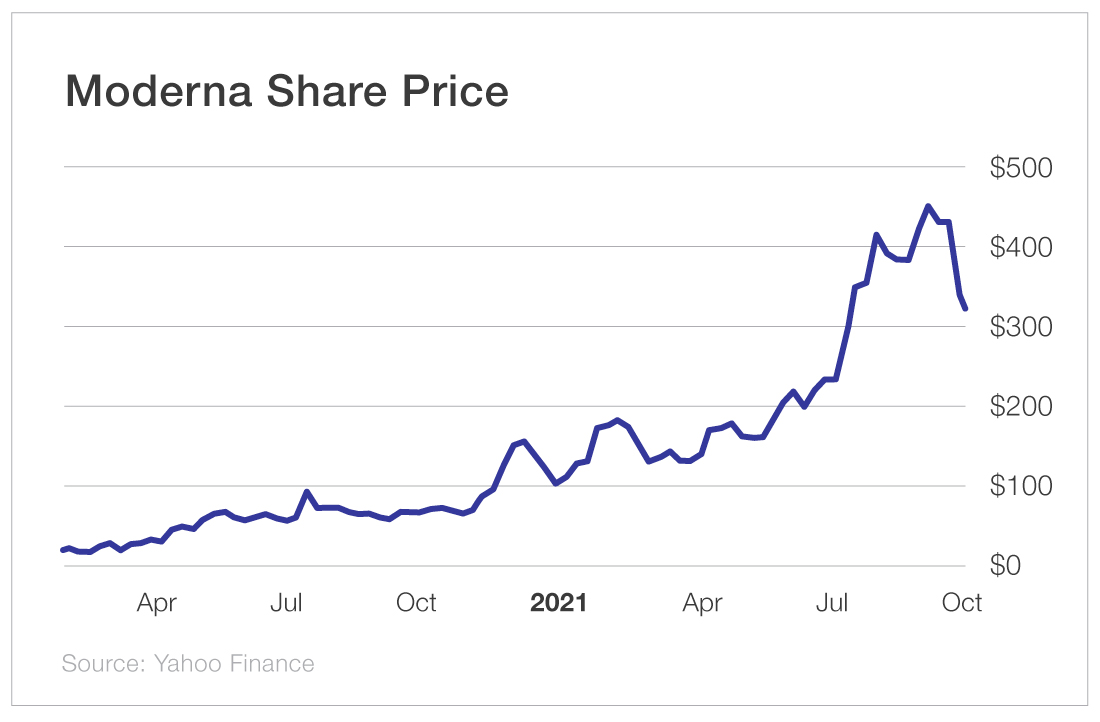
The pandemic is ancient history now, though, and the demand for COVID vaccines has taken a nosedive. Worse for Moderna, the number of companies offering them has also risen.
Moderna is all the way back down to below $30 now, even though it had annual revenue of $3.1 billion in 2024. It’s true that revenue is declining, but I don’t think that will be the case for long.
Right now, Moderna markets two products: its COVID-19 vaccine and an RSV vaccine for adults over 60.
However, the company is currently seeking approval for a next-generation COVID shot, a COVID-flu combination vaccine, and an RSV vaccine for high-risk adults age 18 to 59.
Management expects all three to be approved this year, with a total of 10 new product approvals by 2027.
And this company is far from a one-trick pony. It also has drugs in the works to treat other respiratory illnesses, infectious diseases like herpes, and potentially cancer, all by leveraging the company’s mRNA platform…
Teach a Man to Fish…
What makes Moderna’s vaccines so effective and able to be deployed rapidly to prevent even emerging diseases like COVID is their mRNA mechanism.
Traditional vaccines operate on the idea of introducing a weakened version of a given virus into your body to allow your immune system to develop a response.
See, the human immune system is rather robust. It just needs to learn how to fight different diseases, and then oftentimes it can handle them itself. But introducing a weakened virus carries a good deal of risk, as you might imagine.
But the mRNA, or messenger ribonucleic acid, that Moderna’s vaccines operate on carries no such risk. It is a DNA template that delivers instructions to your body’s cells. It then destroys itself once the instructions are relayed.
So, when it comes to a disease, an mRNA vaccine is coded with the information your body needs to produce antibodies for the virus. Once it teaches your body how to do that, it destroys itself and makes no permanent changes to your body, nor does it alter your DNA in any way.
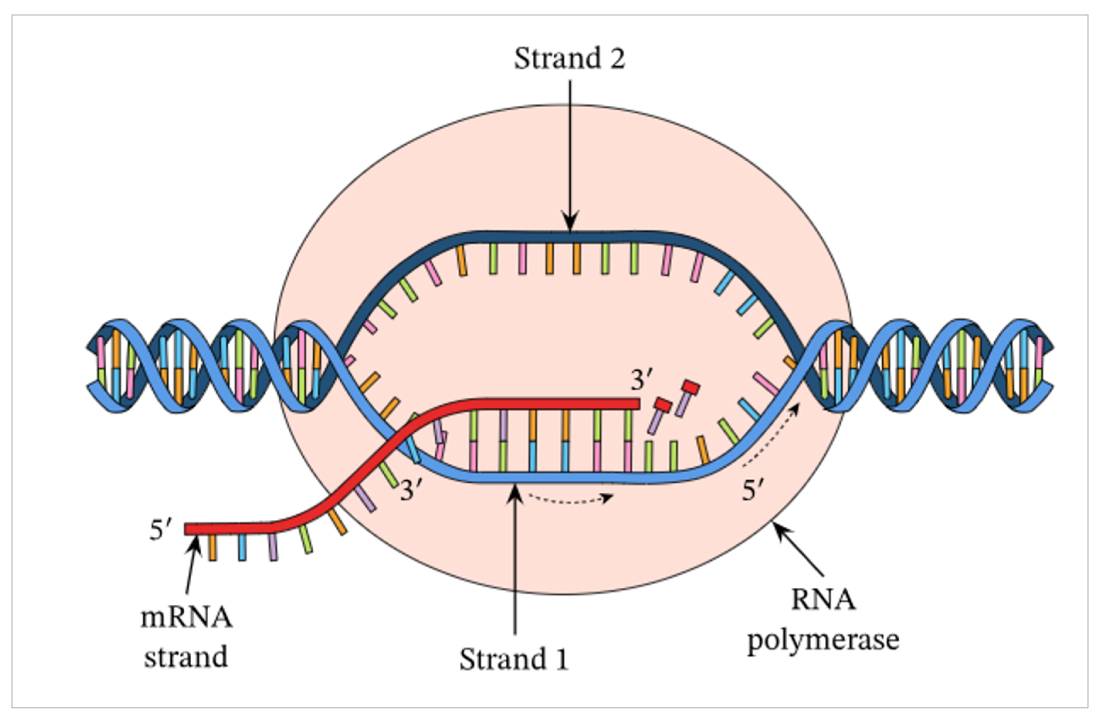
In the company’s own words, it teaches your body to make its own medicine…
And that is what makes it viable against cancer or herpes.
I’ll start with cancer.
The reason our bodies struggle with eliminating cancer is that cancerous cells are us, in a sense. Your immune system is meant to protect your body from foreign invaders like viruses or bacteria. But cancer is one of your own cells gone wrong.
When a cell turns cancerous, it refuses to undergo apoptosis and die so that a new cell can take its place. Its DNA is slightly different from yours, but it’s similar enough that the cancer cells can often go undetected by your immune system and grow until they become tumors and start causing serious problems.
But an mRNA vaccine can teach your body to view cancerous cells as the enemy and destroy them as it would any virus or bacterial infection. No need for chemo – your immune system just gets given the tools it needs to deal with the cancer itself.
That makes mRNA vaccines one of the most promising tools for defeating cancer. And Moderna currently has a couple of oncology vaccines in clinical trials. One, mRNA-4157, is being developed to treat skin cancer. It’s in Phase 2 trials right now.
Now on to herpes. The infamous STD is known for never going away. There may be gaps between outbreaks, but once a person has it, they have it forever. That’s because, while the immune system can fight diseases off very effectively, herpes has developed a rather devious biological mechanism.
The herpes virus goes dormant in the one place your immune system won’t look for it: your nerve cells. Nerve cells are weird relative to the rest of the human body for two reasons. First, they don’t regenerate like other cells in your body. That means damage is permanent.
And second, the blood-brain barrier, a protective structure that isolates the central nervous system from the general circulatory system, prevents your immune cells from going into the spine or the brain.
That’s for good reason. Your immune cells have numerous weapons to deal with diseases, like raising your temperature or causing inflammation. If those damage skin or muscle tissue, it’s fine – those cells will die and be replaced. But if those weapons could damage your nervous system, then you could end up paralyzed from the flu.
But with herpes, by the time your body has fought off the initial infection, some of the virus cells have already made it to your spine and will remain there forever. However, if your immune system knew what to be on the lookout for and was able to eliminate the herpes fully upon first exposure, before it hid in your nervous system, then, well, no herpes.
And Moderna has a vaccine, mRNA-1608, in Phase 2 clinical trials right now.
So we’ve seen what Moderna is capable of with its COVID-19 vaccine. We’ve seen what it’s potentially able to do with its cancer and herpes vaccines. Why is now the time to buy?
Wading Through the Swamp
Washington, D.C., is often referred to as “the swamp,” which is an allusion to both the marshes on the banks of the Potomac that were drained so the city could be built and the murky and unpleasant nature of politics.
But if you know what’s going on under that slimy water and keep track of what your politicians are trading, you can profit alongside them as their legislation shapes the economy. And two politicians in particular have been loading up on Moderna shares…
The first, Ro Khanna, a Democrat congressman from California, is the most active trader in Congress. In 2024 alone, he made 4,013 trades, more than double the 1,925 trades of the next most active congressman, Texas Republican Michael McCaul.
And Khanna seems to be pretty good at it, seeing as he has an estimated return of 19.1% for 2024, which is triple the S&P 500’s average return over the last 20 years (8.4%). And he has been steadily buying up small numbers of Moderna shares for years now and holding them, which tells me he’s bullish on the stock.
Congressman Khanna’s buys would be enough to catch my attention, but it’s another House representative I’m particularly interested in.
Republican Rob Bresnahan of Pennsylvania is a young, fresh face in the swamp, a 35-year-old who was sworn in for his first term this January. He hasn’t been in office long, but he has already cultivated a reputation for being one of the savviest traders in the Capitol.
The former CEO of Kuharchik Construction, Bresnahan has already made over 400 transactions since taking office. He bought Berkshire Hathaway shortly after being sworn in, and that’s up 14.91% at the time of writing. He bought Intel just before its 28% jump in February. And he bought Alibaba in January just before its 40% run.
He has also avoided some nasty losses by selling shares just before a big drop. He sold e.l.f. Beauty just before it began its 51.7% drop. He sold Manhattan Associates before it dropped 34.7%. And he sold Deckers Outdoor before its 32.9% drop.
And then in late February, Bresnahan bought as many as 451 shares of Moderna at $33.28, and he’s still holding those shares. His history of picking winners caught my eye. And both he and Khanna were buying shares in late February. While these purchases are smaller than I usually like to see, Khanna’s and Bresnahan’s track records compensate for that.
That means Moderna already checks off my second, third, and fourth criteria. But it’s the other insiders at Moderna who check off my $1 million requirement…
Remember Sagan, the insider who bought shares of Moderna a few months before it released the COVID-19 vaccine? He bought 31,620 shares in early March, around the same time as Khanna and Bresnahan. At the time, the stock was trading for $31.76, so that purchase was worth just over $1 million.
Stéphane Bancel, the CEO of Moderna, made an even bigger move around that time, buying 160,314 shares at $31.04 for a total value of $4.97 million. So, between the two of them, I think we have seen enough big buys to pique my interest in Moderna.
The last time the insider stars aligned like this for Moderna, it peaked at a 1,889% gain. It has the potential for that sort of moonshot again. And we’re going to ride insider coattails the whole way…
Action to Take: Buy Moderna Inc. (Nasdaq: MRNA) at market. Set a 25% trailing stop to protect your principal and your profits.