You are now logged out.

TABLE OF CONTENTS
This Overlooked AI Stock Is Riding America’s Labor Revolution
Alexander Green, Chief Investment Strategist, The Oxford Club

Our model portfolios have soared this year.
In addition to the profits we’ve already taken, we’re sitting on open gains of as much as 165% in our Oxford Trading Portfolio, 247% in our Ten-Baggers of Tomorrow Portfolio, 378% in our Profit Accelerator Portfolio, 832% in our Gone Fishin’ Portfolio, and 1,024% in our Oxford All-Star Portfolio.
Yet – if you have fresh money to put to work – I’m still finding attractive opportunities out there.
This month I’ll highlight one of them. It’s an AI-play. But not the kind we usually recommend.
AI is destroying many white-collar jobs. It is also creating millions of blue-collar ones.
Everyone agrees that building knowledge and skills is crucial for success. But that doesn’t necessarily require deep reading in the humanities.
This month’s new recommendation is an undervalued small cap that is a national leader in vocational training.
Sales are growing at a double-digit rate. Profits are growing at a triple-digit rate. And the stock is up 106% over the past year.
Yet technological innovation, increasing programs, new campuses, accelerating enrollment, and greater access to Pell Grants – thanks to expected education policy changes under the Trump administration – are about to juice sales and profits further.
For all these reasons, the company is the newest addition to our Oxford Trading Portfolio.
The AI Job Shake-Up
Over the past few years, I’ve highlighted many of the ways artificial intelligence will improve our lives by boosting productivity and reducing costs.
However, as I mentioned, advancements in AI will also disrupt millions of white-collar, professional jobs over the next decade. (Particularly entry-level jobs – the kind your kids or grandkids may be applying for.)
Think data entry, customer support, junior analysts, legal assistants, low-level coding, basic accounting.
If the job involves predictable decision-making or structured repetition, AI can likely do it faster, cheaper, and without calling in sick or taking a vacation.
Amazon’s CEO has already said the company will slow hiring for back-office functions. Ford and Walmart have echoed similar plans. (Walmart is now experimenting with AI to manage logistics, restocking, and HR queries.)
This isn't a passing phase. We’re witnessing the largest white-collar labor realignment since the PC replaced the typewriter.
Companies that lean into AI aren't just saving money – they're growing margins.
According to McKinsey, firms that aggressively implement AI across operations could see productivity boosts of 20%-40%.
For large firms, that’s not small change. That’s billions in cost savings and profit leverage.
However, the need for workers in skilled trades and healthcare is greater than ever. And most of those jobs are AI-proof.
How does an investor capitalize on this? By owning shares of Universal Technical Institute (NYSE: UTI).
Training for Tomorrow
Founded in 1965 and based in Phoenix, Arizona, Universal Tech has established itself as a leading vocational training provider. That puts it on the right side of this transformative period in the labor market.
The company operates technical colleges across the U.S. that focus on career-oriented training in two high-demand sectors: skilled technicians and healthcare.
Programs include auto/diesel/motorcycle and marine technicians, welding, HVAC service and repair, aviation maintenance, robotics and automation.
Its healthcare training – offered through Concorde Career Colleges which it acquired in early 2023 – produces dental hygienists, medical assistants, registered nurses, healthcare administrators, and physical therapy assistants.
Universal Tech is recognized for providing high-quality, state-of-the-industry training and support. Its diploma, certificate, and associate degree programs combine online learning with hands-on training at its 32 campuses nationwide.
It currently has more than 35 program offerings, over 22,000 active students, and its curricula are specifically designed to meet the demands of today’s employers and evolving technology.
Best of all, it works: 84% of graduates are employed in less than a year.
A Structural Labor Shift
The for-profit technical education and training sector is growing rapidly as the U.S. economy faces an acute shortage of workers, particularly in manufacturing, skilled trades, and healthcare.
Hiring for these positions could be more than 20 times the projected increase in net new jobs created in the U.S. through 2032, according to a recent McKinsey report.
This trend is being further amplified by factors such as the reshoring of manufacturing, investments in domestic infrastructure, and the adoption of advanced technologies that require a more highly trained workforce.
The North American education and training market is expected to reach over $66 billion in 2025, driven by demand for both degree and non-degree credentialing programs.
In fact, the U.S. Bureau of Labor Statistics projects over 500,000 new openings in the skilled trades each year through 2032. Many of the jobs are already there. The people to fill them are not.
And as vehicles become more complex – particularly with the rapid growth of EVs – today’s mechanics can’t just rely on a wrench and some elbow grease. They need diagnostic tools, software knowledge, and specialized training in high-voltage systems.
Universal Tech embraces next-gen learning tools. Virtual reality and augmented reality are now part of the classroom.
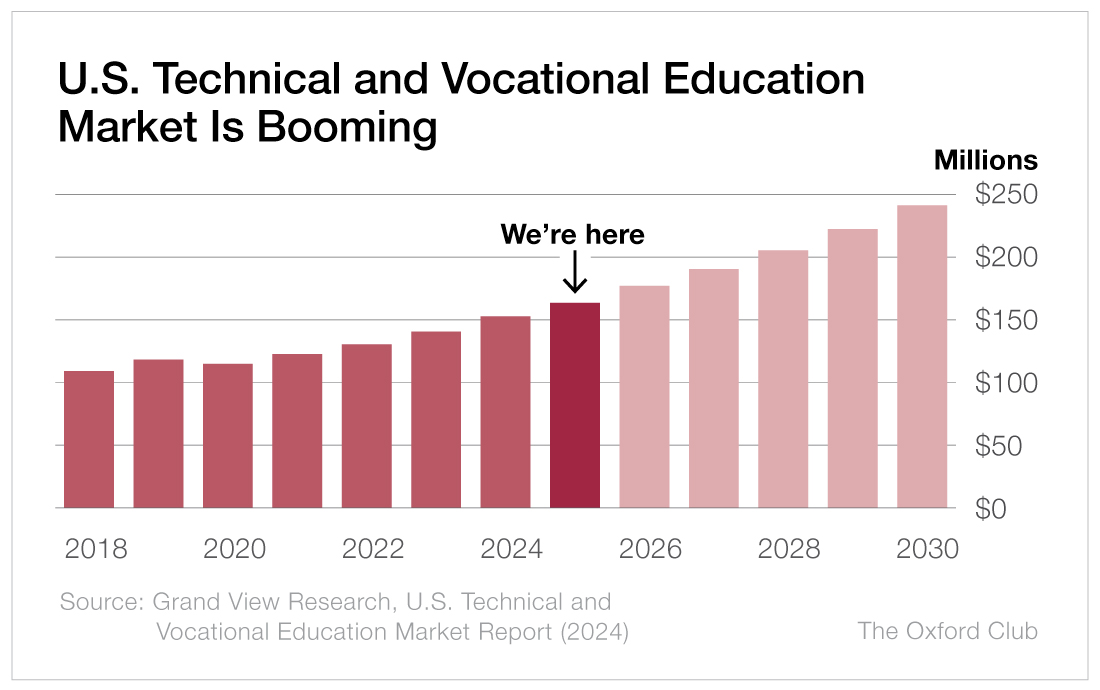
That means more efficient training, more engaged students, and more marketable graduates.
The company isn’t just preparing students for work – it’s preparing them to thrive in a tech-driven workforce.
Bottom line? The company is set to benefit from a multiyear tailwind driven by technology, labor shortages, and economic necessity.
Numbers That Deliver
Vocational education is no longer a fallback. It’s a fast track to a good job – and investors who recognize that shift early stand to benefit.
Especially since the Trump administration is expanding federal funding to support technical training programs with new provisions for Pell Grants.
The numbers here are already excellent. In the most recent quarter, earnings soared 114% on a 15% increase in revenue.
Other metrics are also solid. Management is earning a healthy 23% return on equity. Ninety-four percent of the company’s outstanding shares are owned by financial institutions.
And the stock has more than doubled over the past year, while the S&P 500 is up just 18%.
The outlook remains exceptional.
Demand for the company’s programs has held up even as recent employment data offered mixed signals, because its programs are tightly linked to employer demand. Enrollment momentum is outperforming expectations.
As CEO Jerome Grant says, “We anticipate continued growth as artificial intelligence, automation, and advanced electronics reshape industries and expand into nearly every sector of the economy.”
The company has plans to launch new programs, increase the capacity of current programs, and add three more campuses.
It is also leveraging deep industry relationships – with companies like Ford (NYSE: F), Toyota (NYSE: TM) and Tesla (Nasdaq: TSLA) – to meet the rising demand for its students in the workforce.
Plus, management is looking to grow through acquisitions.
As more high school graduates – and their parents – start questioning the value of a four-year degree, this kind of fast-track, job-ready training looks more and more appealing. And so does this stock.
Universal Tech is filling a critical gap in the U.S. labor market by training workers for careers that are hard – if not impossible – to automate.
In short, white-collar jobs are under pressure. But the firm’s programs prepare students for careers that won’t be replaced by AI anytime soon.
Action to Take: Buy Universal Technical Institute (NYSE: UTI) at market. And use our customary 25% trailing stop to protect your principal and your profits.

Building Wealth
How to “AI-Proof” Your Portfolio and Your Career
Kristin Orman, Research Director, The Oxford Club

The world looks very different than it did just a few years ago. And the big driver of that change? Artificial intelligence.
AI writes emails. It codes. It drafts slide decks. It crunches data faster than any analyst. It can even ace law exams and medical tests.
That’s impressive – and a little scary. But here’s the good news: Many jobs are safe from AI.
AI can’t crawl under a truck to fix a transmission.
It can’t rewire a house without burning it down.
It can’t squeeze into an attic to install an HVAC system. The more hands-on, human, and on-site the work is, the harder it is to automate.
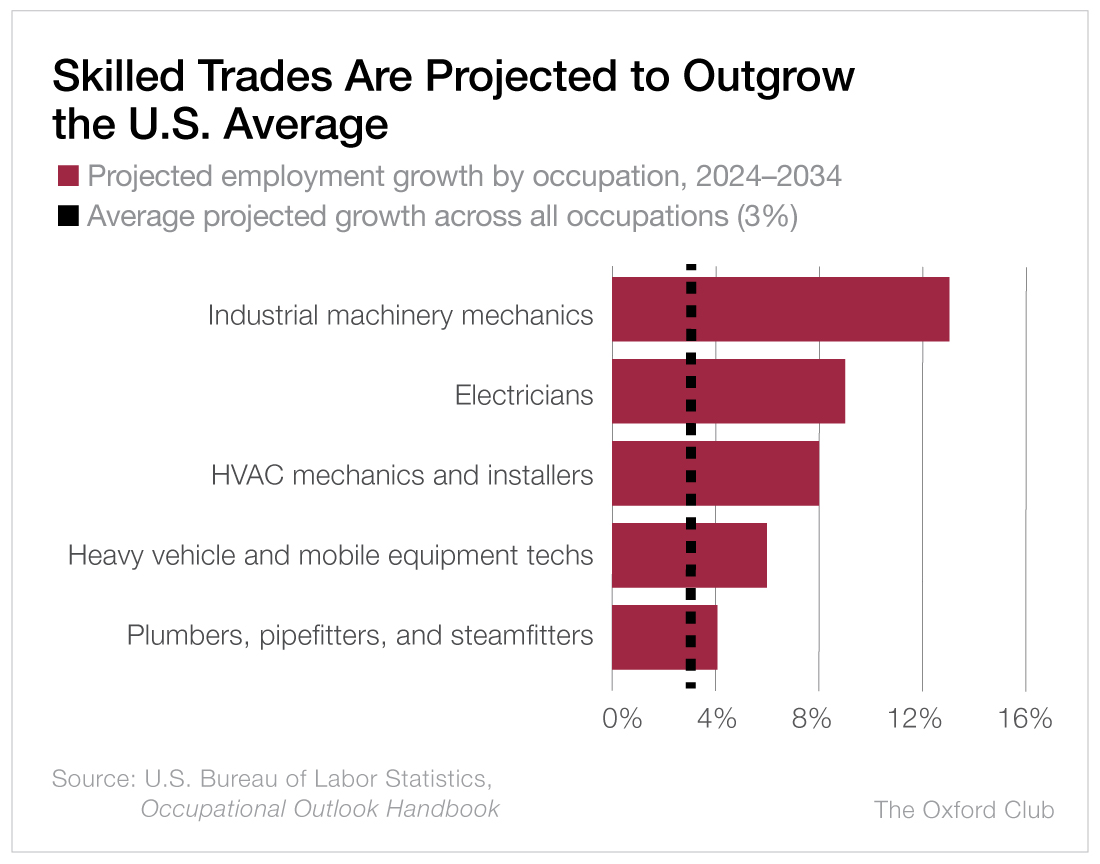
That’s why skilled trades – from electricians and welders to diesel mechanics and HVAC techs – are in high demand and will stay that way.
The U.S. Bureau of Labor Statistics expects steady growth across most skilled trade categories over the next decade. Layer on a wave of baby boomer retirements, and the country is staring at a major labor shortage.
These jobs demand problem-solving, dexterity, and customer service – all things robots struggle to replicate. Every job site is different, messy, and unpredictable. That’s the human edge.
A Career Shift in Education
For decades, high school graduates were told: “If you want a six-figure career, you need a four-year degree.”
But that’s changing fast. Four-year college is still right for some – but not all. Costs are sky-high, debt loads are crushing, and too many grads end up underemployed.
Enter career-focused training programs.
Think... automotive, diesel, welding, HVAC, electrical, plumbing, healthcare tech, cyber, and mechatronics.
These programs are shorter, cheaper, and designed with employers. They’re built around outcomes – graduation, certifications, job placement, and wages. Best of all, they update quickly to match industry needs.
The key is time-to-value: Students want to move from classroom to paycheck in months, not years. Employers want new hires who can contribute on day one. Schools that deliver this value win trust – and enrollment.
Why It Matters for Investors
This trend is both defensive and growth-oriented – a rare combo...
- Demand: It is steady, local, and immune to outsourcing. Broken transmissions won’t get shipped to China for repair. Hospitals will always need techs. Homes will always need power, plumbing, and AC.
- Growth: The skills gap is wide, the pipeline is thin, and the need is urgent. New programs and campuses can scale quickly to meet that demand.
The Bottom Line
AI is rewriting the rules for many industries.
But it won’t replace the people who build, repair, and care for the world around us. Skilled trades and specialized education will only grow more valuable.
For workers, that means steady pay and strong demand. For students, it means faster, cheaper career paths.
For investors, it means a chance to tap into a long-term, human-powered trend.
In an AI-obsessed market, the smart money isn’t always on the machines. Sometimes, it’s on the people who can do what machines can’t.

Beyond Wealth
Why the American Dream Is Alive and Well
Rachel Gearheart, Publisher, The Oxford Club

Ever had someone ask what The Oxford Club is all about and felt a bit stumped?
Well, Chief Investment Strategist Alexander Green has written a new book that provides a comprehensive answer: It’s a vehicle for making your most important financial dreams a reality.
The book is called The American Dream: Why It’s Still Alive… and How to Achieve It. And – as I’ll explain in a moment – you should grab a copy while you still can. This isn’t a political book. It’s not about what Washington should fix. (And you don’t have to be a U.S. citizen to benefit from the book.)
It’s about what you can do – starting today – to create the life you want.
You may have seen recent polls that show just 30% of Americans still believe the American Dream is attainable.
Alex finds the pessimism astonishing and argues persuasively that we are in a new golden age for investors.
Achieving your most important financial goals has never been simpler for those who understand the universal principles of wealth creation. Yet, sadly, the vast majority of people don’t.
The American Dream provides readers with the essential education most never received. Including observations like…
- Why capitalism is the greatest anti-poverty program ever created.
- How personal habits and choices guide men and women – almost unerringly – to great wealth. How everyone benefits from an attitude of “radical responsibility.”
- And why the United States, despite all its faults and problems, remains a truly exceptional nation.
In the book, Alex deals with every aspect of the investment process, from thrift and saving to investing and compounding, with crucial insights about cutting costs, lowering your taxes, and spending your money on meaningful experiences while you’re still young enough to enjoy them.
Alex claims he wrote the book for three types of readers:
Type No. 1: Dream Deniers. Who no longer believe that it’s possible to achieve the American Dream.
Type No. 2: Frustrated Dreamers. Who still believe in it - but worry they won’t attain it.
Type No. 3: Dream Achievers. Folks who’ve already lived some version of the Dream but worry whether it will be maintained for future generations.
Alex makes a convincing case that the American Dream isn’t about luck or privilege, but about attitude, discipline, and financial know-how.
He offers stories, evidence, and real-world advice that will leave readers feeling inspired and empowered.
This may be the most optimistic book I’ve ever read. It shows how anyone, no matter where they start, can achieve financial independence and the satisfaction and peace of mind that come with it.
Best of all, it’s chock-full of the things that Oxford Club Members tell us they like best about Alex’s writings.
If you enjoy his positive take on the improving state of the world – something entirely missing from the mainstream and social media – you’ll find it here.
If you appreciate his uplifting “Beyond Wealth” insights, you’ll find those here. And if you like the way he simplifies the investment process – breaking it down to the most elemental level – you’ll really enjoy what he calls “The World’s Simplest Portfolio.”
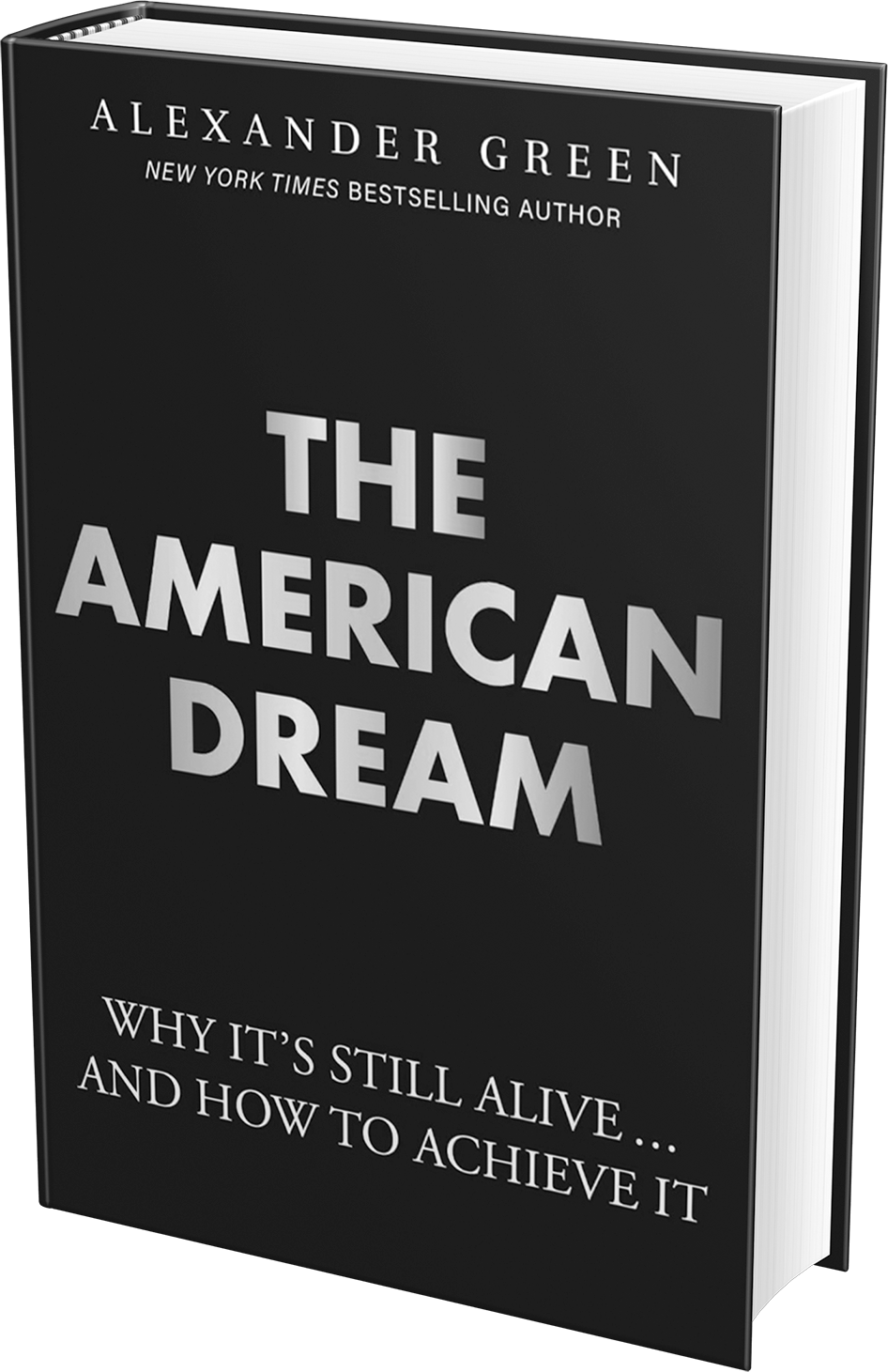
The American Dream: Why It’s Still Alive... and How to Achieve It will be published on November 11. You can pre-order it on Amazon or through any bookseller.
There is some bad news, however. His publisher, Wiley, only printed 13,200 copies of the book. That’s an absurdly low number since we have over 165,000 Oxford Club Members and several hundred thousand more subscribers to our free e-letters.
If you plan to download the book onto your iPad or Kindle, that’s not a problem. But for Members who want to hold the actual volume, be forewarned that it is likely to sell out quickly.
Especially since many Members intend to give it to their kids or grandkids as a gift, with the holidays right around the corner.
One Member told me he had already pre-ordered 10 copies for his family.
If you would prefer physical copies, you should act quickly and pre-order the book. The American Dream isn’t just about saving and investing. It’s about living life on your own terms.
Highly recommended for anyone who needs a boost of confidence, a dose of optimism, or a concrete plan to make their most important dreams come true.

Portfolio Review
Two Innovators Powering the Future
Alexander Green, Chief Investment Strategist, The Oxford Club
As I write, all 13 recommendations in our Oxford Trading Portfolio are profitable, with the sole exception of HealthEquity (NYSE: HQY), currently rated a "Hold."
Our biggest gainer is IBM (NYSE: IBM). It’s up 166% since I added it to the portfolio – and has rallied 28% over the past 52 weeks vs. 17% for the S&P 500.
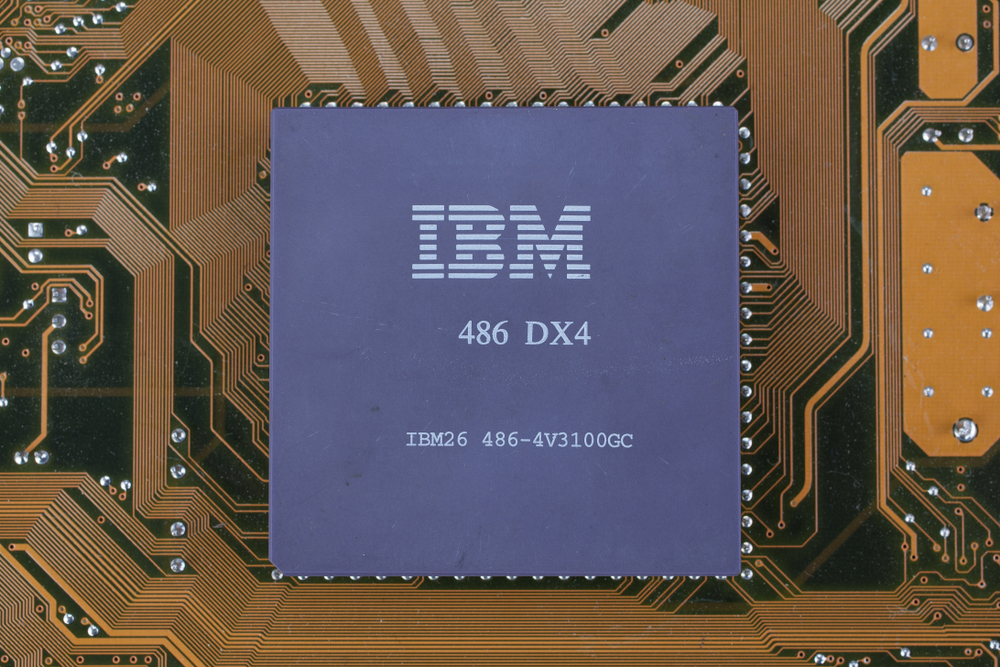
Yet there is still plenty of upside here.
Long known as “Big Blue,” IBM specializes in cloud computing, data analytics, cybersecurity, artificial intelligence, and other leading technologies.
It helps businesses, governments, and other organizations reconfigure their IT departments for the cloud era, ensuring that technology systems are not only faster and more efficient, but also far more secure.
Cloud computing is on-demand access to computing resources – applications, services, data storage, networking capabilities, and more – hosted at a remote data center managed by a cloud services provider.
This allows businesses and other organizations to “plug into” IT infrastructure rather than installing and maintaining it on premises. It lowers costs, saves time, and allows businesses and other organizations to scale up easily.
Over the past couple years, investors have flocked to companies that will benefit from the new AI megatrend.
Yet most seem to not know that IBM is a world leader in the field, with greater experience than any other company.
IBM now provides large language models and other AI tools to several key markets, including manufacturing and financial services.
Rather than building public domain models like ChatGPT, IBM creates private models for organizations that can’t risk putting their proprietary data on the street.
By offering efficient and personalized AI models, the company is offering businesses cost-effective solutions tailored to their specific needs.
They can be trained in weeks instead of months and are easier to fine-tune for specific tasks.
IBM’s annual book of AI business now exceeds $5 billion.
Second-quarter earnings jumped 20% on an 8% increase in revenue. And the future looks bright too.
The firm is focused on investing in emerging technologies. Last year, it opened Europe’s first IBM Quantum Data Center.
With IBM, we’re holding not just an AI superstar but the world leader in quantum computing, with $64 billion in annual sales, gross profit of $37 billion, and a 2.3% dividend yield.
Our shares have performed well. But the stock remains attractive at current levels.
Editing Life Itself
Our Ten-Baggers of Tomorrow Portfolio is home to the Club’s most speculative stocks, ones with the potential to rise tenfold or more.

But they are also more volatile than most of our stocks. In fact, Crispr (Nasdaq: CRSP) dropped sharply in the first half of the year.
On July 8, I wrote a Portfolio Update where I urged Members to do something we rarely do: average down on the stock.
It was a good call. Just eight days later, Director George Simeon bought nearly a million shares at $57.03. (He now owns over 2 million shares.) And since July 8, the stock has rallied 40%.
Here’s why...
Based in Zug, Switzerland, Crispr stands at the forefront of the biotechnology revolution.
The company was named to Time’s 2025 Most Influential Companies list, underscoring its leadership and transformative potential in healthcare.
It launched after researchers discovered the CRISPR gene-editing technology that aims to cure diseases that were previously considered untreatable.
The company’s platform uses molecular “scissors” to make cuts in patients’ DNA at specific places to add, remove, or change their genetic code.
Often referred to as “molecular surgery,” these are not just therapies to treat patients. They can cure them for life.
In 2023, Crispr won approval for the first gene-editing treatment ever, Casgevy.
The drug is approved for patients ages 12 and older with blood diseases known as sickle cell disease or beta thalassemia.
This was a very big deal. The CRISPR technique was only discovered a little over a decade ago.
(Jennifer Doudna and Emmanuelle Charpentier won the Nobel Prize in chemistry for it in 2011.)
Yet this futuristic technology has already won its first approval.
Casgevy is what’s known as an ex vivo gene-editing drug. That means genetic editing is applied to the patient’s cells outside the body through the drug, rather than inside the patient.
Sickle cell patients experience malformed hemoglobin, a key protein involved in carrying oxygen to the blood.
And beta thalassemia patients don’t make enough beta globin, one of the building blocks of hemoglobin.
Casgevy helps the body make correct forms of hemoglobin. And I expect the treatment to have massive commercial success.
Crispr estimates a total patient population of at least 35,000, and the treatment costs $2.2 million per patient in the U.S.
If Casgevy grabs just a third of that target market, it will mean billions of dollars in revenue.
Why is the drug price so high? Two reasons.
The first is that the drug requires just a single administration. Crispr spent many years researching this novel biotechnology and must recoup its investment so it can continue creating new ones.
Another is that drugs that provide a cure – rather than just managing symptoms – command higher prices. (And are often far less expensive than lifelong treatments.)

However, Crispr Therapeutics is no one-trick pony. The firm has numerous therapies in its pipeline.
It is testing two in vivo gene-editing treatments for atherosclerotic cardiovascular disease, known as ASCVD.
With this form of heart disease, plaque builds up in the arterial walls, increasing the risk of heart attacks, angina, or stenosis (hardening of the artery walls).
Earlier this year, Crispr announced a multi-target collaboration with Sirius Therapeutics to develop novel therapies to treat and even prevent thrombotic diseases caused by blood clots.
Crispr is also testing immuno-oncology treatments, including drugs for lymphoma, kidney cancer, and solid tumors.
And it is working on a gene-editing treatment for diabetes.
CEO Sam Kulkarni expects these next-generation drugs will be 10 times more powerful than their predecessors.
Yet he insists this is just the beginning for Crispr, as the platform is easily scalable and expandable.
Kulkarni says that within four years the company will have up to 30 different programs in the clinic. That’s 30 potential blockbusters.
However, the stock is below its peak of $200 a share in 2021, when the groundbreaking potential of CRISPR treatments was first recognized.
Crispr is not just a pioneer in gene editing. It is now a commercial-stage biotech with a transformative product on the market, a deep pipeline, and the resources to deliver on its promise.
The field of genomics is one of the most exciting megatrends for 2025 and beyond. And Crispr is the best way to play it.

MEET THE EXPERTS

Alexander Green
Chief Investment Strategist
Alexander Green is Chief Investment Strategist of The Oxford Club and Liberty Through Wealth. For 16 years, Alex worked as an investment advisor, research analyst and portfolio manager on Wall Street. After developing his extensive knowledge and achieving financial independence, he retired at the age of 43. Since then, he has been living “the second half of his life.” He is the Senior Editor of The Oxford Communiqué, which was ranked as one of the top investment newsletters by Hulbert Digest for more than a decade. He also operates three fast-paced trading services: The Momentum Alert, The Insider Alert, and Oxford Microcap Trader. Alex is also the author of four New York Times bestselling books: The Gone Fishin’ Portfolio: Get Wise, Get Wealthy… and Get On With Your Life; The Secret of Shelter Island: Money and What Matters; Beyond Wealth: The Road Map to a Rich Life; and An Embarrassment of Riches: Tapping Into the World’s Greatest Legacy of Wealth. His newest book The American Dream: Why It’s Still Alive… and How to Achieve It is now available on Amazon.