 You are now logged out.
Is This the End of Investing as We Know It?
From Baltimore – Patience is a virtue. At least, it used to be.
But by my estimation, public favor for patience has been waning for a very long time.
These days, it’s instant gratification, not patience, that drives our behavior as consumers.
Our consumption timelines were once defined in terms of weeks or even months. Save up enough money for a purchase, mail in an order form, and wait for the post office to do its slow and steady work.
Today, with high-speed broadband and one-day deliveries, closely tracking our latest same-day Amazon (Nasdaq: AMZN) shipments is completely normal.
Of course, this isn’t an entirely bad thing. After all, our collective desire for instant gratification has resulted in a great deal of technological invention and innovation.
Yet the death of patience as a virtue hasn’t just affected our habits as consumers. It has also changed the way many of us seek to build and maintain wealth.
In particular, it has resulted in a major shift from long-term investing to short-term trading.
The Popular Rise of Stock Trading
Studies have shown that investors – much like consumers – have become less patient. So much so that they can hardly even be called “investors” anymore.
For example, consider one Harvard study that found that over the past 60 years, the average holding period for stocks has plummeted from more than a decade to less than a year.
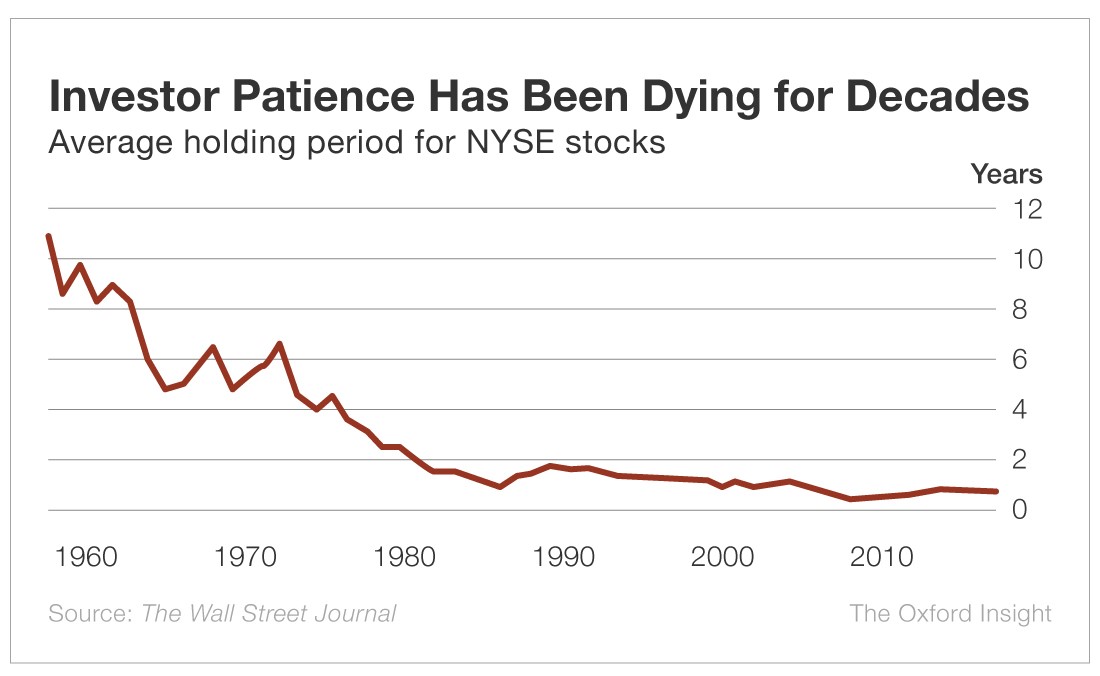
That’s no minor shift. Rather, it’s a pattern that reveals a significant behavioral alteration among many market participants, from being stock investors to stock traders.
The difference?
As a general rule, the line between investing and trading is one year. If you’re holding an asset for a year or more, you’re investing. Anything less than that means you’re trading. This is reinforced by our tax code, which treats short-term (less than a year) and long-term capital gains differently.
Investors benefit from the long-term appreciation of stocks and other assets over time. Traders, by contrast, exploit market volatility to collect faster profits on short-term trends.
Investors and traders have always coexisted in the market. But only recently has active trading become so common among ordinary market participants. As a result, we’re now witnessing the death of traditional investing in favor of fast trading.
Monument Traders Alliance Head Trade Tactician Bryan Bottarelli understands this phenomenon better than most. In fact, he’s made a career of helping ordinary people understand the difference between investing and trading, often finding opportunities for big, short-term gains.
Bryan leads a community of people who aim to collect quick profits using proven trading strategies he’s developed over decades.
“Why make 15% per year investing,” says Bryan, “when you can make 20% per day trading? The financial difference in this approach could be life-changing.”
Bryan typically recommends holding a position no longer than one to three days. Oftentimes, it’s much less than that. But the idea is always the same: Exploit price volatility for the chance at easy profits.
As it turns out, day traders don’t need to make much money on each trade. Small, consistent profit taking over time is all it takes to capture significant gains over the long term.
Of course, professional traders don’t settle for small, quarter-of-a-percent gains. In fact, Bryan’s track record sports hundreds of huge one-day wins from his options trading strategies.
The one downside of active trading is, of course, trading fees. Unlike buy-and-hold investing, frequent trading can be costly.
But while high trading costs once discouraged day trading, the race by brokerages to lower fees has been a boon for day traders. Many firms even offer zero-cost trading these days.
Time will tell if traditional stock investing will make a comeback. But for now, it seems that stock trading will continue to supplant it. It’s a whole new world.
Good investing (and trading),
Anthony
Weekly Winners
Our VIP Trading Research Services reported a profitable week, with six closed equities and options trades. Four of those trades were winners…
- SmileDirectClub (Nasdaq: SDC) for a 15.31% gain in 161 days in Alexander Green’s The Insider Alert
- Synopsys (Nasdaq: SNPS) for a 2.4% gain in 16 days in Marc Lichtenfeld’s Technical Pattern Profits
- Synopsys (Nasdaq: SNPS) call option for a 14.27% gain in 16 days in Marc Lichtenfeld’s Technical Pattern Profits
- Digital Turbine (Nasdaq: APPS) for a 153.6% gain in 119 days in Alexander Green’s The Momentum Alert.
The weighted average gain for all equities and options trades closed last week was 15.91% while the S&P 500 recorded a loss of 0.67% during the same period.
Keep up the great work, Oxford Club strategists!