 You are now logged out.
Welcome to Absurd Volatility

From the Baltimore Clubhouse – The roller-coaster ride seems far from over.
The Dow Jones Industrial Average soared a stunning 1,293 points Monday, dropped 786 points Tuesday, jumped 1,173 points Wednesday and fell back 970 points Thursday. As I write this, it is down another 500 points.
Just take a look at this chart of the CBOE Volatility Index.
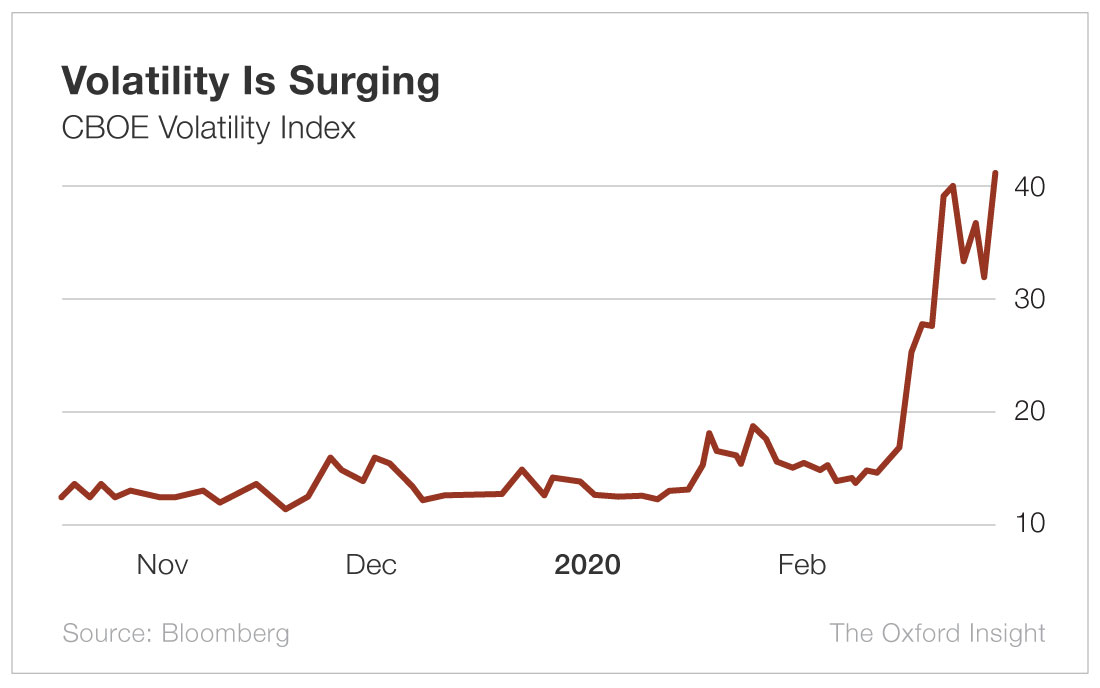
As you can see, the index generally hovers around 15 or so. Anything above 25 is considered extreme volatility. Lately, the index has been in the high 30s, and it hit 49.48 a week ago, the highest level it’s seen since 2009.
My colleague Senior Research Analyst Anthony Summers calls what we’re seeing in markets right now “absurd volatility.”
And despite the Fed’s half-point emergency interest rate cut last week (which didn’t do much to calm markets) and the $7.8 billion emergency coronavirus bill that President Trump signed Friday, that volatility is expected to continue until the virus is contained.
What’s an investor to do?
Well, they could become a trader. Good traders live for volatility.
While investors tend to sit on their hands in times like these, rightly confident that the long-term direction of stock prices is up, traders go to work.
That’s particularly true for options traders. To them, it doesn’t matter whether markets move up or down, as long as they move. There are even strategies to profit from an individual stock’s movement, regardless of direction. The only way you lose on that trade is if the stock doesn’t move at all, which is not much of a danger in this market.
If that sounds like a highly risky undertaking, keep in mind that options also present a way to protect your portfolio. This is called hedging, which is essentially using an option as an insurance policy that compensates you if the underlying stock drops in price.
In fact, options can be safer than stocks. When you buy a call option (which gives you the right to buy the underlying stock at a set price), you’re putting less money at risk because options cost far less than the underlying stocks they’re linked to. And they also give you the opportunity to make greater profits.
Options, essentially, are leveraged plays on an underlying stock, with limited downside. By limited, I mean that you can’t lose more than the price of the option.
That said, the chance of loss is higher with options, and they’re not suitable as long-term investments (options contracts are typically for just a few months). So, as with all asset classes, options should be just a part of a highly diversified portfolio.
If you want to witness a true options trader’s excitement about the “absurd volatility” of markets like these, definitely check out this week’s Market Wake-Up Call with Bryan Bottarelli of Monument Traders Alliance.
And to learn more about the strategies behind Bryan’s winning trades, check out his latest presentation here.
I think you’ll find it very informative.
Enjoy your Sunday,
Matt