 You are now logged out.
Buy These Stocks When Volatility Spikes
Note From Editorial Director Matt Benjamin: As we head into 2020, investors everywhere are seeking shelter. It could prove to be a volatile election year.
But at The Oxford Club, we’re not concerned.
Below, Senior Research Analyst Anthony Summers details the best ways to profit when volatility rears its head.
And for more profit opportunities, click here to view Chief Income Strategist Marc Lichtenfeld’s latest presentation. Marc has identified a way to profit from spikes in volatility by trading just one ticker symbol. You don’t want to miss it.
From the Baltimore Clubhouse – Volatility is a scary word for many investors.
Many view volatility as a good gauge of fear since fear can cause volatility in markets. You can see this by observing how volatility has spiked and receded over the past few months as CNN’s Fear & Greed Index shifted from “neutral” to “extreme fear” to “extreme greed.”
But moves in volatility can be an opportunity if you’re looking in the right place.
Recently, CNBC studied the performance of various exchange-traded funds (ETFs) after spikes in volatility, when the CBOE Volatility Index (VIX) exceeded 15.
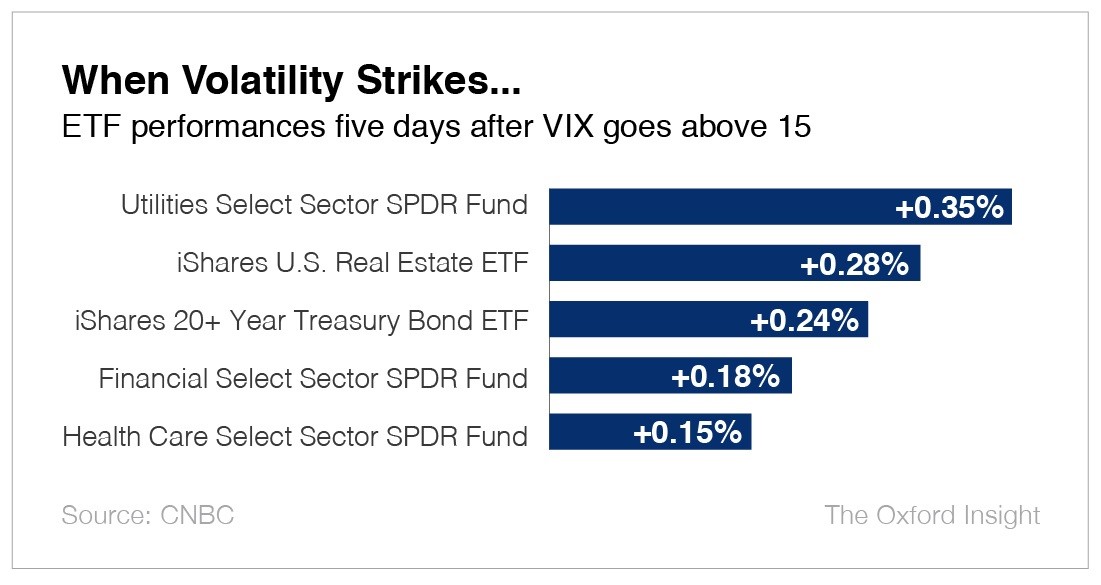
The study found, unsurprisingly, that utilities dominated other sectors of the market during these periods.
This fits the investor narrative perfectly. The utilities sector is considered one of the safest and least volatile sectors of the market.
When investors are uncertain, many rush to cash, bonds and even precious metals. But many also shift their capital into utilities and stable dividend payers.
Think about last fall’s market correction.
As stocks plummeted 20% between September and December last year, utilities, as tracked by the Utilities Select Sector SPDR Fund (NYSE: XLU), proved very resilient.
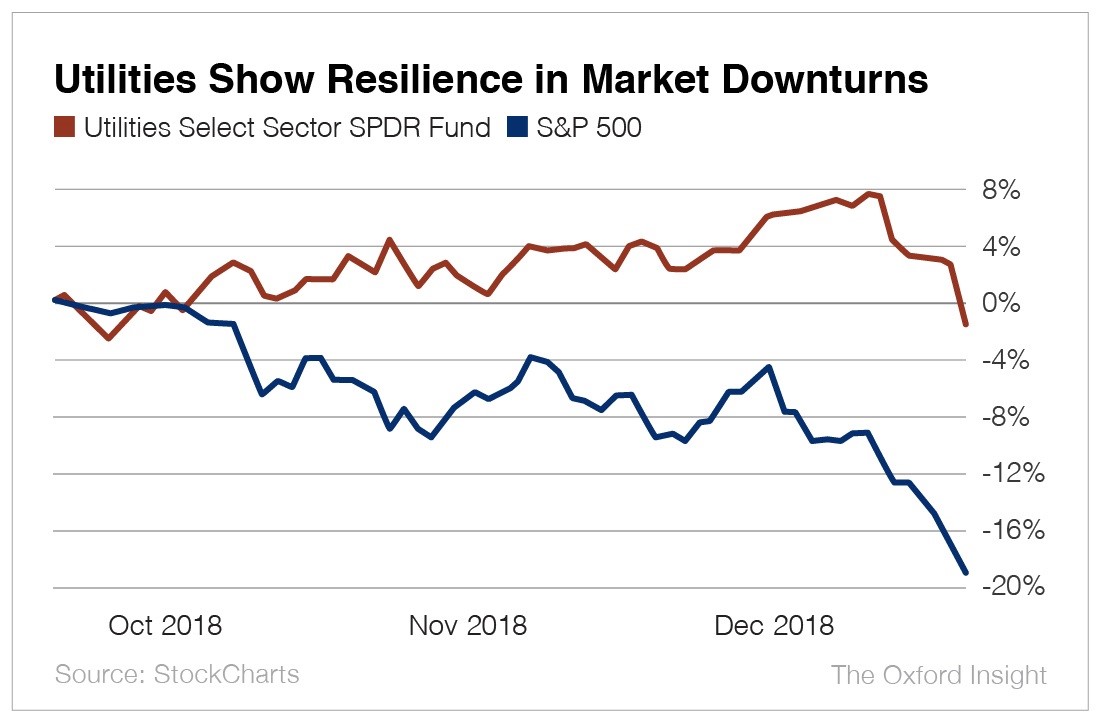
This ETF actually gained during most of that period before eventually succumbing to some downward market pressure in December.
Even so, its loss during the full length of that correction was under 2% – less than a tenth of the losses endured by the broader market.
A similar situation took place a few months ago.
As volatility again reared its head, utilities showed stability – and even some growth – while stocks overall dipped in performance. From July to September, utilities gained about 5% while the broader market struggled to stay in the black.
Utilities are also attractive in volatile periods because of their competitive yields.
The S&P 500’s last reported dividend yield was 1.8%.
Compare that with utilities’ average dividend yield of 3.16%, and you can see why utilities become so attractive during volatile times.
But the utilities sector isn’t the only one sporting gains in the midst of volatility.
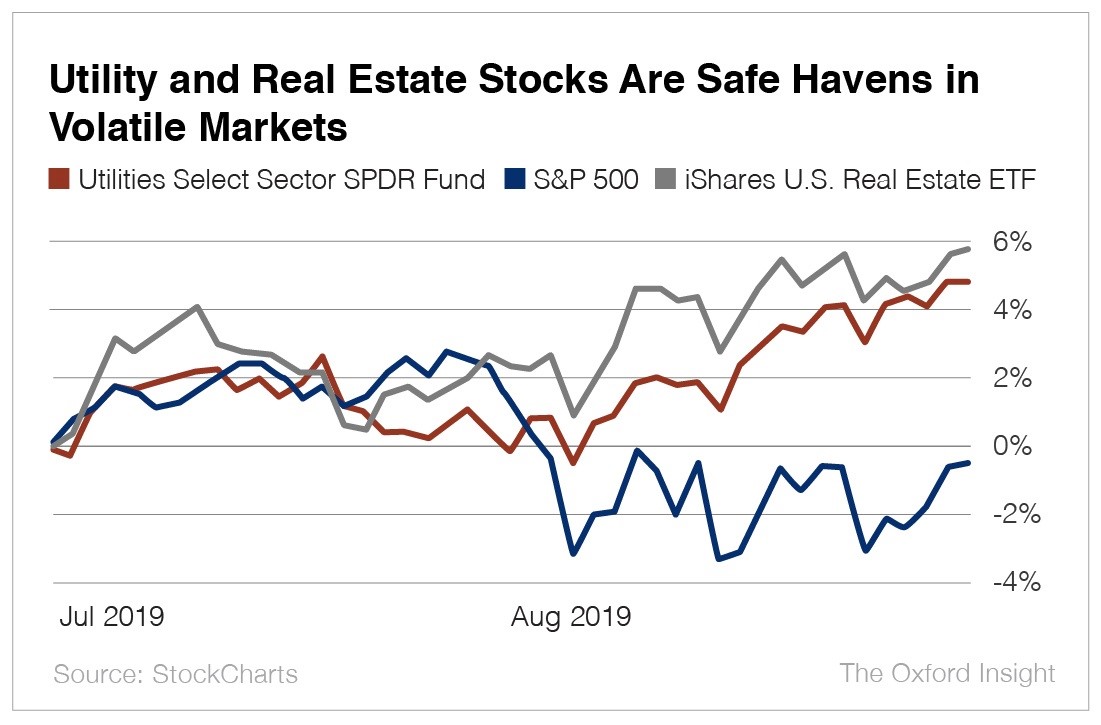
The iShares U.S. Real Estate ETF (NYSE: IYR), which tracks the performance of both real estate companies and real estate investment trusts, also gained during the period of volatility we saw a few months ago.
It even outperformed utilities, with a 6% gain from July to September.
Like utilities, the real estate sector offers price stability and higher yields than most stocks on the market.
In fact, the iShares U.S. Real Estate ETF has a current distribution yield of 2.6%, which is close to the average yield offered by utilities.
Real estate also has the added bonus of being less correlated to stocks than other sectors, giving it another buffer to resist stock market volatility.
Volatility may be an unpleasant result of fear-driven market behavior. But that doesn’t mean you should start acting out of fear too.
Instead, try to make the best of volatility spikes as they appear and consider leveraging these sectors’ gains to pad your portfolio’s performance.
Good investing,
Anthony
P.S. The Oxford Club’s Chief Income Strategist Marc Lichtenfeld has just launched a brand-new, unique trading service designed specifically to profit from market volatility. Click here to learn more.